What Is a Grimoire? Seven Historical Examples
What is a grimoire? Compare seven illustrated examples, including the Key of Solomon, Abramelin and the Goetia, with manuscript and edition links.
In this article
Seven historical books of magic
Choose a book to see what sets it apart. Open Editions and records for the surviving manuscripts, printed pages or catalogue descriptions available for that example.
 Three Books of Occult PhilosophyHow a printed work orders magic1533 · Latin print
Editions and records
 ArbatelAphorisms about magic and conduct1575 · Basel print
Editions and records
 Secret of SecretsA Solomonic title applied to a distinct textLate 18th century · French manuscript
Editions and records
 The MagusAn author copies, arranges and illustrates1801 · Manuscript and print
Editions and records
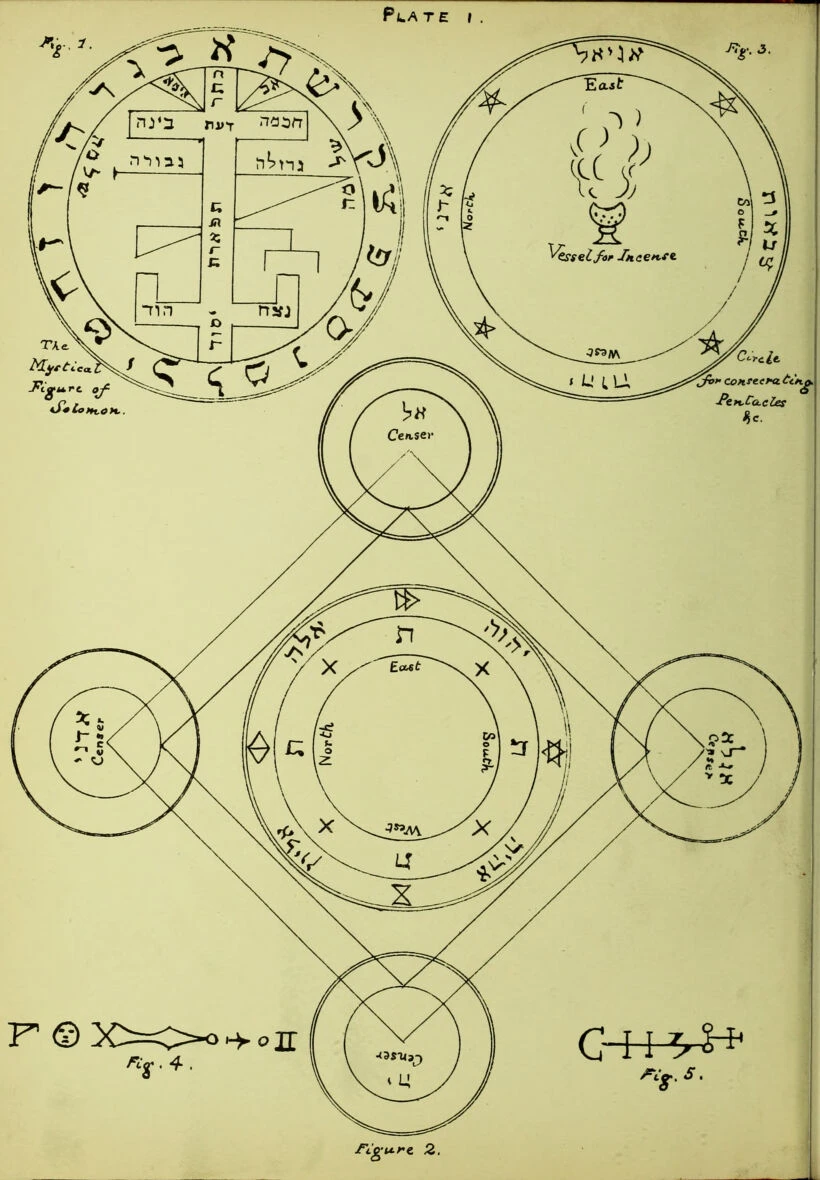 The Key of SolomonA translation assembled from manuscripts1889 · English edition
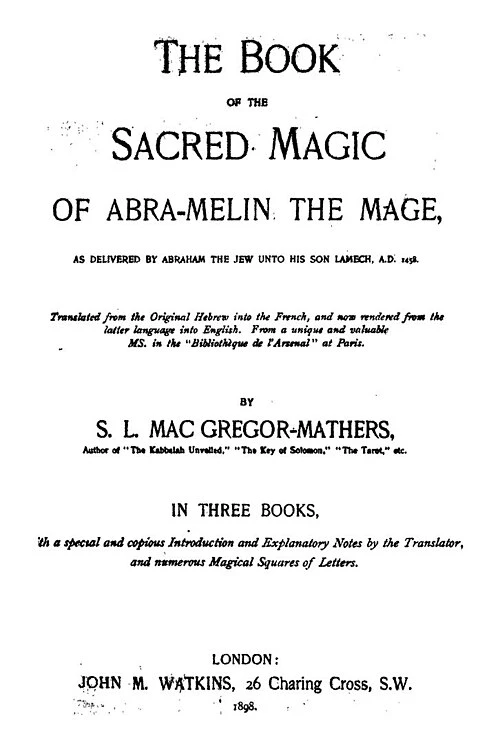 The Book of AbramelinA book presented as an account to a son1898 · Mathers’s English edition
Editions and records
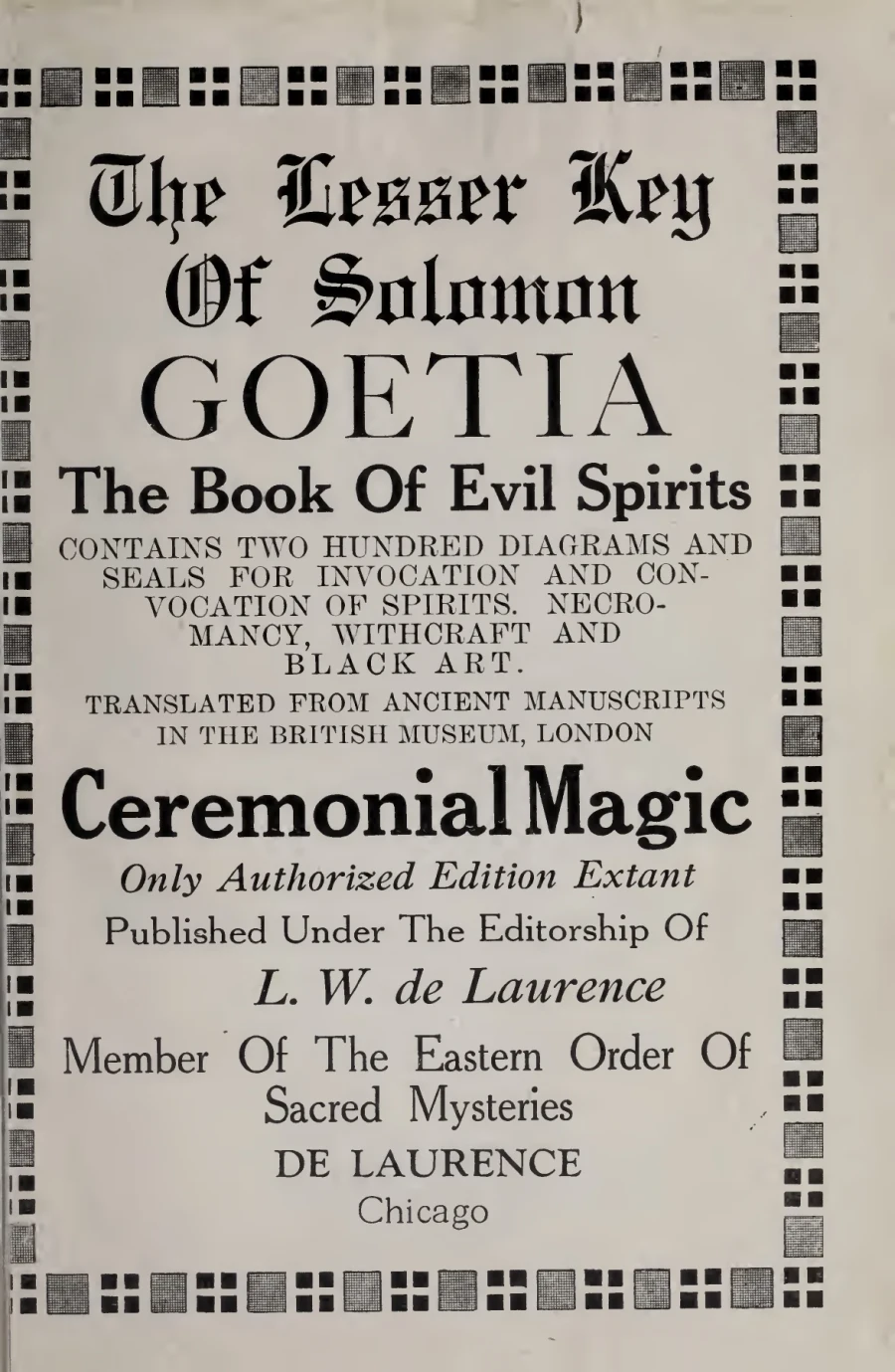 The Lesser Key of Solomon: GoetiaA catalogue of spirits in a modern edition1916 · Chicago edition
What is a grimoire?
A grimoire is a book of magic written to guide a reader in some part of magical practice. It might gather prayers, diagrams, lists of spirits or directions for making and using a figure. Surviving copies range from handwritten manuscripts to printed translations. The name also extends to some systematic works of occult philosophy, whose scope can be much wider than an individual manual. [20][23][27][15]
A grimoire is a manual of ritual magic. It may collect prayers, names and diagrams alongside directions for using them. A name such as Solomon can lend the book authority, and a diagram can show where people, objects and inscriptions belong in a rite. [1][2][3][4][5][6]
See references (10)
- Witchcraft Magic & Alchemy, printed p. 102, Reader page 95
- Witchcraft Magic & Alchemy, printed p. 104, Reader page 97
- Witchcraft Magic & Alchemy, printed p. 105, Reader page 98
- Moonchild, Reader page 190
- Moonchild, Reader page 212
- Moonchild, Reader page 213
- Agrippa’s 1533 De occulta philosophia
- French manuscript of the Secret of Secrets
- Mathers’s 1889 Key of Solomon
- De Laurence’s Goetia, 1916
Three Books of Occult Philosophy
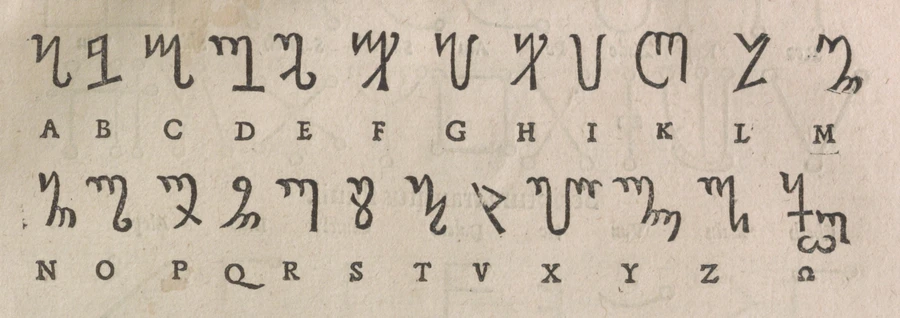
Agrippa’s De occulta philosophia is a work of learned synthesis. Its three-book architecture takes the reader through natural, celestial and ceremonial material. In place of a single operation there is an attempt to explain how the natural world, heavenly influences and religious or ceremonial learning fit together. That breadth helps explain why later compilers could take a chart or passage out of Agrippa and give it a new role. [15][16]
Check what an edition actually promises before using it as evidence for a passage. The 1898 Chicago volume edited by Willis F. Whitehead identifies itself as Book One, devoted to natural magic. To find the alphabet illustrated here, open Book Three, chapter 29, in the 1533 printing. Its position makes clear what would disappear if you read only the first book. [15][16][17][29]
Agrippa pairs Theban characters with Latin letters in Book Three, chapter 29. This detail is from printed p. 273.
Heinrich Cornelius Agrippa, De occulta philosophia libri tres, 1533, p. 273. Library of Congress via Wikimedia Commons. Public Domain Mark. · Image source ↗ · Public Domain
Arbatel
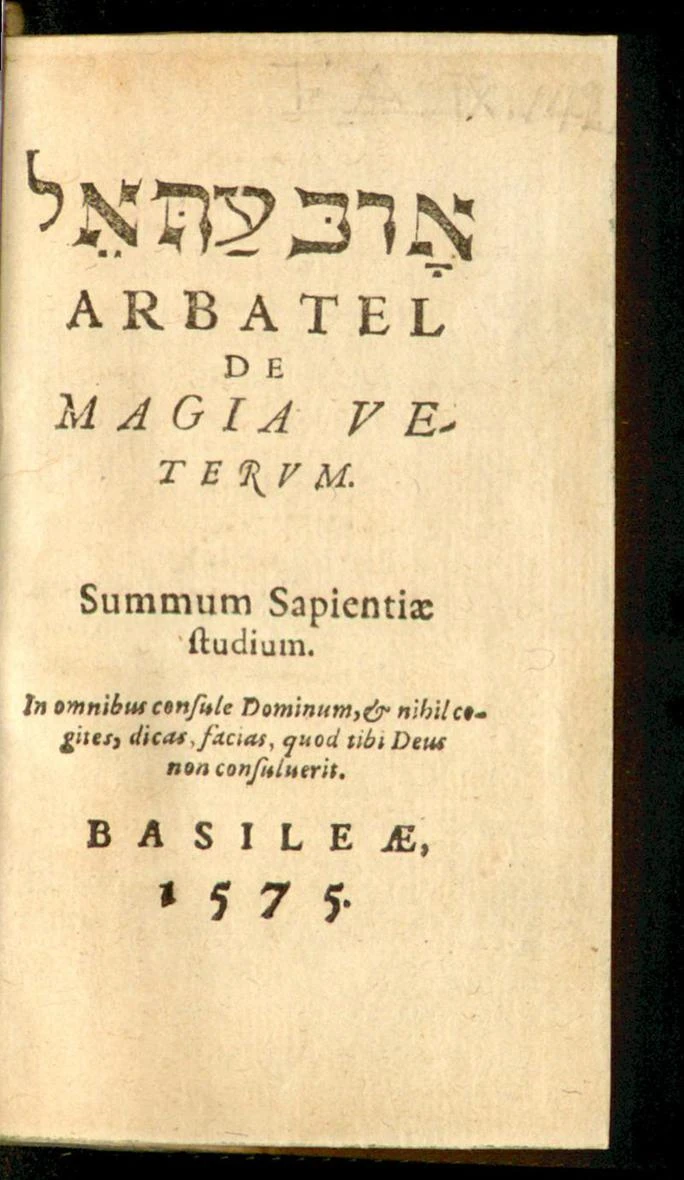
The surviving Arbatel presents magic in short numbered aphorisms. It brings together devotional conduct and an account of powers associated with the planets. The form matters. A reader encounters maxims about how a practitioner ought to live alongside material about the structure of the world. The Basel copy gives a secure date and place for the printed object. [18][19]
The opening material sets out an ambitious plan. The surviving text printed here contains the first part, arranged as seven groups of seven aphorisms. A projected list in a preface is evidence of a plan. To see what a particular copy contains, turn from that list to the numbered aphorisms and the end of the book. [18][19]
The Basel copy identifies itself as Arbatel and supplies a year on the printed page.
Arbatel de magia veterum, Basel, 1575. Universitätsbibliothek Basel, AN VI 37, doi:10.3931/e-rara-8789. Public Domain Mark. · Image source ↗ · Public Domain
See references (2)
Secret of Secrets
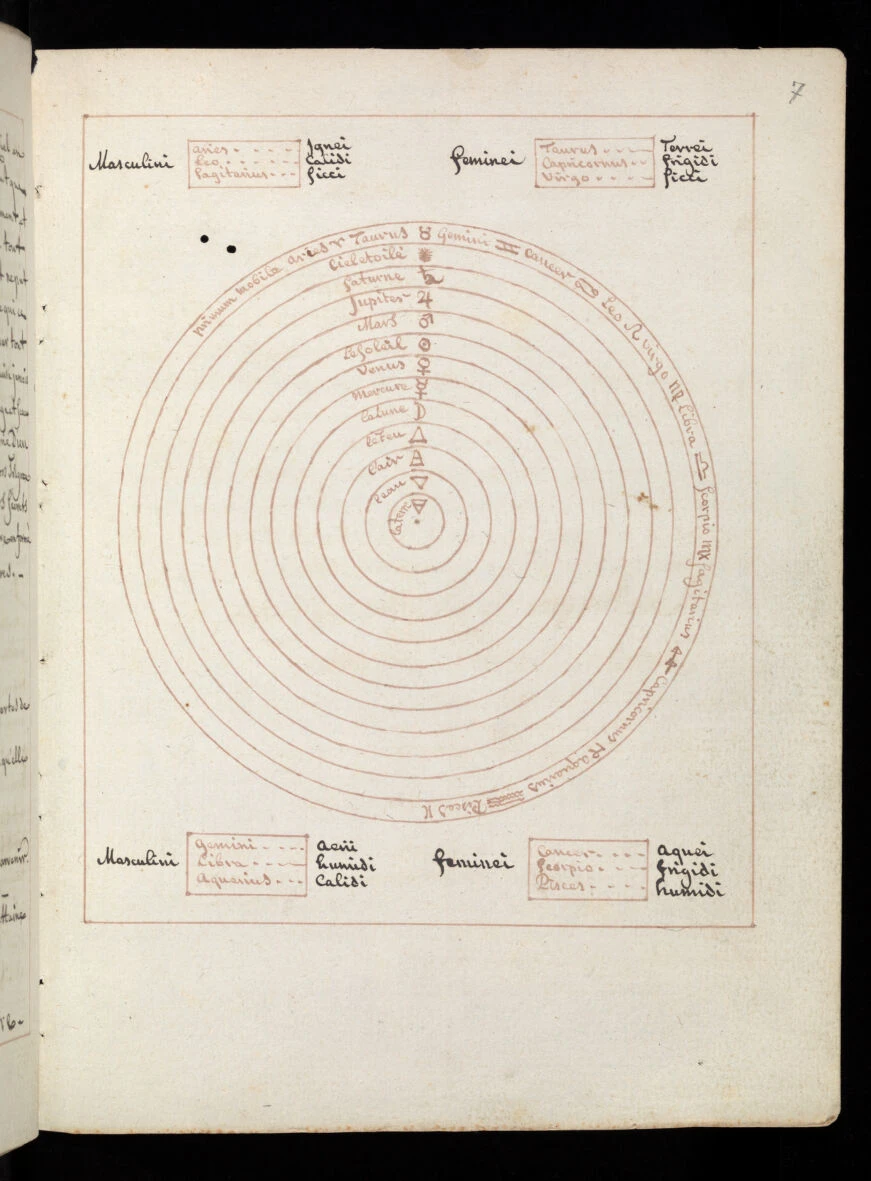
This late eighteenth-century French manuscript is catalogued as MS.4662. Its longer title calls itself a Clavicule of Solomon, while the end of the preface gives a title associated with Tozgraec. Wellcome describes two treatises and notes that their contents differ from texts usually ascribed to Solomon under the Clavicule name. The shelfmark keeps this particular witness distinct from similarly titled books. [20]
Compare the illustrated leaf with the printed Key of Solomon below. Both contain circular forms, figures and written labels. The manuscript leaf shows how these elements sit together on one handwritten page. That visual resemblance offers a comparison across books. Finding a shared passage would require checking the wording and its position in each copy. [20][31][33]
A circular figure in Wellcome MS.4662. The line and lettering are part of the manuscript page.
Pseudo-Solomon, Wellcome Collection MS.4662, canvas 12. Public Domain Mark. · Image source ↗ · Public Domain
The Magus
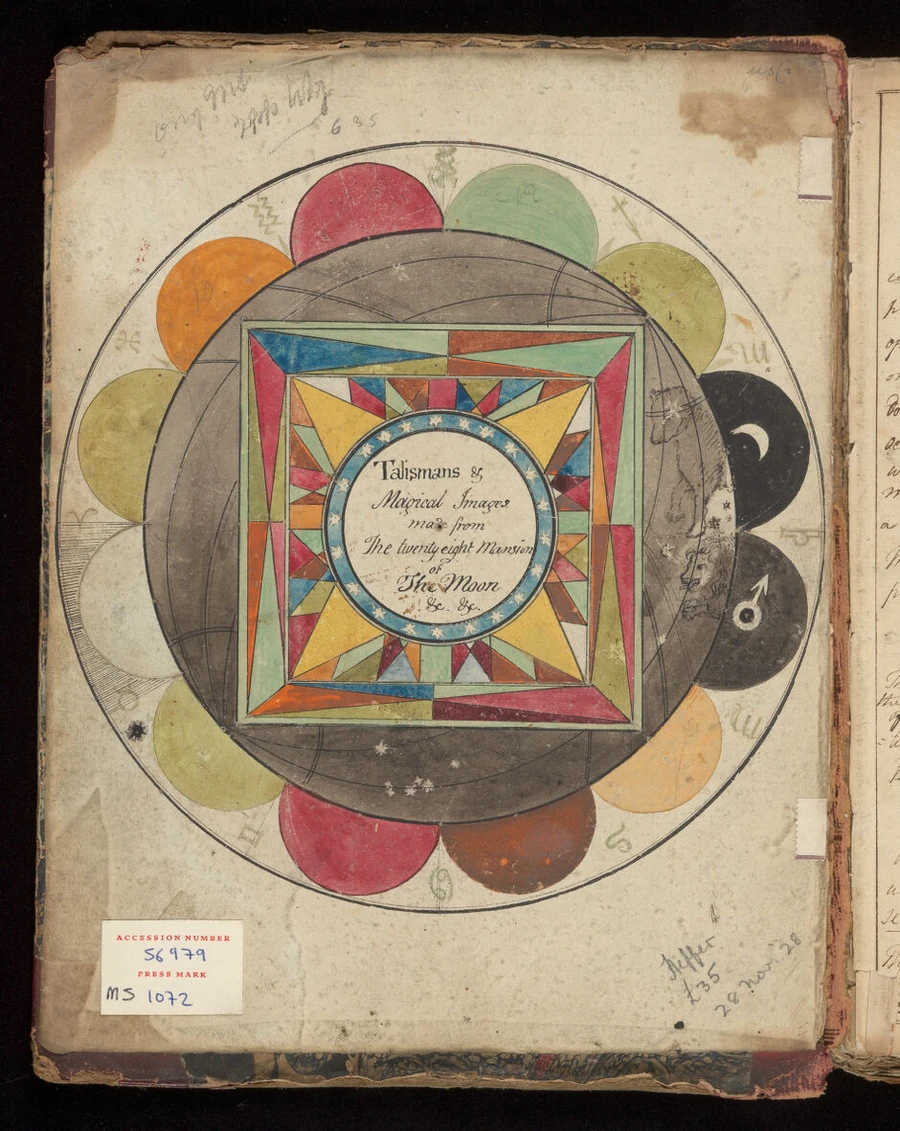
Francis Barrett’s Magus calls itself a complete system of occult philosophy. Its printed presentation brings earlier learning into a book with its own portraits, tables and figures. Wellcome also holds a holograph manuscript, a document in Barrett’s own hand, which ends at Book II, Part III. The manuscript and the printed edition are separate witnesses to his work. [22][21][12]
Open the coloured diagram pasted inside the manuscript’s cover, then look at the portrait and small diagram in the Library’s printed facsimile. A manuscript’s pasted insert records the making and use of an individual object. A printed image helps establish the order in which the publisher presents the work. Reading both reveals choices hidden by a single neat title in a catalogue. [21][32][12]
The coloured diagram is pasted inside the cover of Barrett’s manuscript. Wellcome identifies it with talismans and the mansions of the Moon.
Francis Barrett, The Magus or Celestial Intelligencer, Wellcome Collection MS.1072, canvas 2. Public Domain Mark. · Image source ↗ · Public Domain
The Key of Solomon
Clavicula Salomonis, the Key of Solomon, names a family of texts. Mathers’s English edition says on its title page that he translated and edited it from manuscripts in the British Museum. The result has the shape of a printed book, with a table of contents, numbered pages and a sequence of plates. The nineteenth-century editor mediates what an English-language reader sees. [23][24][11]
Read the manuscript and the print as different kinds of evidence. Wellcome’s mid-eighteenth-century French copy includes coloured figures inside red rules. Mathers’s frontispiece consists of figures assembled on a printed plate. A resemblance can guide you towards a closer comparison of labels and placement. It does not establish that Mathers used this particular French copy. [24][33][11]
Mathers gives these figures an entire printed plate near the front of the English edition.
The Key of Solomon the King, edited and translated by S. L. MacGregor Mathers, London, 1889. Wellcome Collection, canvas 8. Public Domain Mark. · Image source ↗ · Public Domain
The Book of Abramelin
Mathers’s title page presents Abraham’s account to his son Lamech as a transmission dated 1458. The London imprint gives 1898 and identifies Mathers as translator from a French manuscript. The date in the narrated title and the date of the physical edition answer different questions. The first situates the book’s story. The second tells you which printed object you are reading. [13][34]
This English version moves from the account of transmission to spiritual preparation and a collection of lettered squares. Other witnesses can organise the material differently. The Warburg record describes a facsimile of a 1725 German edition, a useful comparison when an English title page seems to stand for the whole tradition. [13][25][26]
The title places the story in 1458. The imprint dates this London edition to 1898.
The Book of the Sacred Magic of Abra-Melin the Mage, translated by S. L. MacGregor Mathers, London, 1898. Wikimedia Commons. Public domain. · Image source ↗ · Public Domain
The Lesser Key of Solomon: Goetia
The Lesser Key belongs to the Lemegeton tradition. The 1916 Chicago edition on this shelf prints the Goetia, the section that lists spirits and gives each a description and a seal. Its repeated entries are useful for studying how a book builds a catalogue out of names, ranks, attributes and marks. Keep the section name when citing the edition. [27][28]
The Key and Lesser Key share Solomonic authority in their titles. Mathers’s Key and de Laurence’s Goetia organise their pages differently and represent different texts. The title page of the Chicago book also advertises its own authority. Read those claims as part of the publication’s history, then use the edition statement and the scan to identify exactly what it contains. [14][27][23]
The publisher advertises the diagrams and seals on the title page of this 1916 Chicago edition.
The Lesser Key of Solomon, Goetia, edited by L. W. de Laurence, Chicago, 1916. Lumitheca facsimile. Public domain. · Image source ↗ · Public Domain
Witchcraft Magic & Alchemy by Grillot de Givry
Grillot de Givry describes how material attributed to Solomon and Pope Honorius circulated in overlapping forms. He reproduces two Solomonic ritual circles. Arsenal MS 2350 puts inscriptions around several joined shapes. In MS 2348, four smaller circles surround the main one and mark places for assistants. [1][2][3]
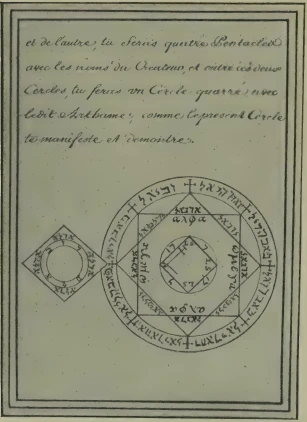
A diagram from Arsenal MS 2350, reproduced as figure 74 by De Givry. It is one of several circle designs in manuscripts transmitted as the Key of Solomon.
Bibliothèque de l’Arsenal, MS 2350, eighteenth century. Diagram reproduced by De Givry. · Image source ↗ · Public Domain
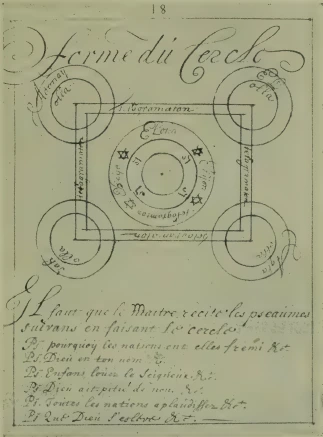
The Solomonic manuscript figure reproduced by De Givry gives a central figure four smaller circles and an enclosing square.
Bibliothèque de l’Arsenal, MS 2348, eighteenth century. Diagram reproduced by De Givry. · Image source ↗ · Public Domain
Moonchild by Aleister Crowley
In Aleister Crowley’s Moonchild, Edwin Arthwait disparages grimoires in public and relies on them in private. He favours The Black Pullet and treats the Grand Grimoire and the work attributed to Pope Honorius as more dangerous. [4][7]
Vesquit puts Arthwait to work making a manual for a particular operation. The narrator explains that a grimoire should suit its purpose and have appropriate illustrations. Arthwait becomes absorbed in making the prose difficult to understand, treating obscurity as a sign of learning. [5][6][8][9][10]
How a manual guides its reader
The manuscript diagrams give a reader a way to locate people and inscriptions at a glance. Crowley’s satire imagines a writer who makes the same kind of book difficult to read on purpose. [2][3][5][6][8][9]
Read further in the library
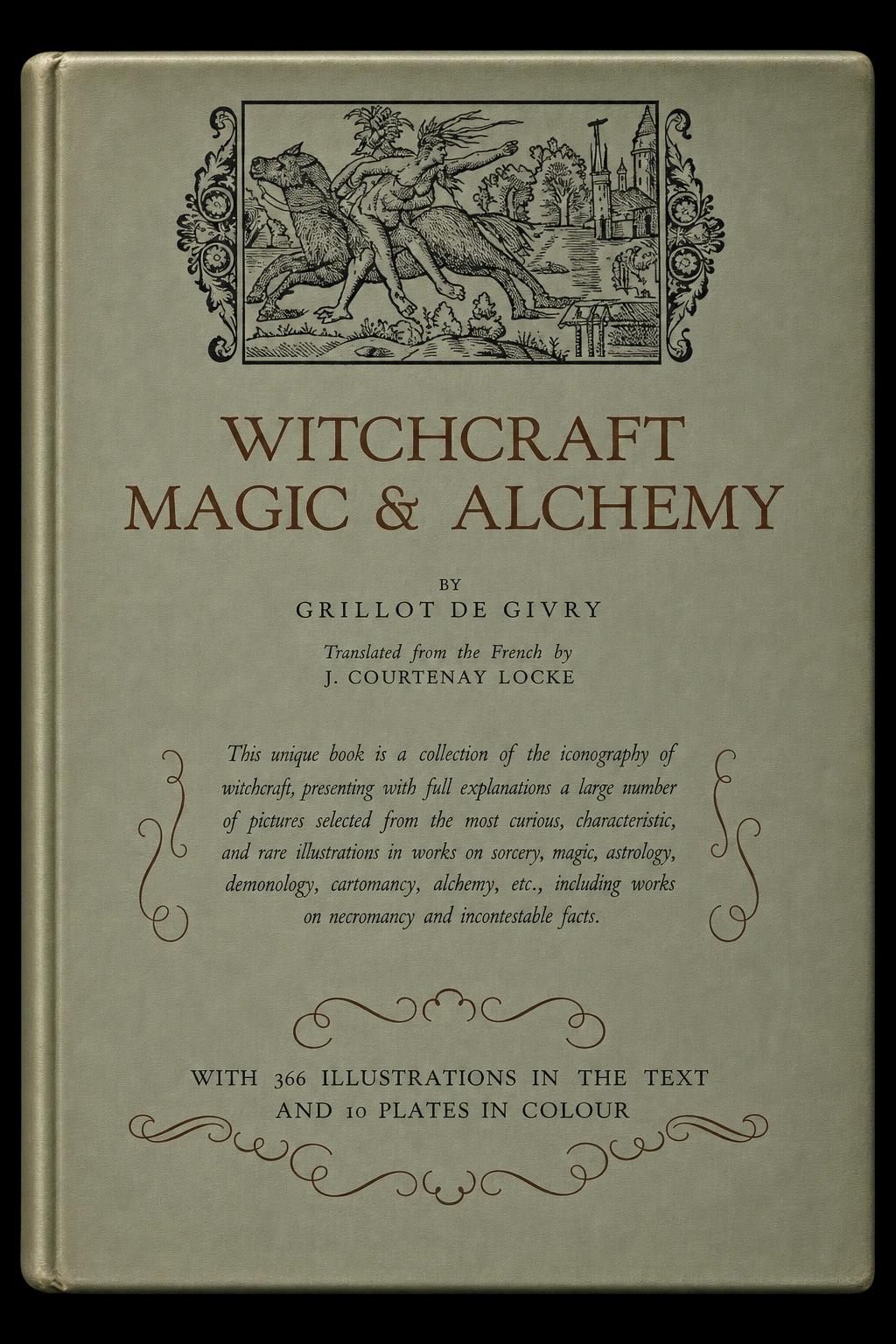
Witchcraft Magic and Alchemy
Reading note
Separately attributed primary Library account, cited on exact verified Reader leaves.
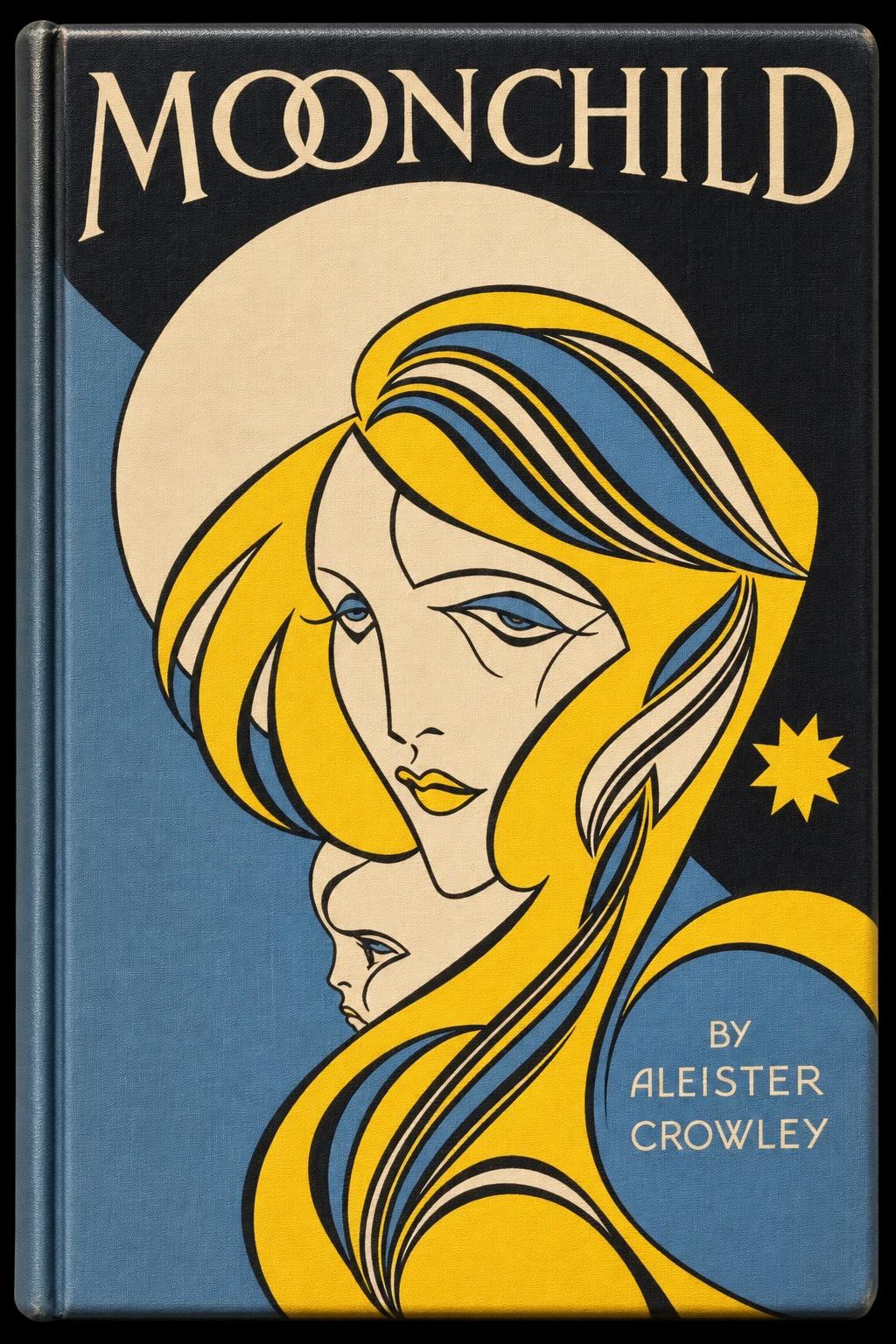
Moonchild
Reading note
The separately titled account draws on exact passages in the consulted Library edition.
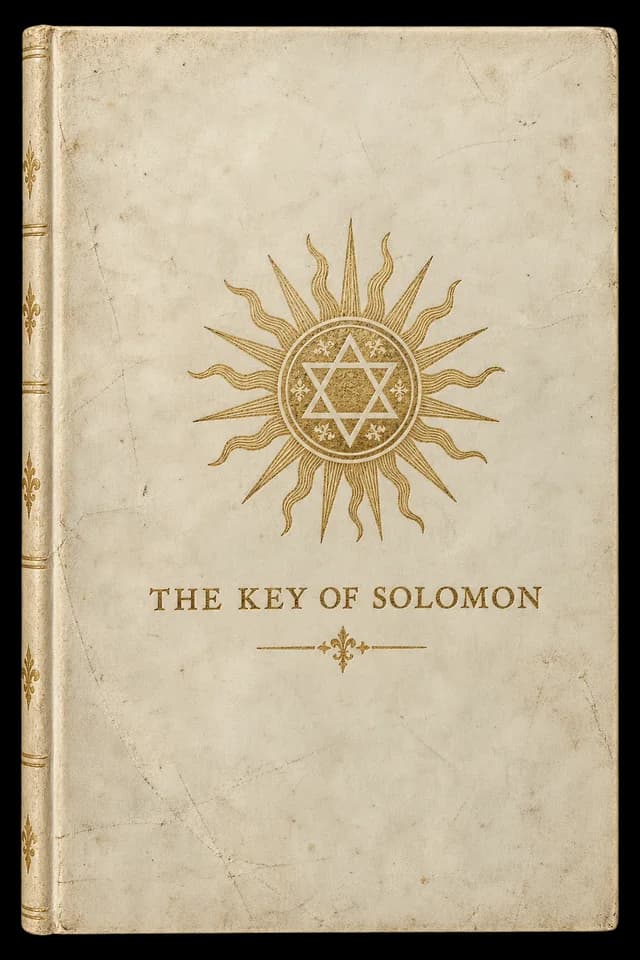
The Key of Solomon the King
Reading note
Compare the printed 1889 frontispiece with the figures in a handwritten Clavicule.
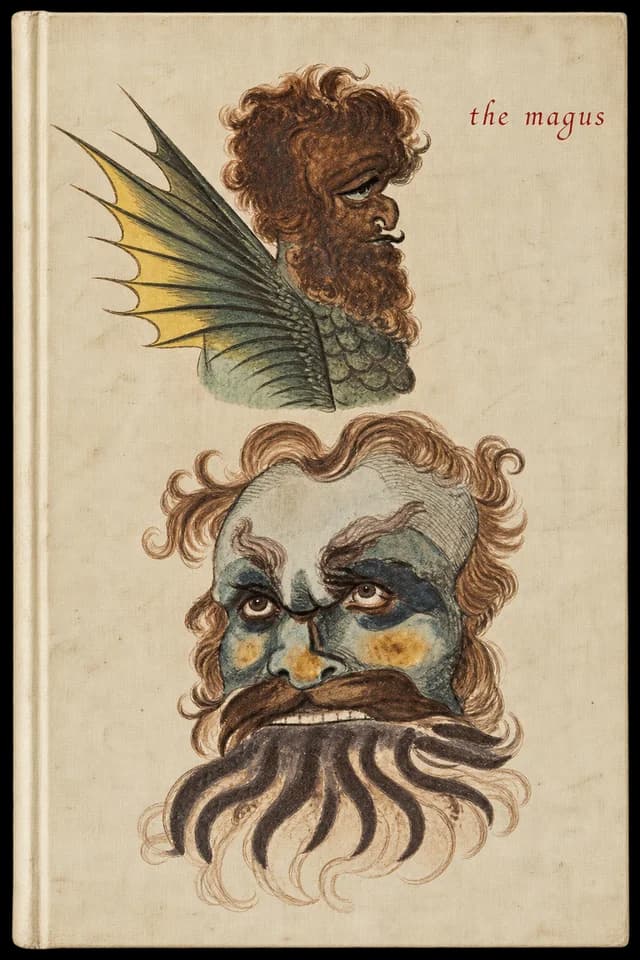
The Magus; or, Celestial Intelligencer
Reading note
See how Barrett’s printed volume introduces its author and images.
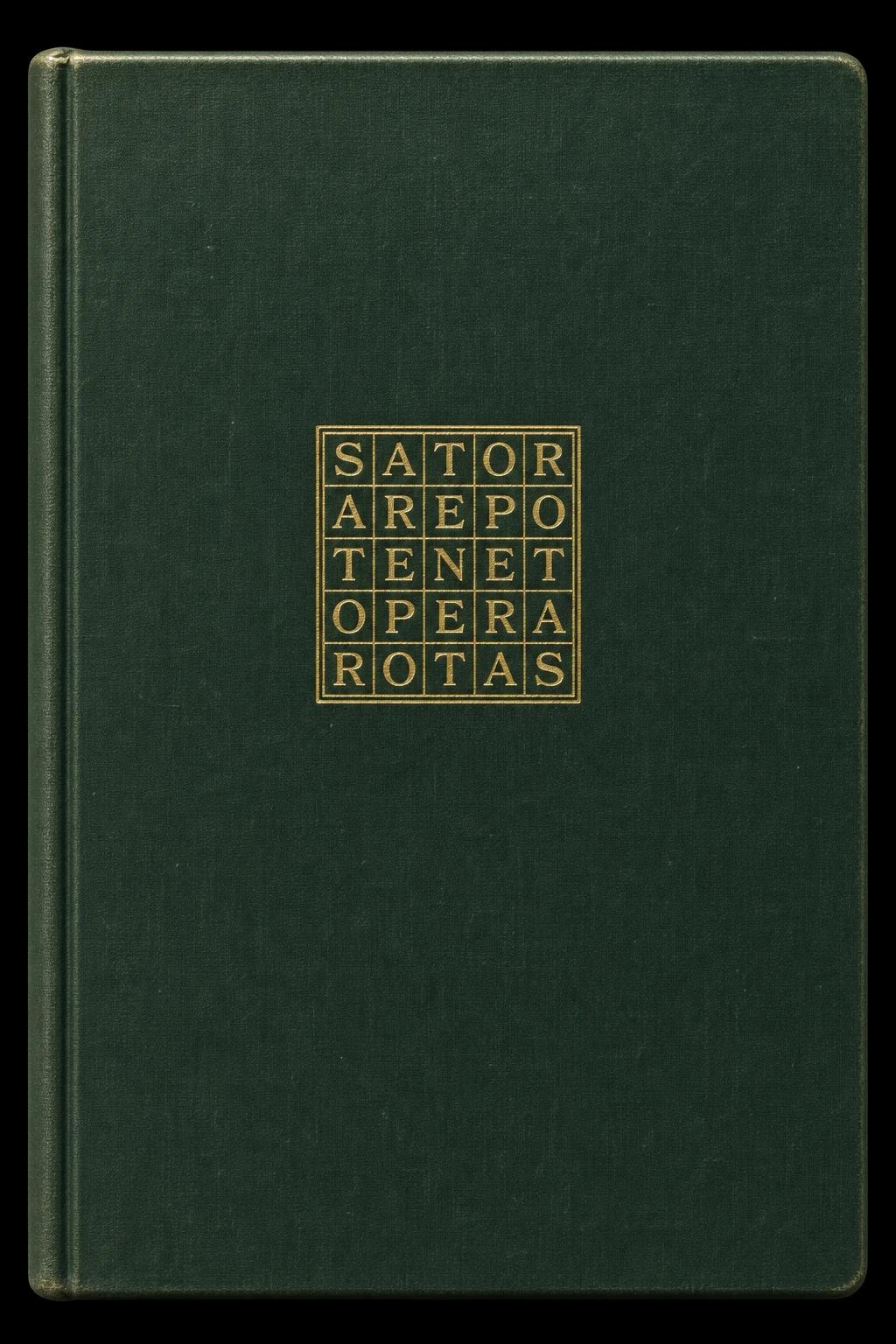
The Book of the Sacred Magic of Abra-Melin the Mage
Reading note
Read the title page and follow the structure of Mathers’s 1898 edition.
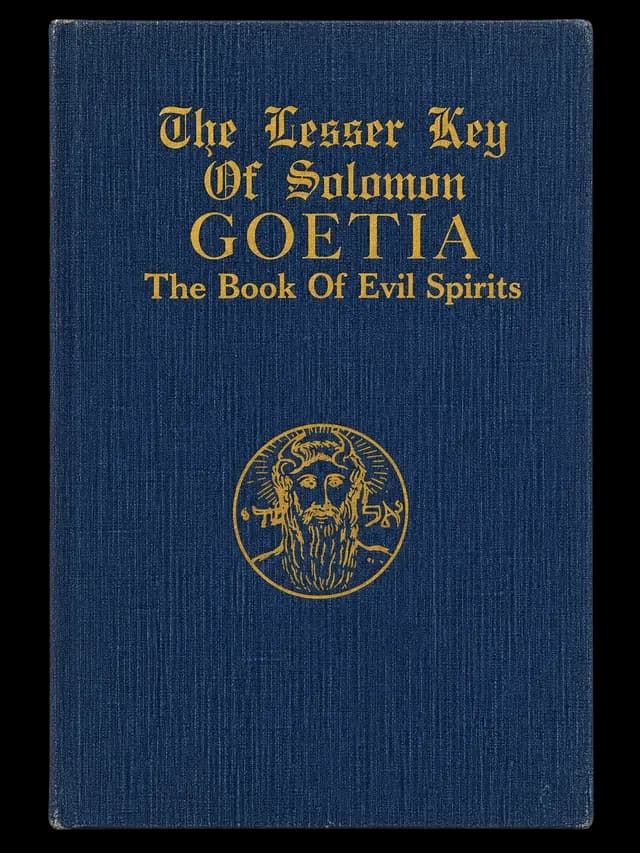
The Lesser Key of Solomon: Goetia
Reading note
Read the 1916 Chicago title page and compare the Goetia with the Key.
Sources
See references (35)
- Witchcraft Magic & Alchemy, printed p. 102, Reader page 95Grillot de Givry, Witchcraft Magic & Alchemy, translated by J. Courtenay Locke. Boston and New York, Houghton Mifflin Company, 1931.Read this page in Witchcraft Magic and Alchemy ↗Return to text ↑
- Witchcraft Magic & Alchemy, printed p. 104, Reader page 97Grillot de Givry, Witchcraft Magic & Alchemy, translated by J. Courtenay Locke. Boston and New York, Houghton Mifflin Company, 1931.Read this page in Witchcraft Magic and Alchemy ↗Return to text ↑
- Witchcraft Magic & Alchemy, printed p. 105, Reader page 98Grillot de Givry, Witchcraft Magic & Alchemy, translated by J. Courtenay Locke. Boston and New York, Houghton Mifflin Company, 1931.Read this page in Witchcraft Magic and Alchemy ↗Return to text ↑
- Moonchild, Reader page 190Aleister Crowley, Moonchild (Liber LXXXI, The Butterfly Net), Library digital transcription IMJ-0629-E001.Read this page in Moonchild ↗Return to text ↑
- Moonchild, Reader page 212Aleister Crowley, Moonchild (Liber LXXXI, The Butterfly Net), Library digital transcription IMJ-0629-E001.Read this page in Moonchild ↗Return to text ↑
- Moonchild, Reader page 213Aleister Crowley, Moonchild (Liber LXXXI, The Butterfly Net), Library digital transcription IMJ-0629-E001.Read this page in Moonchild ↗Return to text ↑
- Moonchild, Reader page 194Aleister Crowley, Moonchild (Liber LXXXI, The Butterfly Net), Library digital transcription IMJ-0629-E001.Read this page in Moonchild ↗Return to text ↑
- Moonchild, Reader page 214Aleister Crowley, Moonchild (Liber LXXXI, The Butterfly Net), Library digital transcription IMJ-0629-E001.Read this page in Moonchild ↗Return to text ↑
- Moonchild, Reader page 215Aleister Crowley, Moonchild (Liber LXXXI, The Butterfly Net), Library digital transcription IMJ-0629-E001.Read this page in Moonchild ↗Return to text ↑
- Moonchild, Reader page 242Aleister Crowley, Moonchild (Liber LXXXI, The Butterfly Net), Library digital transcription IMJ-0629-E001.Read this page in Moonchild ↗Return to text ↑
- Mathers’s printed frontispieceS. L. MacGregor Mathers, The Key of Solomon the King. London, George Redway, 1889.Read this page in The Key of Solomon the King ↗Return to text ↑
- Barrett’s portrait and diagram in the Library facsimileFrancis Barrett, The Magus, 1801. Lumitheca Library facsimile.Read this page in The Magus; or, Celestial Intelligencer ↗Return to text ↑
- Mathers’s title page, London, 1898S. L. MacGregor Mathers, The Book of the Sacred Magic of Abra-Melin the Mage. London, John M. Watkins, 1898.Read this page in The Book of the Sacred Magic of Abra-Melin the Mage ↗Return to text ↑
- De Laurence’s title page, Chicago, 1916L. W. de Laurence, The Lesser Key of Solomon, Goetia. Chicago, 1916.Read this page in The Lesser Key of Solomon: Goetia ↗Return to text ↑
- Agrippa’s 1533 De occulta philosophia ↗Bayerische Staatsbibliothek.Return to text ↑
- 1533 edition of De occulta philosophia ↗Library of Congress Rare Book and Special Collections Division.Return to text ↑
- Whitehead’s 1898 edition of Book One ↗Library of Congress, Harry Houdini Collection.Return to text ↑
- Arbatel de magia veterum, Basel, 1575 ↗Universitätsbibliothek Basel, AN VI 37.Return to text ↑
- The Arbatel in the original Latin ↗Latin text of Arbatel de magia veterum from the 1575 Basel edition.Return to text ↑
- French manuscript of the Secret of Secrets ↗Wellcome Collection, MS.4662.Return to text ↑
- Barrett’s surviving manuscript of The Magus ↗Wellcome Collection, MS.1072.Return to text ↑
- Barrett’s printed Magus, London, 1801 ↗Wellcome Collection.Return to text ↑
- Mathers’s 1889 Key of Solomon ↗Wellcome Collection, BVA.CA.Return to text ↑
- Mid-eighteenth-century French Clavicule ↗Wellcome Collection, French manuscript associated with the Colorno tradition.Return to text ↑
- Catalogue for a facsimile of the 1725 German edition ↗Warburg Institute Digital Library.Return to text ↑
- Mathers’s edition, contents and historical collation ↗Digital edition and collated primary text, edited by Joseph H. Peterson.Return to text ↑
- De Laurence’s Goetia, 1916 ↗Harold B. Lee Library copy digitised by Internet Archive.Return to text ↑
- Transcription of the 1916 Chicago Goetia ↗Project Gutenberg ebook 72679.Return to text ↑
- Three Books of Occult Philosophy · 1533 · Latin print ↗Heinrich Cornelius Agrippa, De occulta philosophia libri tres, 1533, p. 273. Library of Congress via Wikimedia Commons. Public Domain Mark.Return to text ↑
- Arbatel · 1575 · Basel print ↗Arbatel de magia veterum, Basel, 1575. Universitätsbibliothek Basel, AN VI 37, doi:10.3931/e-rara-8789. Public Domain Mark.
- Secret of Secrets · Late 18th century · French manuscript ↗Pseudo-Solomon, Wellcome Collection MS.4662, canvas 12. Public Domain Mark.Return to text ↑
- The Magus · 1801 · Manuscript and print ↗Francis Barrett, The Magus or Celestial Intelligencer, Wellcome Collection MS.1072, canvas 2. Public Domain Mark.Return to text ↑
- The Key of Solomon · 1889 · English edition ↗The Key of Solomon the King, edited and translated by S. L. MacGregor Mathers, London, 1889. Wellcome Collection, canvas 8. Public Domain Mark.Return to text ↑
- The Book of Abramelin · 1898 · Mathers’s English edition ↗The Book of the Sacred Magic of Abra-Melin the Mage, translated by S. L. MacGregor Mathers, London, 1898. Wikimedia Commons. Public domain.Return to text ↑
- The Lesser Key of Solomon: Goetia · 1916 · Chicago edition ↗The Lesser Key of Solomon, Goetia, edited by L. W. de Laurence, Chicago, 1916. Lumitheca facsimile. Public domain.