Grihastha: The Hindu Householder
Grihastha is the Hindu householder stage of life. Read how the Mahanirvana Tantra and Vivekananda connect family care, honest work and public service.
In this article
Understanding the concept
Grihastha is the householder stage of life in Hindu ashrama schemes. It brings marriage, earning a living and care for others into the practice of religion. In Vivekananda’s account a householder can pursue spiritual freedom through the responsibilities of this life. [3][4]
Those responsibilities extend outside the home. The household receives guests, supports dependants and can put resources towards work that many people use. What someone does with what they earn is part of the discipline. [5][6][7][8][9][10]
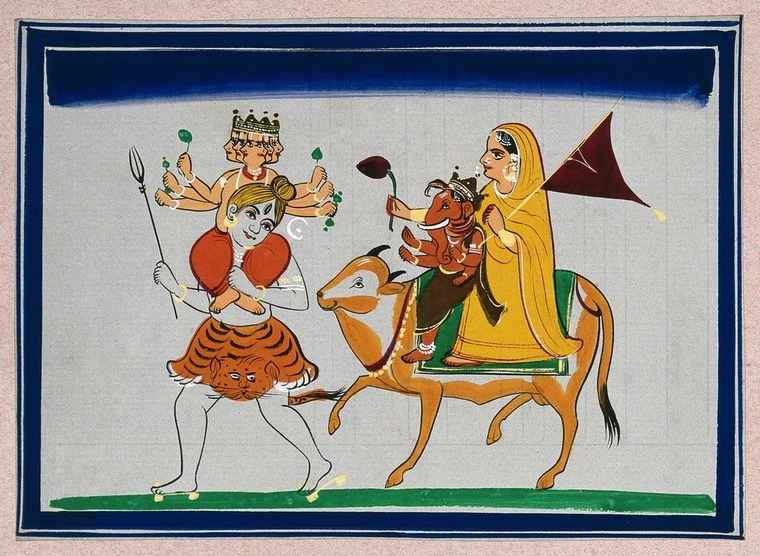
Shiva and Parvati with Ganesha and Kartikeya, Indian gouache, probably nineteenth century.
Unidentified Indian artist, [between 1800 and 1899?]. Wellcome Collection, 581704i. Public Domain Mark. · Image source ↗ · Public Domain
The Mahanirvana Tantra: household responsibility
In the Mahanirvana Tantra, chapter VIII, the householder’s contemplation and offering to Brahman sit beside truthfulness and care for family and guests. In Arthur Avalon’s translation, verse 63 includes reservoirs, trees, rest-houses and bridges among meritorious works. [1]
Karma-Yoga by Swami Vivekananda
Swami Vivekananda presents student life, household life, retirement and renunciation as distinct stages. He places the household beside the monastic life to show how different circumstances can give a person different kinds of duty. [3][4]
He explicitly introduces passages from the Mahanirvana Tantra when discussing the householder. These join devotion to God with work and the offering of its fruits. Parents, children, spouse, relatives, guests and people needing help enter the resulting account of responsibility. [4][5][6][7]
The account praises earning by honest means and spending for good purposes. It places reservoirs, roadside trees, rest-houses, roads and bridges beside the work of a great yogin. These examples make community infrastructure a religious concern rather than leaving spirituality confined to private worship. [9][10]
A parable gives the two vocations separate tests. A young renunciant refuses a marriage and a kingdom. Later, a family of birds gives up its life for guests. The story pushes hospitality to an extreme to ask what steadfastness would look like for each character. [11][12][13][14][15][16]
The chapter also gives duties according to gender and inherited social position, including a male breadwinner model and rules for wives and children. Vivekananda argues for the spiritual significance of domestic work within that historical social framework. [4][5][6][7][8][9]
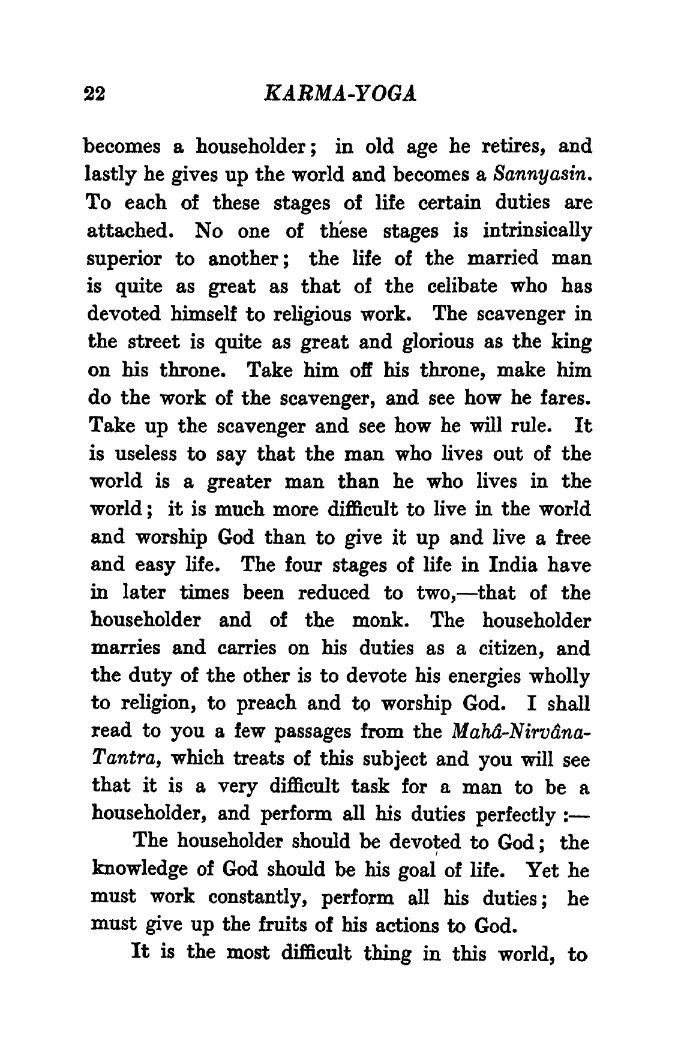
Karma-Yoga (1939), Library Reader page 24. Vivekananda introduces household life through passages from the Mahanirvana Tantra.
Swami Vivekananda, Karma-Yoga, English second printing in the 1939 combined volume. Historical public-domain text, exact checksum-verified Library scan. · Image source ↗ · Public Domain
See references (14)
- Karma-Yoga, Reader page 23
- Karma-Yoga, Reader page 24
- Karma-Yoga, Reader page 25
- Karma-Yoga, Reader page 26
- Karma-Yoga, Reader page 27
- Karma-Yoga, Reader page 28
- Karma-Yoga, Reader page 29
- Karma-Yoga, Reader page 30
- Karma-Yoga, Reader page 31
- Karma-Yoga, Reader page 32
- Karma-Yoga, Reader page 33
- Karma-Yoga, Reader page 34
- Karma-Yoga, Reader page 35
- Karma-Yoga, Reader page 36
How the householder and renunciant serve
The Mahanirvana Tantra puts the household in a Shaiva scriptural setting. Vivekananda uses its duties to compare vocations. Avalon’s later translation gives readers the cited verses in another textual witness. [1][4]
Vivekananda’s householder has wealth and relationships through which to serve. His renunciant is tested by what they can leave behind. The two lives have different work, and he asks how freely each person undertakes it. [3][4][11][16][17][18]
Read further in the library
Karma Yoga
Reading note
The separately titled account draws on exact passages in the consulted Library edition.
Sources
See references (18)
- Mahanirvana Tantra, chapter VIII, verses 8–23, 35–39, 62–63 and 221–279, Arthur Avalon translation ↗Mahanirvana Tantra, translated by Arthur Avalon (Sir John Woodroffe), 1913. Selected numbered verses of chapter VIII. This is a separately consulted translation, not a claim that Vivekananda quoted a translation published after his death.Return to text ↑
- The holy family: Shiva with his wife Parvati and their children Ganesha and Kartikeya ↗Unidentified Indian artist, [between 1800 and 1899?]. Wellcome Collection 581704i. Historical artwork with Public Domain Mark.
- Karma-Yoga, Reader page 23Swami Vivekananda, Karma-Yoga, in Karma-Yoga & Bhakti-Yoga, English second printing, Ramakrishna-Vivekananda Center of New York, Inc., 1939. Exact Library edition IMJ-0097-E002. Only the Karma-Yoga part is used in this crawl; the old Work slug mentioning Hindi does not identify this edition’s language.Read this page in Karma Yoga ↗Return to text ↑
- Karma-Yoga, Reader page 24Swami Vivekananda, Karma-Yoga, in Karma-Yoga & Bhakti-Yoga, English second printing, Ramakrishna-Vivekananda Center of New York, Inc., 1939. Exact Library edition IMJ-0097-E002. Only the Karma-Yoga part is used in this crawl; the old Work slug mentioning Hindi does not identify this edition’s language.Read this page in Karma Yoga ↗Return to text ↑
- Karma-Yoga, Reader page 25Swami Vivekananda, Karma-Yoga, in Karma-Yoga & Bhakti-Yoga, English second printing, Ramakrishna-Vivekananda Center of New York, Inc., 1939. Exact Library edition IMJ-0097-E002. Only the Karma-Yoga part is used in this crawl; the old Work slug mentioning Hindi does not identify this edition’s language.Read this page in Karma Yoga ↗Return to text ↑
- Karma-Yoga, Reader page 26Swami Vivekananda, Karma-Yoga, in Karma-Yoga & Bhakti-Yoga, English second printing, Ramakrishna-Vivekananda Center of New York, Inc., 1939. Exact Library edition IMJ-0097-E002. Only the Karma-Yoga part is used in this crawl; the old Work slug mentioning Hindi does not identify this edition’s language.Read this page in Karma Yoga ↗Return to text ↑
- Karma-Yoga, Reader page 27Swami Vivekananda, Karma-Yoga, in Karma-Yoga & Bhakti-Yoga, English second printing, Ramakrishna-Vivekananda Center of New York, Inc., 1939. Exact Library edition IMJ-0097-E002. Only the Karma-Yoga part is used in this crawl; the old Work slug mentioning Hindi does not identify this edition’s language.Read this page in Karma Yoga ↗Return to text ↑
- Karma-Yoga, Reader page 28Swami Vivekananda, Karma-Yoga, in Karma-Yoga & Bhakti-Yoga, English second printing, Ramakrishna-Vivekananda Center of New York, Inc., 1939. Exact Library edition IMJ-0097-E002. Only the Karma-Yoga part is used in this crawl; the old Work slug mentioning Hindi does not identify this edition’s language.Read this page in Karma Yoga ↗Return to text ↑
- Karma-Yoga, Reader page 29Swami Vivekananda, Karma-Yoga, in Karma-Yoga & Bhakti-Yoga, English second printing, Ramakrishna-Vivekananda Center of New York, Inc., 1939. Exact Library edition IMJ-0097-E002. Only the Karma-Yoga part is used in this crawl; the old Work slug mentioning Hindi does not identify this edition’s language.Read this page in Karma Yoga ↗Return to text ↑
- Karma-Yoga, Reader page 30Swami Vivekananda, Karma-Yoga, in Karma-Yoga & Bhakti-Yoga, English second printing, Ramakrishna-Vivekananda Center of New York, Inc., 1939. Exact Library edition IMJ-0097-E002. Only the Karma-Yoga part is used in this crawl; the old Work slug mentioning Hindi does not identify this edition’s language.Read this page in Karma Yoga ↗Return to text ↑
- Karma-Yoga, Reader page 31Swami Vivekananda, Karma-Yoga, in Karma-Yoga & Bhakti-Yoga, English second printing, Ramakrishna-Vivekananda Center of New York, Inc., 1939. Exact Library edition IMJ-0097-E002. Only the Karma-Yoga part is used in this crawl; the old Work slug mentioning Hindi does not identify this edition’s language.Read this page in Karma Yoga ↗Return to text ↑
- Karma-Yoga, Reader page 32Swami Vivekananda, Karma-Yoga, in Karma-Yoga & Bhakti-Yoga, English second printing, Ramakrishna-Vivekananda Center of New York, Inc., 1939. Exact Library edition IMJ-0097-E002. Only the Karma-Yoga part is used in this crawl; the old Work slug mentioning Hindi does not identify this edition’s language.Read this page in Karma Yoga ↗Return to text ↑
- Karma-Yoga, Reader page 33Swami Vivekananda, Karma-Yoga, in Karma-Yoga & Bhakti-Yoga, English second printing, Ramakrishna-Vivekananda Center of New York, Inc., 1939. Exact Library edition IMJ-0097-E002. Only the Karma-Yoga part is used in this crawl; the old Work slug mentioning Hindi does not identify this edition’s language.Read this page in Karma Yoga ↗Return to text ↑
- Karma-Yoga, Reader page 34Swami Vivekananda, Karma-Yoga, in Karma-Yoga & Bhakti-Yoga, English second printing, Ramakrishna-Vivekananda Center of New York, Inc., 1939. Exact Library edition IMJ-0097-E002. Only the Karma-Yoga part is used in this crawl; the old Work slug mentioning Hindi does not identify this edition’s language.Read this page in Karma Yoga ↗Return to text ↑
- Karma-Yoga, Reader page 35Swami Vivekananda, Karma-Yoga, in Karma-Yoga & Bhakti-Yoga, English second printing, Ramakrishna-Vivekananda Center of New York, Inc., 1939. Exact Library edition IMJ-0097-E002. Only the Karma-Yoga part is used in this crawl; the old Work slug mentioning Hindi does not identify this edition’s language.Read this page in Karma Yoga ↗Return to text ↑
- Karma-Yoga, Reader page 36Swami Vivekananda, Karma-Yoga, in Karma-Yoga & Bhakti-Yoga, English second printing, Ramakrishna-Vivekananda Center of New York, Inc., 1939. Exact Library edition IMJ-0097-E002. Only the Karma-Yoga part is used in this crawl; the old Work slug mentioning Hindi does not identify this edition’s language.Read this page in Karma Yoga ↗Return to text ↑
- Karma-Yoga, Reader page 102Swami Vivekananda, Karma-Yoga, in Karma-Yoga & Bhakti-Yoga, English second printing, Ramakrishna-Vivekananda Center of New York, Inc., 1939. Exact Library edition IMJ-0097-E002. Only the Karma-Yoga part is used in this crawl; the old Work slug mentioning Hindi does not identify this edition’s language.Read this page in Karma Yoga ↗Return to text ↑
- Karma-Yoga, printed p. 101, Reader page 103Swami Vivekananda, Karma-Yoga, in Karma-Yoga & Bhakti-Yoga, English second printing, Ramakrishna-Vivekananda Center of New York, Inc., 1939. Exact Library edition IMJ-0097-E002. Only the Karma-Yoga part is used in this crawl; the old Work slug mentioning Hindi does not identify this edition’s language.Read this page in Karma Yoga ↗Return to text ↑