What Is the Difference Between Green Tārā and White Tārā?
Compare Green and White Tārā by posture, eyes and lotus attributes. An open-access Tibetan painting shows both forms side by side.
In this article
How can you tell Green and White Tārā apart?
Green and White Tārā are two forms of the Buddhist figure Tārā. In many Tibetan paintings, Green Tārā lowers one leg and White Tārā sits cross-legged. Seven-eyed White Tārā has a third eye on her forehead and an eye in each palm and sole. Look for the posture first if those details are too small to see. [2][3][6]
The Gods of Northern Buddhism by Alice Getty
Alice Getty describes White Tārā with an open white lotus and Green Tārā with a blue lotus whose petals are often closed. She also records images of Green Tārā with an open flower. A lotus is one clue among several. [2][3]
Getty associates White Tārā with the Chinese princess Wencheng and Green Tārā with the Nepalese princess known as Bhṛkuṭī. The Met gives the opposite pairing in its account of the Guge painting below. These identifications vary across accounts. [1][6]
In one Tibetan banner Getty describes, Green Tārā occupies the centre of an assembly and seven-eyed White Tārā appears in the upper right. The painting below gives the two forms equal prominence side by side. [4]
What the Twenty-One Praises emphasise
In the Twenty-One Praises, translated by Stefan Mang and Peter Woods, Tārā’s glance is as quick as lightning, her face shines like full moons, and a lotus graces her hand. The verses celebrate qualities a devotee can call to mind. Getty’s descriptions help identify particular figures in paintings. [5][2][3]
White and Green Tārā side by side
White Tārā sits with both legs folded on the left. Green Tārā lowers one leg on the right. Both offer the same gesture of giving, with one hand extended downwards. Their contrasting postures are easier to see here than White Tārā’s additional eyes. [6][2][3]
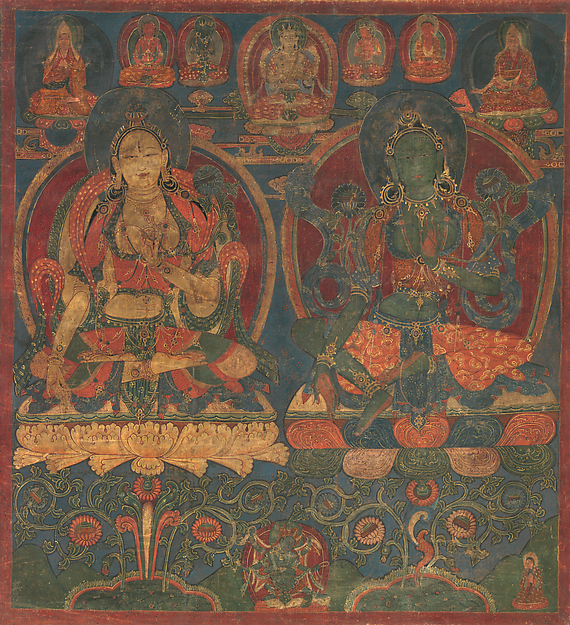
White Tārā and Green Tārā, Western Tibet, 1450–1500. Both lower a hand in the gesture of giving.
The Metropolitan Museum of Art. Western Tibet (Guge), 1450–1500. Zimmerman Family Collection, Purchase, Oscar L. Tang Gift, in honor of Agnes Hsu, 2012. Accession 2012.460. · Image source ↗ · CC0
In the library
The Gods of Northern Buddhism
Reading note
Read Alice Getty’s illustrated discussion of Green Tārā and White Tārā.
Sources
See references (6)
- The Gods of Northern Buddhism, printed p. 120, Reader page 168Alice Getty, The Gods of Northern Buddhism, 1928 revised second edition, Munshiram Manoharlal reprint. Lumitheca Library edition IMJ-0597-E001.Read this page in The Gods of Northern Buddhism ↗
- The Gods of Northern Buddhism, printed p. 122, Reader page 170Alice Getty, The Gods of Northern Buddhism, 1928 revised second edition, Munshiram Manoharlal reprint. Lumitheca Library edition IMJ-0597-E001.Read this page in The Gods of Northern Buddhism ↗
- The Gods of Northern Buddhism, printed p. 123, Reader page 171Alice Getty, The Gods of Northern Buddhism, 1928 revised second edition, Munshiram Manoharlal reprint. Lumitheca Library edition IMJ-0597-E001.Read this page in The Gods of Northern Buddhism ↗
- The Gods of Northern Buddhism, printed p. 124, Reader page 172Alice Getty, The Gods of Northern Buddhism, 1928 revised second edition, Munshiram Manoharlal reprint. Lumitheca Library edition IMJ-0597-E001.Read this page in The Gods of Northern Buddhism ↗
- Praise to Tārā with Twenty-One Verses of Homage, Toh 438, §§ 1.2–1.4 ↗Praise to Tārā with Twenty-One Verses of Homage, Toh 438, §§ 1.2–1.4. Translation credit: Samye Translations, Stefan Mang and Peter Woods. Published by 84000.
- White Tara and Green Tara ↗The Metropolitan Museum of Art. Western Tibet (Guge), 1450–1500. Zimmerman Family Collection, Purchase, Oscar L. Tang Gift, in honor of Agnes Hsu, 2012. Accession 2012.460.