Gravitation and Radiation in Walter Russell
Walter Russell pairs gravitation with radiation as formation and dissolution. Follow his falling apple example and how it differs from Newton’s law.
In this article
Gathering and dispersal
Gravitation and radiation are opposing tendencies in Walter Russell’s cosmology. He uses them to explain how matter gathers into a form and how it later disperses. [3][4][5]
The Universal One by Walter Russell
In The Universal One, Walter Russell associates gravitation with generation and concentration, which he assigns to electricity. He associates radiation with degeneration and expansion, which he assigns to magnetism. He uses the two tendencies to account for the life of a form. [3][6][5]
A falling apple gives him an example of accumulated matter moving toward greater potential. As it decays, its products disperse. Russell calls that second movement radiation, and he uses the pair to argue that masses have relative powers of attraction and repulsion. [4][7][8][9]
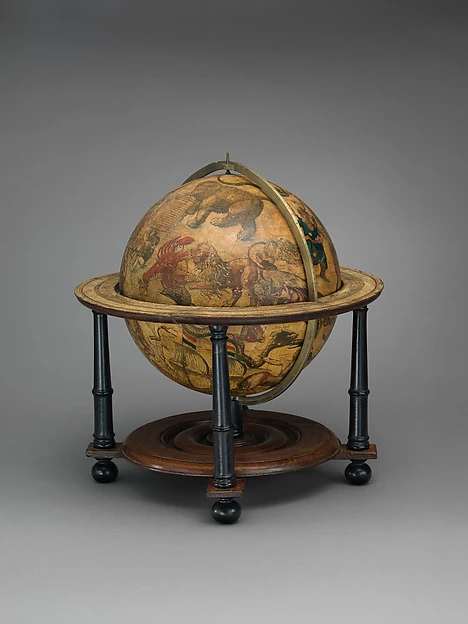
A historical celestial globe maps positions in the sky. Russell develops his own account of motion using the opposing tendencies he calls gravitation and radiation.
Willem Jansz Blaeu, Celestial Globe. The Metropolitan Museum of Art. Purchase, Friends of European Sculpture and Decorative Arts Gifts, 1990. · Image source ↗ · CC0
See references (7)
- The Universal One, printed p. 35, Reader page 34
- The Universal One, printed p. 167, Reader page 166
- The Universal One, printed p. 183, Reader page 182
- The Universal One, printed p. 102, Reader page 101
- The Universal One, printed p. 184, Reader page 183
- The Universal One, printed p. 185, Reader page 184
- The Universal One, printed p. 191, Reader page 190
What the falling apple illustrates
In Newton’s law of gravitation, the force depends on the masses and falls off with the square of their separation. Russell treats the apple’s fall and decay as complementary stages. In Newtonian mechanics, the law of gravitation concerns the fall. [4][5][7][9][2]
In the library
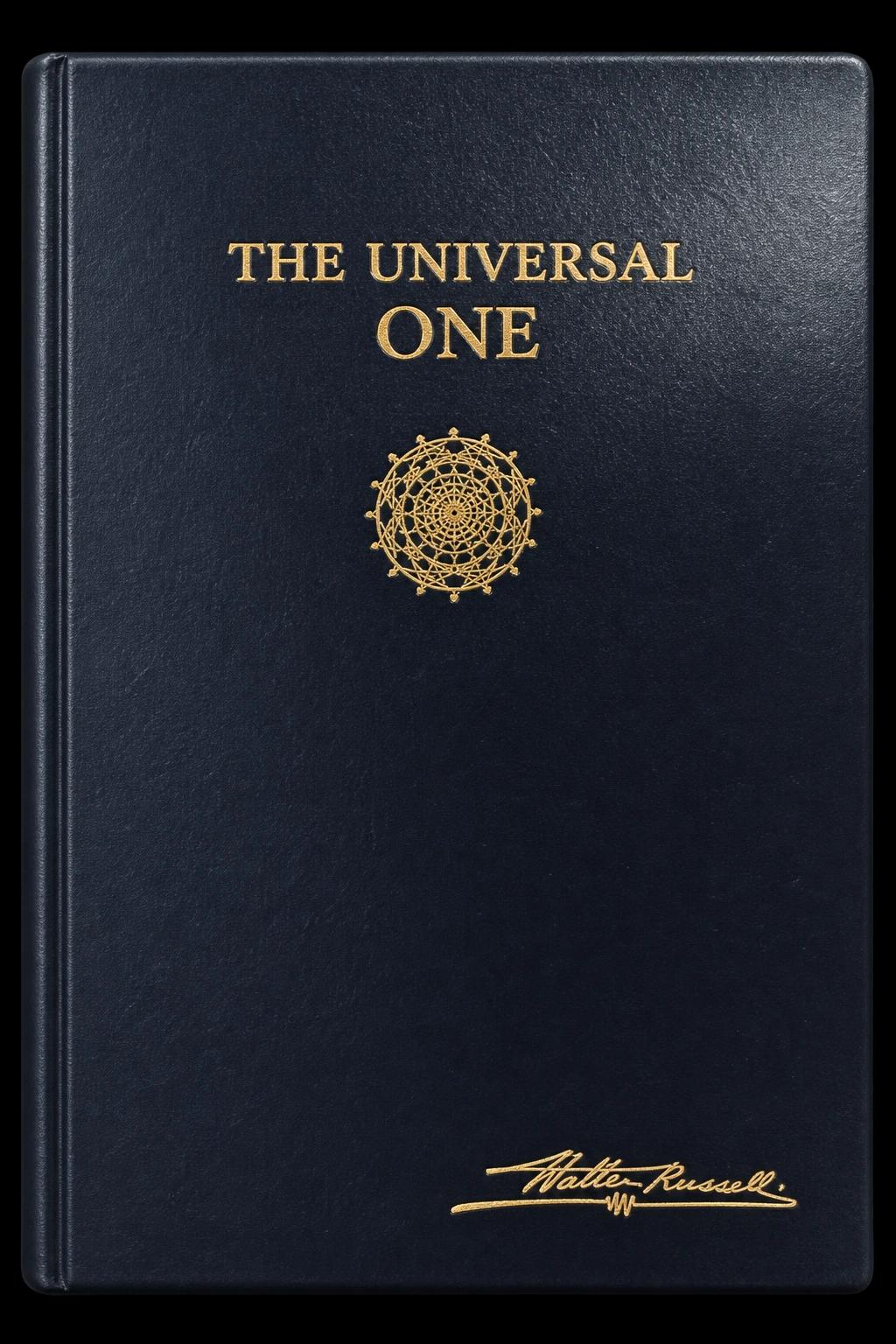
The Universal One
Reading note
The separately titled account draws on exact passages in the consulted Library edition.
Sources
See references (9)
- Willem Jansz Blaeu, Celestial Globe ↗Willem Jansz Blaeu, Celestial Globe. The Metropolitan Museum of Art. Purchase, Friends of European Sculpture and Decorative Arts Gifts, 1990.
- NASA Heliophysics, Newton’s Law of Gravity ↗NASA Heliophysics Education Activation Team, Heliophysics Big Idea 1.1, Newton’s Law of Gravity.
- The Universal One, printed p. 35, Reader page 34Walter Russell, The Universal One, edited by Louise Russell, University of Science and Philosophy, Limited Edition De Luxe. Lumitheca Library edition IMJ-0605-E001.Read this page in The Universal One ↗
- The Universal One, printed p. 167, Reader page 166Walter Russell, The Universal One, edited by Louise Russell, University of Science and Philosophy, Limited Edition De Luxe. Lumitheca Library edition IMJ-0605-E001.Read this page in The Universal One ↗
- The Universal One, printed p. 183, Reader page 182Walter Russell, The Universal One, edited by Louise Russell, University of Science and Philosophy, Limited Edition De Luxe. Lumitheca Library edition IMJ-0605-E001.Read this page in The Universal One ↗
- The Universal One, printed p. 102, Reader page 101Walter Russell, The Universal One, edited by Louise Russell, University of Science and Philosophy, Limited Edition De Luxe. Lumitheca Library edition IMJ-0605-E001.Read this page in The Universal One ↗
- The Universal One, printed p. 184, Reader page 183Walter Russell, The Universal One, edited by Louise Russell, University of Science and Philosophy, Limited Edition De Luxe. Lumitheca Library edition IMJ-0605-E001.Read this page in The Universal One ↗
- The Universal One, printed p. 185, Reader page 184Walter Russell, The Universal One, edited by Louise Russell, University of Science and Philosophy, Limited Edition De Luxe. Lumitheca Library edition IMJ-0605-E001.Read this page in The Universal One ↗
- The Universal One, printed p. 191, Reader page 190Walter Russell, The Universal One, edited by Louise Russell, University of Science and Philosophy, Limited Edition De Luxe. Lumitheca Library edition IMJ-0605-E001.Read this page in The Universal One ↗