The Gospel of Thomas: What It Contains and Where to Start
Start reading the Gospel of Thomas with a searchable saying index, Gospel parallels, and an illustrated guide to the Coptic and Greek manuscripts.
In this article
Read Thomas by saying number
The numbers follow the modern division of the Coptic manuscript. The descriptions are short paraphrases, with links into Mark M. Mattison’s public-domain translation.
What the Gospel of Thomas contains
The Gospel of Thomas is a collection of sayings attributed to Jesus. The nearly complete Coptic copy in Nag Hammadi Codex II is conventionally divided into 114 sayings by modern editors. It opens with an attribution to Didymos Judas Thomas and ends with a title naming Thomas. The collection moves among short sayings, questions, conversations and parables. It has no continuous account of Jesus’ ministry, trial or resurrection. [3][4][2][5]
The opening attribution tells us how the writing presents itself. The name and the age of the surviving copy leave the historical author and date of composition open. A Greek scrap and a Coptic codex can establish that particular words were circulating in different languages. They give only part of the evidence needed to reconstruct when the sayings first came together. [5][6][9]
See references (6)
- Coptic Scriptorium · Gospel of Thomas, Coptic edition
- Nag Hammadi Codex II · Opening of Thomas, page 32
- Nag Hammadi Codex II · Closing title, pages 50–51
- Gospel of Thomas · Manuscript inventory and introduction
- Bodleian Library · P.Oxy. I 1, MS. Gr. th. e. 7 (P)
- The Sayings of Jesus (Logia Jesou) · The Greek leaf and its context
Where to start reading the sayings
Read sayings 1–3 together. The opening makes interpretation part of the reader’s task. Saying 2 puts discovery on the far side of a search and introduces disturbance as part of finding. Saying 3 contrasts places in the sky and sea with a different account of where the kingdom is, then turns to self-knowledge. The three sayings make a useful first group because they put different questions to the reader. [17][18][19]
Then read a familiar example and an unfamiliar one. Saying 9, the sower, gives an immediate point of comparison with Mark. Saying 97 describes a woman who arrives home with an empty jar without noticing the flour she lost on the road. It leaves the reader to work out how that ordinary accident can picture the kingdom. The search above can take you to either saying by number or image. [21][12][29]
How to compare Thomas with Matthew, Mark and Luke
The sower is a useful first comparison. Thomas 9 and Mark 4 describe seed falling on several kinds of ground. In Mark, the parable sits within a larger episode and an explanation follows. Thomas moves on to the next saying. The shared image makes the parallel easy to spot, while the arrangement changes what the reader is given to interpret. [21][12]
Thomas 20 and Mark 4:30–32 both use a mustard seed whose growth makes room for birds. Compare the frame around the image. In Thomas the disciples request a comparison for the kingdom, while in Mark Jesus poses the question. Thomas 26 retains the contrast between a small impediment in another person’s eye and a much larger one in one’s own, a saying also found in Matthew 7 and Luke 6. [22][13][23][14][15]
Try a comparison with more moving pieces. Thomas 64 and Luke 14 each give reasons invited guests decline a dinner and each opens the invitation to other people. Their lists of excuses and endings differ. Resemblance gives a clear basis for comparison. The direction of dependence and the role of oral transmission remain historical questions beyond any one parallel. [27][16][5]
See references (10)
- Gospel of Thomas · Manuscript inventory and introduction
- Mark 4:1–20 · The sower and its interpretation
- Mark 4:30–32 · The mustard seed
- Matthew 7:1–5 · The speck and the beam
- Luke 6:20 and 41–42 · The poor and the speck
- Luke 14:15–24 · The dinner invitation
- Thomas 9 · The sower
- Thomas 20 · The mustard seed
- Thomas 26 · The speck and the beam
- Thomas 64 · The dinner invitation
What survives in Greek and Coptic
The Coptic Gospel of Thomas occupies pages 32–51 of Nag Hammadi Codex II, in a fourth-century manuscript found in Egypt in 1945. The Claremont archive lets you compare its photographed opening with the closing title. The Greek witnesses are earlier fragments from Oxyrhynchus. P.Oxy. 654 includes part of the opening and the first few sayings, and P.Oxy. 655 contains portions of other sayings. Modern numbers refer to the Coptic arrangement. [3][4][5][7][8]
P.Oxy. 1 preserves a single leaf of a Greek codex, with writing on both sides. Grenfell and Hunt published it in 1897 before the Coptic copy was known. The two plates reproduce that publication’s views of the verso and recto. Compare the damaged edges with the dark, more legible runs of ink. Editors use brackets to distinguish a restoration from text they can read. A fragment’s missing lines can leave more than one reading open. [6][10][9][8]
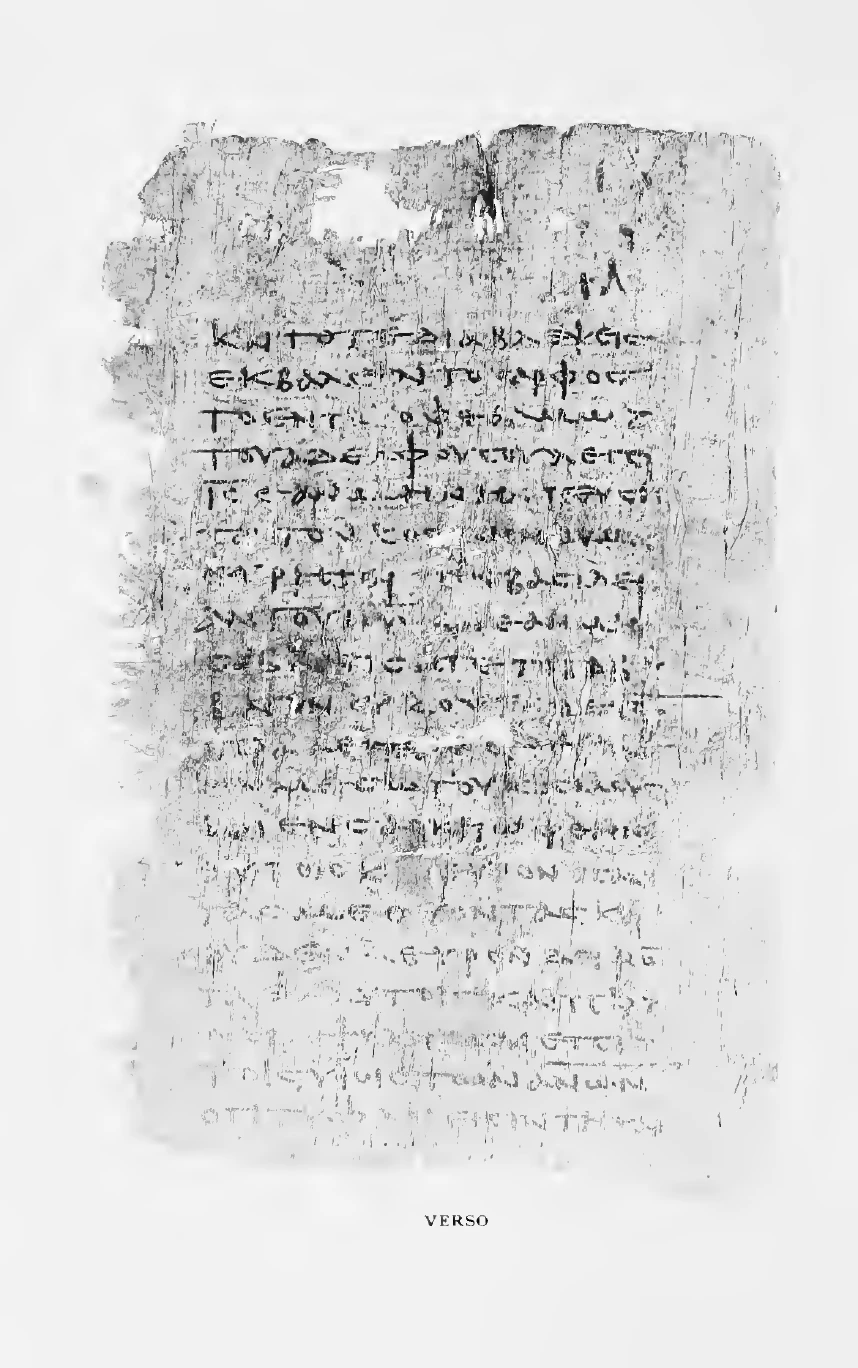
P.Oxy. I 1, verso, reproduced in Grenfell and Hunt’s 1897 edition. A single papyrus leaf preserves writing on both faces.
B. P. Grenfell and A. S. Hunt, Logia Iesou: Sayings of Our Lord from an Early Greek Papyrus, Egypt Exploration Fund, 1897. Cornell University Library copy, digitised by Internet Archive. · Image source ↗ · Public Domain
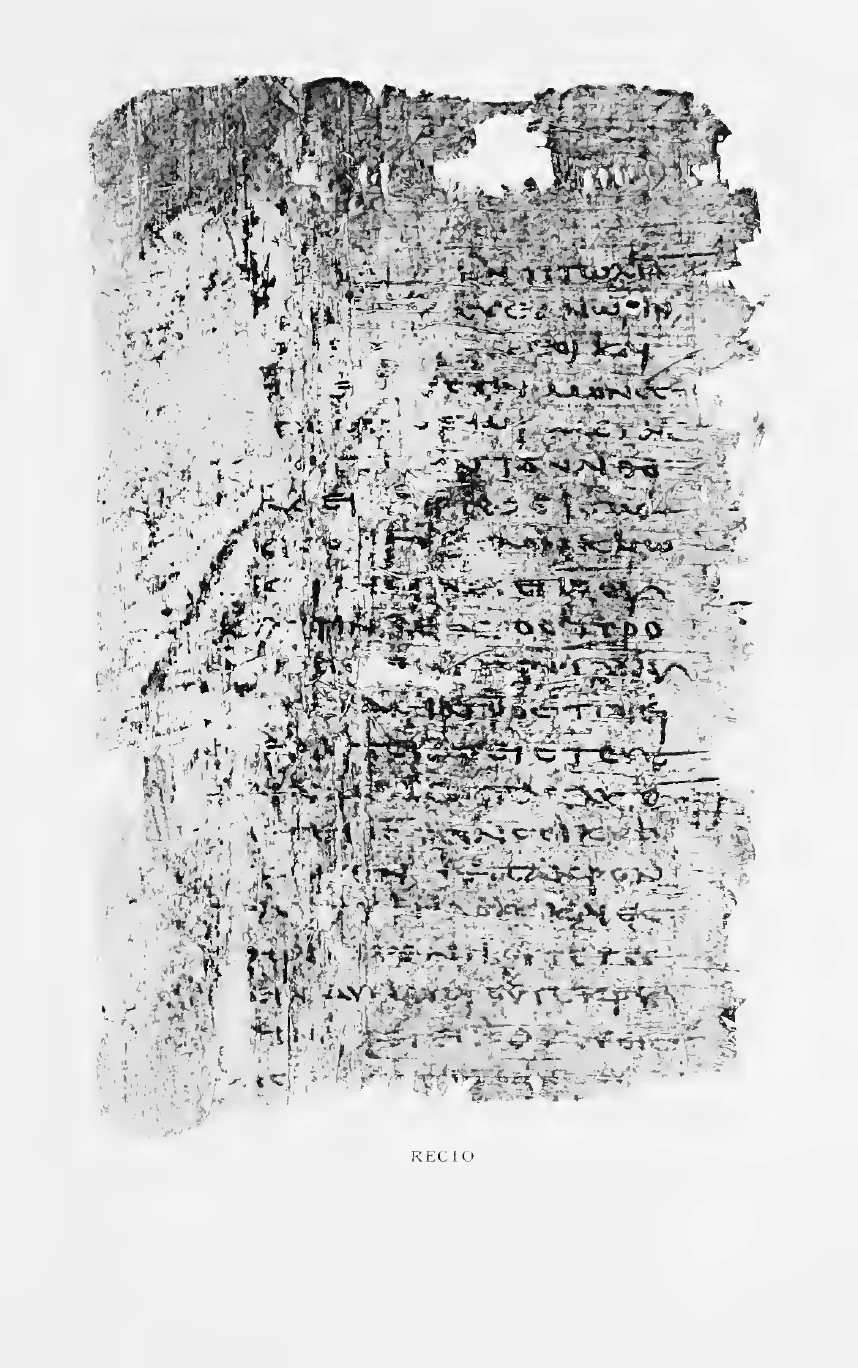
P.Oxy. I 1, recto, reproduced in Grenfell and Hunt’s 1897 edition. A single papyrus leaf preserves writing on both faces.
B. P. Grenfell and A. S. Hunt, Logia Iesou: Sayings of Our Lord from an Early Greek Papyrus, Egypt Exploration Fund, 1897. Cornell University Library copy, digitised by Internet Archive. · Image source ↗ · Public Domain
See references (8)
- Nag Hammadi Codex II · Opening of Thomas, page 32
- Nag Hammadi Codex II · Closing title, pages 50–51
- Gospel of Thomas · Manuscript inventory and introduction
- Bodleian Library · P.Oxy. I 1, MS. Gr. th. e. 7 (P)
- Greek opening of Thomas in P.Oxy. IV 654
- Greek reconstructions of P.Oxy. 1, 654 and 655
- The Sayings of Jesus (Logia Jesou) · The Greek leaf and its context
- Grenfell and Hunt · The 1897 reproduction, verso and recto
Where the Greek and Coptic witnesses differ
Use the line about wood and stone as a test case. In the Coptic copy it occurs inside saying 77, after an opening about light and the All. The Greek P.Oxy. 1 places the surviving wood-and-stone lines beside material corresponding to the earlier saying 30. The match helps identify the scraps as Thomas. The different placement shows that the order in the fuller Coptic copy cannot be read back into every Greek witness. [28][6][8][9]
P.Oxy. 654 takes you back to the opening. It preserves only portions of the early sayings, so a translation of the fragment may mark a place as broken where the Coptic copy supplies a full sentence. When comparing the editions, check whether an apparent difference is one of wording, sequence, or simply what has survived on the leaf. [7][8][17][18][19]
See references (8)
- Bodleian Library · P.Oxy. I 1, MS. Gr. th. e. 7 (P)
- Greek opening of Thomas in P.Oxy. IV 654
- Greek reconstructions of P.Oxy. 1, 654 and 655
- The Sayings of Jesus (Logia Jesou) · The Greek leaf and its context
- Thomas 1 · The promise in the opening
- Thomas 2 · Seeking, disturbance and discovery
- Thomas 3 · The kingdom and self-knowledge
- Thomas 77 · Light, wood and stone
Reading Thomas as a noncanonical gospel
The closing title shows that the Coptic copy calls the work a gospel. Its form is a sayings collection, and its textual history belongs alongside the wider study of early Christian writings. The familiar labels apocryphal and Gnostic refer to different questions about canon and interpretation. Start with what each passage says and which source preserves it, then use a named historical argument to make sense of any larger label. [4][5][2]
Saying 114 is a useful place to practise that approach. It places a dispute about Mary and women in the mouths of Peter and Jesus. The resolution uses language about becoming male that readers have explained in different ways. The wording belongs to this collection’s closing exchange. Read it in context and keep the response of a modern reader, the ancient speaker and the history of interpretation identifiable. [30][2][5]
Sources
See references (30)
- Mark M. Mattison · The Gospel of Thomas, public-domain English translation ↗Gospels.net, translation of Nag Hammadi Codex II, tractate 2.
- Coptic Scriptorium · Gospel of Thomas, Coptic edition ↗Edition and primary annotations by Paul C. Dilley and the Coptic Scriptorium team.Return to text ↑
- Nag Hammadi Codex II · Opening of Thomas, page 32 ↗Claremont Colleges Digital Library, Nag Hammadi Archive.Return to text ↑
- Nag Hammadi Codex II · Closing title, pages 50–51 ↗Claremont Colleges Digital Library, Nag Hammadi Archive.Return to text ↑
- Gospel of Thomas · Manuscript inventory and introduction ↗North American Society for the Study of Christian Apocryphal Literature, e-Clavis.Return to text ↑
- Bodleian Library · P.Oxy. I 1, MS. Gr. th. e. 7 (P) ↗Bodleian Libraries, University of Oxford, catalogue and facsimile.Return to text ↑
- Greek opening of Thomas in P.Oxy. IV 654 ↗NASSCAL catalogue of British Library Papyrus 1531.Return to text ↑
- Greek reconstructions of P.Oxy. 1, 654 and 655 ↗Andrew Bernhard, Greek texts and bibliography based on the facsimiles and published editions.Return to text ↑
- The Sayings of Jesus (Logia Jesou) · The Greek leaf and its context ↗Bruce C. Barker-Benfield, Smithsonian National Museum of Asian Art.Return to text ↑
- Grenfell and Hunt · The 1897 reproduction, verso and recto ↗B. P. Grenfell and A. S. Hunt, Logia Iesou: Sayings of Our Lord from an Early Greek Papyrus, Egypt Exploration Fund, 1897. Cornell University Library copy, digitised by Internet Archive.Return to text ↑
- The 1897 edition’s public-domain record ↗B. P. Grenfell and A. S. Hunt, Logia Iesou: Sayings of Our Lord from an Early Greek Papyrus, Egypt Exploration Fund, 1897. Cornell University Library copy, digitised by Internet Archive.
- Mark 4:1–20 · The sower and its interpretation ↗New American Bible, Revised Edition, United States Conference of Catholic Bishops.Return to text ↑
- Mark 4:30–32 · The mustard seed ↗New American Bible, Revised Edition, United States Conference of Catholic Bishops.Return to text ↑
- Matthew 7:1–5 · The speck and the beam ↗New American Bible, Revised Edition, United States Conference of Catholic Bishops.Return to text ↑
- Luke 6:20 and 41–42 · The poor and the speck ↗New American Bible, Revised Edition, United States Conference of Catholic Bishops.Return to text ↑
- Luke 14:15–24 · The dinner invitation ↗New American Bible, Revised Edition, United States Conference of Catholic Bishops.Return to text ↑
- Thomas 1 · The promise in the opening ↗Mark M. Mattison’s English translation from the Coptic, dedicated to the public domain.Return to text ↑
- Thomas 2 · Seeking, disturbance and discovery ↗Mark M. Mattison’s English translation from the Coptic, dedicated to the public domain.Return to text ↑
- Thomas 3 · The kingdom and self-knowledge ↗Mark M. Mattison’s English translation from the Coptic, dedicated to the public domain.Return to text ↑
- Thomas 5 · What becomes visible ↗Mark M. Mattison’s English translation from the Coptic, dedicated to the public domain.
- Thomas 9 · The sower ↗Mark M. Mattison’s English translation from the Coptic, dedicated to the public domain.Return to text ↑
- Thomas 20 · The mustard seed ↗Mark M. Mattison’s English translation from the Coptic, dedicated to the public domain.Return to text ↑
- Thomas 26 · The speck and the beam ↗Mark M. Mattison’s English translation from the Coptic, dedicated to the public domain.Return to text ↑
- Thomas 31 · The prophet and doctor ↗Mark M. Mattison’s English translation from the Coptic, dedicated to the public domain.
- Thomas 36 · Anxiety about clothing ↗Mark M. Mattison’s English translation from the Coptic, dedicated to the public domain.
- Thomas 54 · The poor ↗Mark M. Mattison’s English translation from the Coptic, dedicated to the public domain.
- Thomas 64 · The dinner invitation ↗Mark M. Mattison’s English translation from the Coptic, dedicated to the public domain.Return to text ↑
- Thomas 77 · Light, wood and stone ↗Mark M. Mattison’s English translation from the Coptic, dedicated to the public domain.Return to text ↑
- Thomas 97 · The empty jar ↗Mark M. Mattison’s English translation from the Coptic, dedicated to the public domain.Return to text ↑
- Thomas 114 · Peter and Mary ↗Mark M. Mattison’s English translation from the Coptic, dedicated to the public domain.Return to text ↑