Gilgamesh and Noah: The Flood Stories Side by Side
Compare the flood stories in Tablet XI of Gilgamesh and Genesis. Follow both boats, their birds and landing places, and the different promises after the flood.
In this article
Two flood stories side by side
Compare the same moments in both texts, from the warning to the promise after the flood.
The warning, the birds and the ending
The chart summarises Tablet XI and Genesis 6–9. The links open the sources.
Who warns the survivor?
- Epic of Gilgamesh, Tablet XI
- Ea speaks through the wall of the dwelling. The gods have different roles and disagree over the consequences.
- Genesis 6–9
- God warns Noah directly and gives the dimensions of the ark.
Where does the vessel settle?
- Epic of Gilgamesh, Tablet XI
- Mount Nimush, rendered Nizir by Smith.
- Genesis 6–9
- The mountains of Ararat.
What order do the birds go out in?
- Epic of Gilgamesh, Tablet XI
- Dove, swallow, raven. The raven stays out.
- Genesis 6–9
- Raven, then a dove sent three times. The olive leaf appears on the second flight.
What changes after the flood?
- Epic of Gilgamesh, Tablet XI
- Utnapishtim and his wife are granted an exceptional life apart from others.
- Genesis 6–9
- God makes a covenant with Noah, his descendants and living creatures. The rainbow is its sign.
Who survives the flood in Gilgamesh and Genesis?
Utnapishtim survives the flood in Tablet XI of the Epic of Gilgamesh. He tells the story to Gilgamesh, who has come looking for a way to escape death. In Genesis, Noah is the person warned about the flood and takes his household into the ark. Start with the speakers. A survivor is answering a visitor’s question in the epic, while Genesis narrates Noah’s actions as part of its account of humanity. [1][4][5]
Ea warns the flood survivor indirectly through the wall of his dwelling. The episode belongs to a world in which gods can disagree. Genesis speaks of one God who sees human wickedness, warns Noah and gives instructions for the ark. Both narratives organise the rescue around foreknowledge given to one household. Their accounts of where that knowledge comes from are very different. [1][4]
Boats, landing places and the order of the birds
Both texts give unusually concrete instructions for a vessel. Noah’s ark is much longer than it is wide, with three decks described in Genesis 6. The Babylonian boat as described in Tablet XI has equal length and breadth, with several levels. That difference is easy to lose in a retelling that begins with a picture of Noah’s ark and uses it for both accounts. [1][4]
In the Babylonian account, the boat comes to rest at a mountain called Nizir in Smith’s old rendering, often called Mount Nimush in newer editions. Utnapishtim sends a dove, then a swallow, then a raven. The raven stays out. Genesis places the ark on the mountains of Ararat and gives Noah a raven first. The dove returns with an olive leaf on its second outing and stays away on its third. The bird tests land in both stories, but the species, order and signals are different. [1][6]
Why the endings matter for the comparison
Both survivors make an offering. In Tablet XI several gods gather around it, and the aftermath leads to Utnapishtim and his wife being granted a special life far away. That outcome matters because Gilgamesh is asking about his own mortality. The privilege turns out to belong to exceptional circumstances rather than to a procedure Gilgamesh can repeat. [1]
In Genesis the aftermath reaches beyond Noah’s family. God makes a covenant with Noah, his descendants and the living creatures of the earth. The rainbow serves as a sign. Read chapters 8 and 9 together to follow the story from the sacrifice to that public promise. [6][7]
Read the clay tablet beside George Smith’s translation
The British Museum’s Flood Tablet is a surviving Neo-Assyrian copy from Nineveh. Its date belongs to the physical copy. It is separate from the age of the story it transmits. In his nineteenth-century book, George Smith called the epic’s hero Izdubar. Use the Library edition to see how the first generation of translators reconstructed the text, and check later names against a modern catalogue before citing it. [2][1]
The vessel, grounding and bird tests make the relationship between the traditions worth examining. A close comparison can show shared narrative details. It cannot by itself identify a particular clay tablet as the object a biblical writer read. The identity of the survivor, the role of divine disagreement and the form of the ending show how each text uses the inherited story for its own purposes. [2][1][6][7]
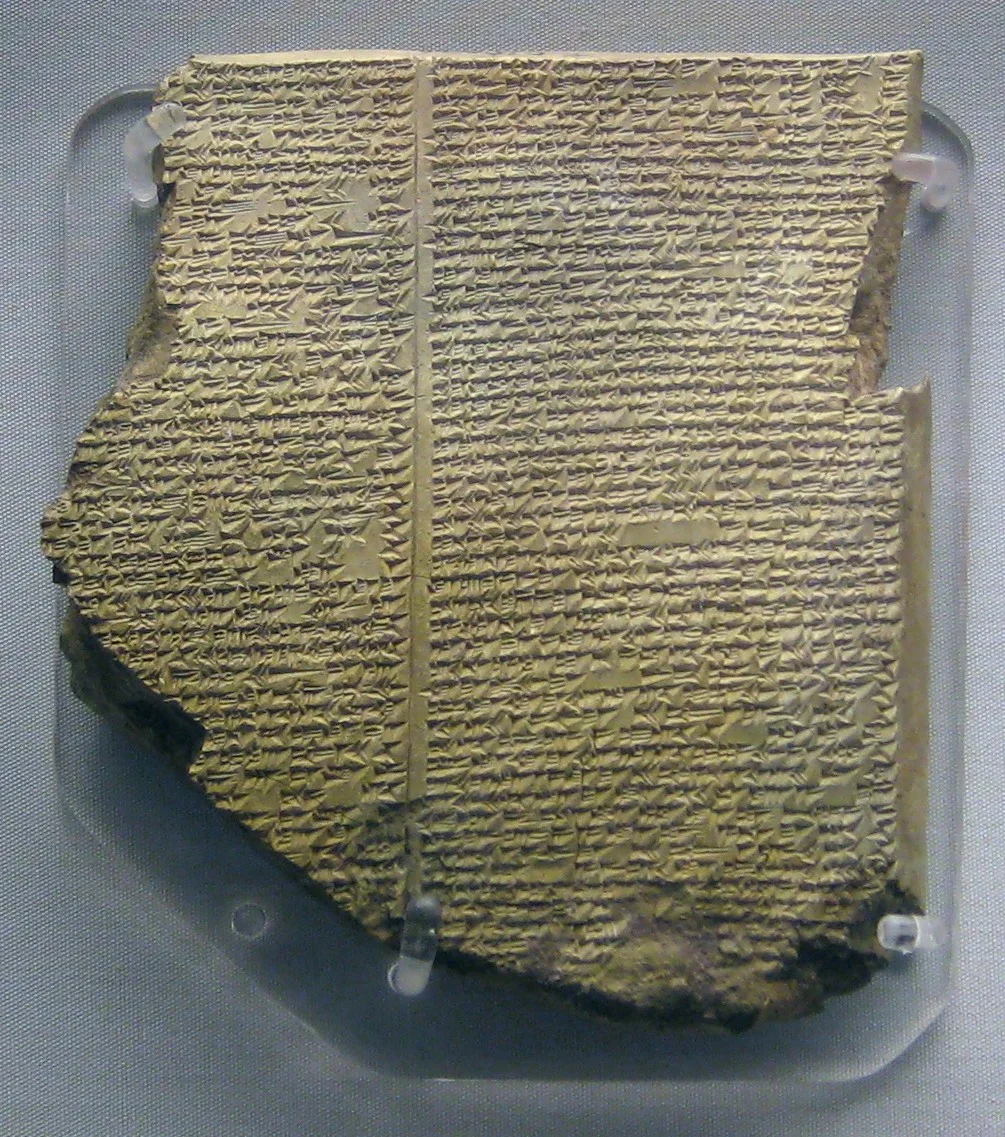
Tablet XI of the Standard Babylonian Epic of Gilgamesh. Neo-Assyrian copy from Nineveh, British Museum K.3375.
Photograph by BabelStone, Wikimedia Commons, CC0. · Image source ↗ · CC0
Read further in the library
The Chaldean Account of Genesis
Reading note
George Smith’s historical translation and comparison, including the Deluge chapter.
Sources
See references (7)
- George Smith, The Chaldean Account of Genesis, the Deluge ↗George Smith’s historical English translation, Sacred TextsReturn to text ↑
- The Flood Tablet, British Museum K.3375 ↗British Museum object record via Google Arts & CultureReturn to text ↑
- The Flood Tablet, photographed by BabelStone ↗Wikimedia Commons, CC0 photograph by BabelStone
- Genesis 6: The warning and preparations ↗New American Bible, Revised EditionReturn to text ↑
- Genesis 7: Entering the ark and the flood ↗New American Bible, Revised EditionReturn to text ↑
- Genesis 8: The birds and the sacrifice ↗New American Bible, Revised EditionReturn to text ↑
- Genesis 9: The covenant and the rainbow ↗New American Bible, Revised EditionReturn to text ↑