The Ghost and the Dog’s Tail
A ghost that must always be kept working tries to straighten a dog’s tail. Compare Vivekananda’s parable of control with Ramakrishna’s story about the ego.
In this article
Understanding the concept
The ghost and the dog’s tail is a parable about the urge to make the world conform to a plan. A man gains command of a ghost that can fulfil his wishes almost instantly. When he runs out of commands, the power he wanted becomes a danger. [2][3][4][5]
The task that finally keeps the ghost busy is to straighten a tail that curls as soon as it is released. Vivekananda uses the repeated return of the curl to ask what it costs to insist that the world stay as one person wants it. [2][3][4]
The Gospel of Sri Ramakrishna: the curly hair
In the Gospel of Sri Ramakrishna, Mahendranath Gupta’s record of the conversation on 13 June 1885 gives the ghost a curly hair to straighten. In Swami Nikhilananda’s translation, Ramakrishna compares the returning curl to an ego that appears to have vanished and then returns. [1]
Karma-Yoga by Swami Vivekananda
Swami Vivekananda introduces a poor man who wants a ghost to supply everything he desires. A sage eventually grants the request but warns that the ghost will kill its master if it is left without work. The man believes he can keep it busy indefinitely. [2]
The ghost builds a palace, supplies money and replaces a forest with a city almost as soon as each command is spoken. The man’s apparent success creates his danger: he exhausts his wishes faster than he can invent new ones and runs back to the sage for help. [3]
The sage gives the ghost a dog’s curled tail to straighten. Every time the ghost releases it, the tail curls again. After repeated failures, the exhausted spirit negotiates its freedom and promises not to harm the man. The impossible assignment breaks the cycle of threat. [3][4]
Vivekananda then makes the application explicit. He likens the world to the curling tail and criticizes fanaticism, hatred and the conviction that one’s own way must prevail. His proposed worker remains active, sympathetic and calm while relinquishing the ambition to impose a permanent final arrangement. [4][5][6]
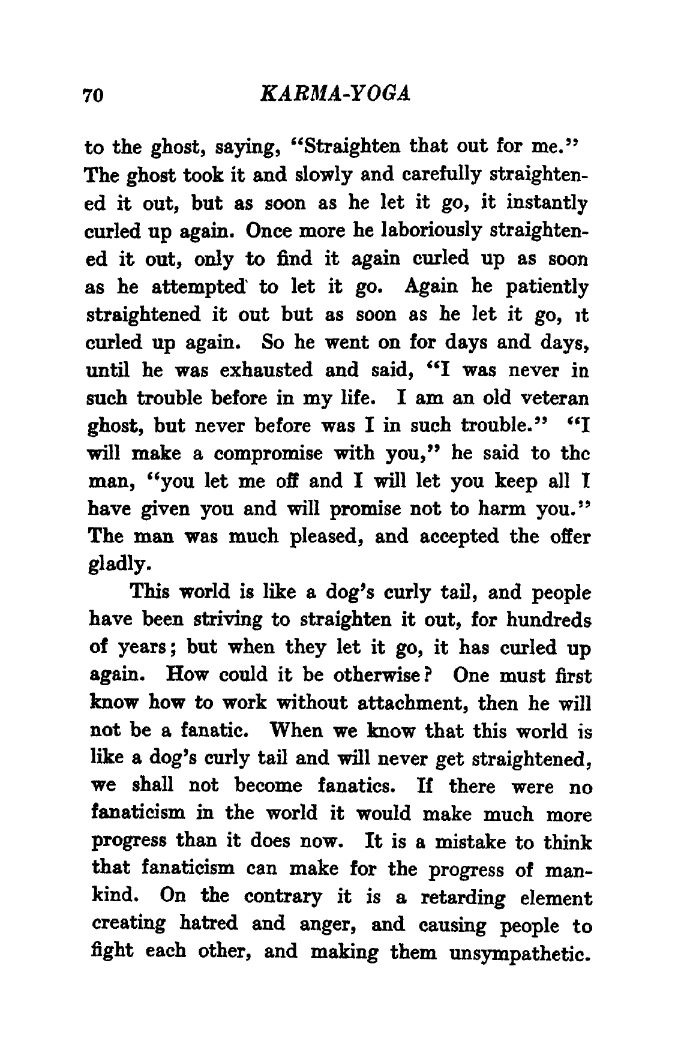
Karma-Yoga (1939), Library Reader page 72. Vivekananda applies the curling tail to the wish to straighten the whole world.
Swami Vivekananda, Karma-Yoga, English second printing in the 1939 combined volume. Historical public-domain text, exact checksum-verified Library scan. · Image source ↗ · Public Domain
The returning ego and the urge to control
Ramakrishna’s story follows the ego as it returns after apparent renunciation. Vivekananda’s story follows the would-be master as he tries to impose a permanent shape on the world. Both make the curl return and give the return a different meaning. [1][4][5]
Vivekananda’s worker still helps and pays attention to people in need. The parable asks them to give up the compulsion to force an outcome on everyone. It keeps sympathy and activity in view after the wish for control has lost its hold. [5][6]
Read further in the library
Karma Yoga
Reading note
The separately titled account draws on exact passages in the consulted Library edition.
Sources
See references (6)
- The Gospel of Sri Ramakrishna, chapter 41, At Ram’s House: conversation dated 13 June 1885 ↗Conversations of Sri Ramakrishna recorded by Mahendranath Gupta (M.), in Swami Nikhilananda’s English translation. Chapter 41, conversation dated 13 June 1885, parable of the ghost and curly hair. The translator’s preface is dated February 1942. No unverified Library pagination supplied.Return to text ↑
- Karma-Yoga, Reader page 70Swami Vivekananda, Karma-Yoga, in Karma-Yoga & Bhakti-Yoga, English second printing, Ramakrishna-Vivekananda Center of New York, Inc., 1939. Exact Library edition IMJ-0097-E002. Only the Karma-Yoga part is used in this crawl; the old Work slug mentioning Hindi does not identify this edition’s language.Read this page in Karma Yoga ↗Return to text ↑
- Karma-Yoga, Reader page 71Swami Vivekananda, Karma-Yoga, in Karma-Yoga & Bhakti-Yoga, English second printing, Ramakrishna-Vivekananda Center of New York, Inc., 1939. Exact Library edition IMJ-0097-E002. Only the Karma-Yoga part is used in this crawl; the old Work slug mentioning Hindi does not identify this edition’s language.Read this page in Karma Yoga ↗Return to text ↑
- Karma-Yoga, Reader page 72Swami Vivekananda, Karma-Yoga, in Karma-Yoga & Bhakti-Yoga, English second printing, Ramakrishna-Vivekananda Center of New York, Inc., 1939. Exact Library edition IMJ-0097-E002. Only the Karma-Yoga part is used in this crawl; the old Work slug mentioning Hindi does not identify this edition’s language.Read this page in Karma Yoga ↗Return to text ↑
- Karma-Yoga, Reader page 73Swami Vivekananda, Karma-Yoga, in Karma-Yoga & Bhakti-Yoga, English second printing, Ramakrishna-Vivekananda Center of New York, Inc., 1939. Exact Library edition IMJ-0097-E002. Only the Karma-Yoga part is used in this crawl; the old Work slug mentioning Hindi does not identify this edition’s language.Read this page in Karma Yoga ↗Return to text ↑
- Karma-Yoga, Reader page 74Swami Vivekananda, Karma-Yoga, in Karma-Yoga & Bhakti-Yoga, English second printing, Ramakrishna-Vivekananda Center of New York, Inc., 1939. Exact Library edition IMJ-0097-E002. Only the Karma-Yoga part is used in this crawl; the old Work slug mentioning Hindi does not identify this edition’s language.Read this page in Karma Yoga ↗Return to text ↑