Gates of the Sun
What were the Gates of the Sun? Compare the roles of Cancer and Capricorn in Porphyry, Macrobius and Manly P. Hall’s account of the soul.
In this article
Two thresholds for the soul
The Gates of the Sun are two thresholds in ancient accounts of the soul’s journey. They are associated with Cancer and Capricorn, the signs of the summer and winter solstices in the ancient zodiac. Cancer marks descent into bodily life. Capricorn marks ascent toward the gods. [2][3][4]
On the Cave of the Nymphs by Porphyry
In On the Cave of the Nymphs, Porphyry reads the two entrances of Homer’s cave as signs of opposite journeys. The north entrance corresponds to Cancer and descent into mortal life. The south entrance corresponds to Capricorn and ascent. [2]
Commentary on the Dream of Scipio by Macrobius
In his Commentary on the Dream of Scipio, Macrobius places the gates where he says the Milky Way and the zodiac meet. He follows the descending soul through successive spheres and gives each sphere a power that the soul acquires on its way toward embodiment. [3]
Man the Grand Symbol of the Mysteries by Manly P. Hall
In Man the Grand Symbol of the Mysteries, Manly P. Hall follows Macrobius in describing a soul that acquires different qualities as it passes through the planetary spheres on its way into a body. [5][4]
Hall goes on to compare the same seven planets with stages of human life and with parts of the body. The journey through the heavens becomes one example of how he links the person to the cosmos. [4][6]
From Homer’s cave to the planetary spheres
Porphyry starts with the entrances to a cave. Macrobius traces the soul’s descent sphere by sphere. Hall carries that sequence into a discussion of qualities he associates with the body. [5][4][6][2][3]
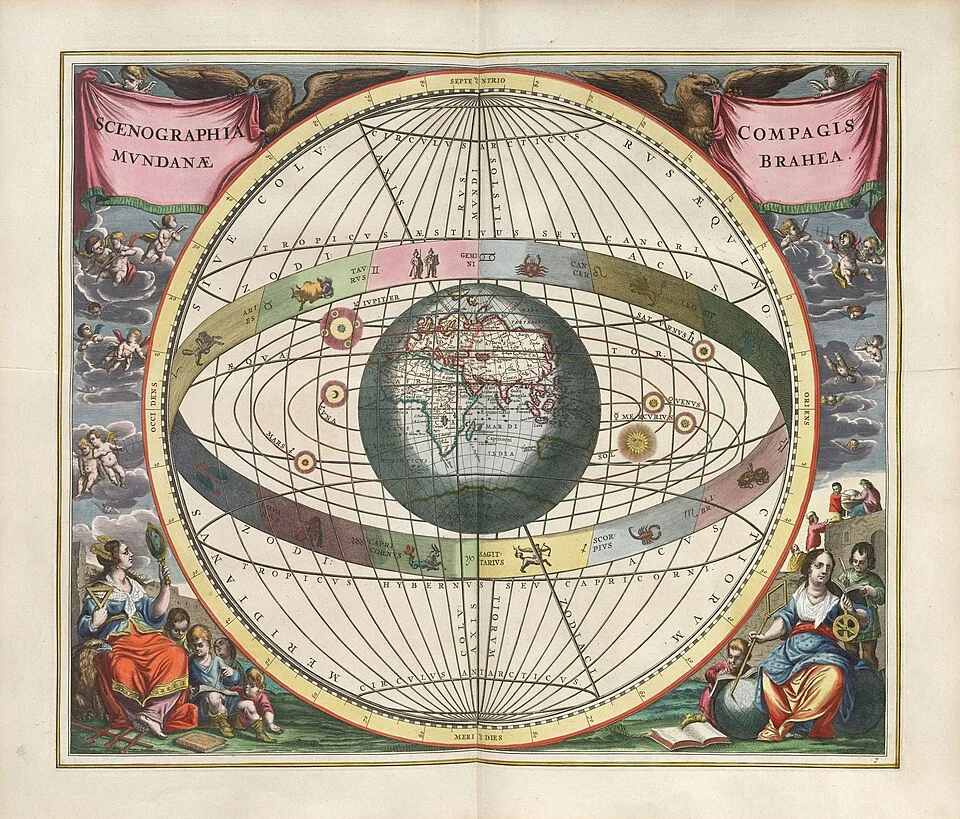
Andreas Cellarius’s later chart shows the concentric orbits of the Tychonic system. It illustrates how a celestial map can arrange planets in successive rings.
Andreas Cellarius, Scenographia Compagis Mundanae Brahea, Harmonia macrocosmica, 1660. Via Wikimedia Commons. · Image source ↗ · Public Domain
See references (5)
- On the Cave of the Nymphs, Taylor translation, printed pp. 26–29 and 32–33
- Commentary on the Dream of Scipio, I.12, pp. 133 to 137
- Man the Grand Symbol of the Mysteries, printed p. 99, Reader page 97
- Man the Grand Symbol of the Mysteries, printed p. 98, Reader page 96
- Man the Grand Symbol of the Mysteries, printed p. 100, Reader page 98
In the library
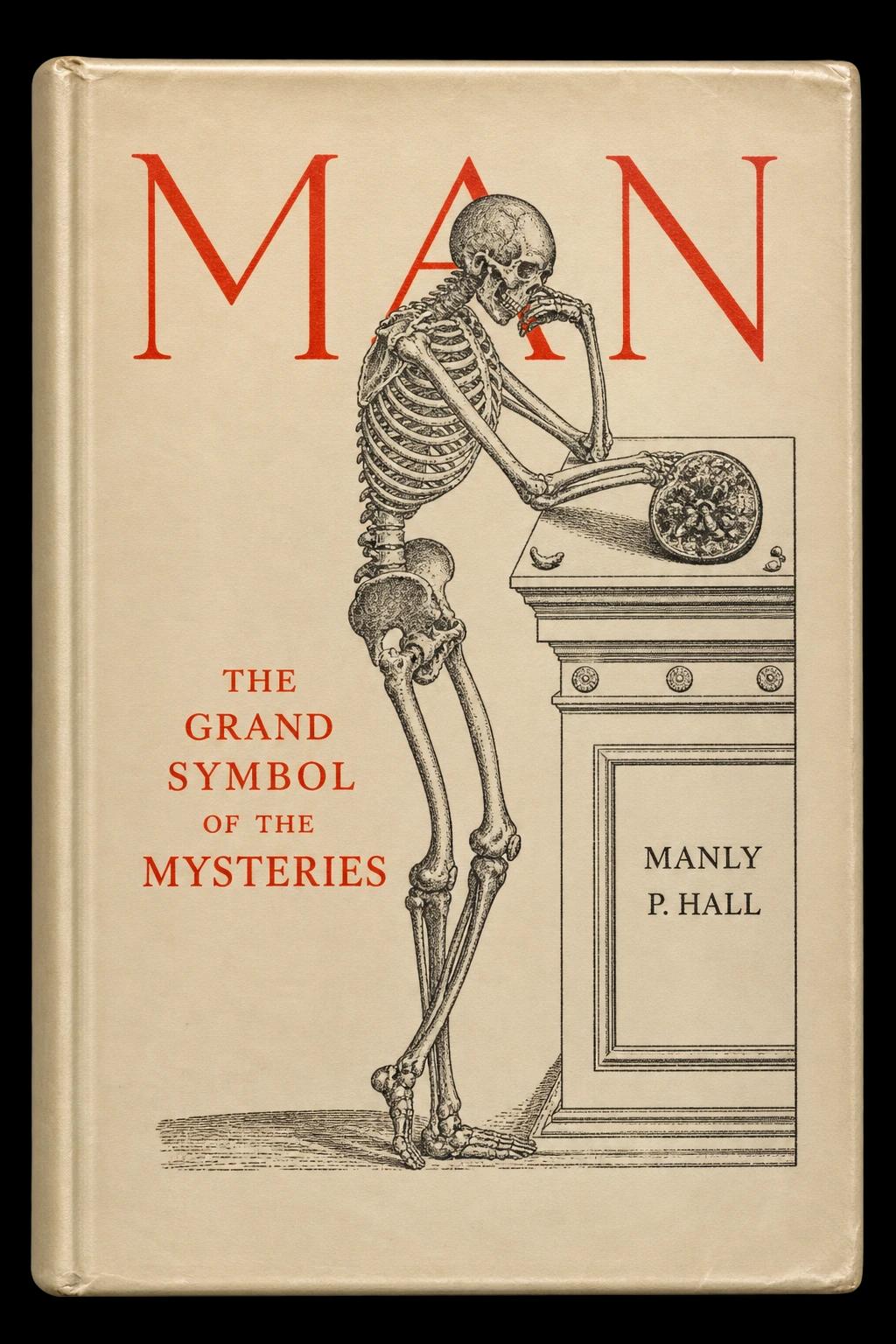
Man the Grand Symbol of the Mysteries
Reading note
The separately titled account draws on exact passages in the consulted Library edition.
Sources
See references (6)
- The Tychonic system in Harmonia macrocosmica ↗Andreas Cellarius, Scenographia Compagis Mundanae Brahea, Harmonia macrocosmica, 1660. Via Wikimedia Commons.
- On the Cave of the Nymphs, Taylor translation, printed pp. 26–29 and 32–33 ↗Porphyry, On the Cave of the Nymphs, translation by Thomas Taylor, 1917 edition.
- Commentary on the Dream of Scipio, I.12, pp. 133 to 137 ↗Macrobius, Commentary on the Dream of Scipio I.12, translated by William Harris Stahl, Columbia University Press, 1952.
- Man the Grand Symbol of the Mysteries, printed p. 99, Reader page 97Manly P. Hall, Man the Grand Symbol of the Mysteries, Fourth Edition, The Philosophers Press, Los Angeles, 1937. Lumitheca Library edition IMJ-0603-E001.Read this page in Man the Grand Symbol of the Mysteries ↗
- Man the Grand Symbol of the Mysteries, printed p. 98, Reader page 96Manly P. Hall, Man the Grand Symbol of the Mysteries, Fourth Edition, The Philosophers Press, Los Angeles, 1937. Lumitheca Library edition IMJ-0603-E001.Read this page in Man the Grand Symbol of the Mysteries ↗
- Man the Grand Symbol of the Mysteries, printed p. 100, Reader page 98Manly P. Hall, Man the Grand Symbol of the Mysteries, Fourth Edition, The Philosophers Press, Los Angeles, 1937. Lumitheca Library edition IMJ-0603-E001.Read this page in Man the Grand Symbol of the Mysteries ↗