The Four Vehicles of Generation
Explore Manly P. Hall’s fourfold account of generation and how he compares it with the four worlds of Jewish Kabbalah.
In this article
Four stages from spirit to body
The four vehicles of generation are steps in Manly P. Hall’s esoteric explanation of how a spiritual cause reaches bodily form. The sequence runs from a hidden cause through a spiritual impulse and an astral agent to a physical carrier. [3][4]
Man the Grand Symbol of the Mysteries by Manly P. Hall
In Man the Grand Symbol of the Mysteries, Hall begins with the idea that generation has a spiritual source. He calls its cause the tincture, its impulse the liquor vitae, its astral agent the aura seminalis and its physical carrier the sperm. [5][3][4]
Hall aligns these four steps with the Kabbalistic worlds from Atzilut to Asiyah. Later in the chapter, he describes a separate set of three forces he associates with the germ: spiritual, psychical and material. [4][6][7]
See references (5)
- Man the Grand Symbol of the Mysteries, printed p. 129, Reader page 127
- Man the Grand Symbol of the Mysteries, printed p. 130, Reader page 128
- Man the Grand Symbol of the Mysteries, printed p. 128, Reader page 126
- Man the Grand Symbol of the Mysteries, printed p. 132, Reader page 130
- Man the Grand Symbol of the Mysteries, printed p. 133, Reader page 131
Sha’arei Kedusha by Chaim Vital
In Sha’arei Kedusha, Chaim Vital describes four worlds, Atzilut, Beriah, Yetzirah and Asiyah. He relates them to the four letters of the divine name in an account of how the worlds are ordered. [2]
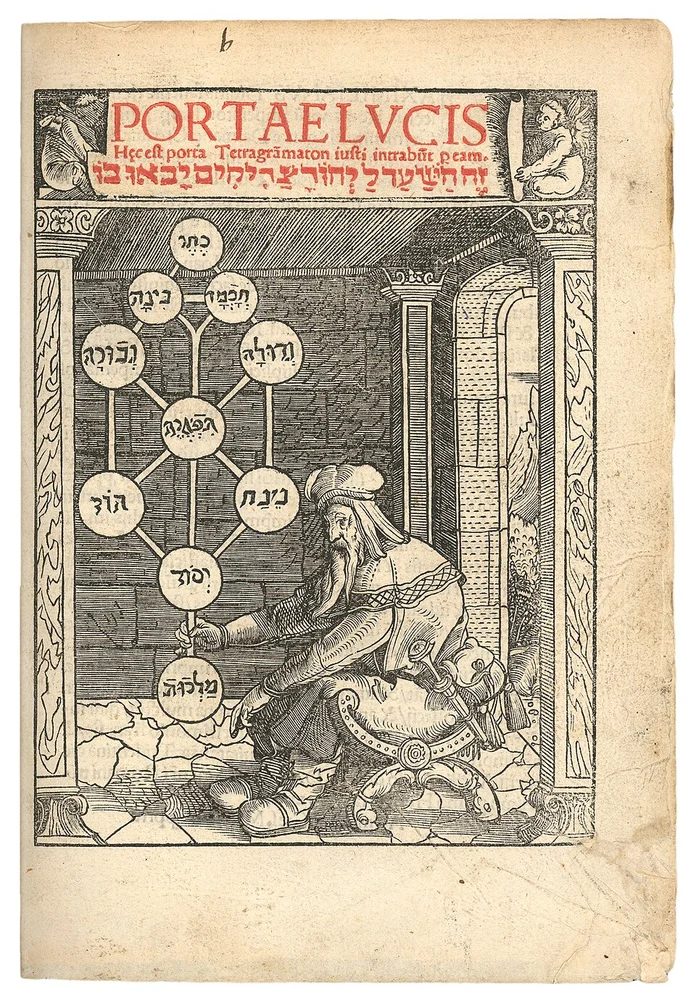
The 1516 Latin Porta Lucis depicts the ten sefirot. The engraving belongs to a separate Kabbalistic work and gives context for the tradition Hall draws on.
Joseph Gikatilla, Porta Lucis, abridged Latin translation by Paulus Ricius (Johann Miller, Augsburg, 1516). University Library of Nijmegen, via Wikimedia Commons. · Image source ↗ · Public Domain
What Hall borrows from Kabbalah
Vital’s four worlds describe an order of emanation and creation. Hall borrows that order to give the stages of his own theory of generation a sequence. [4][6][2]
In the library
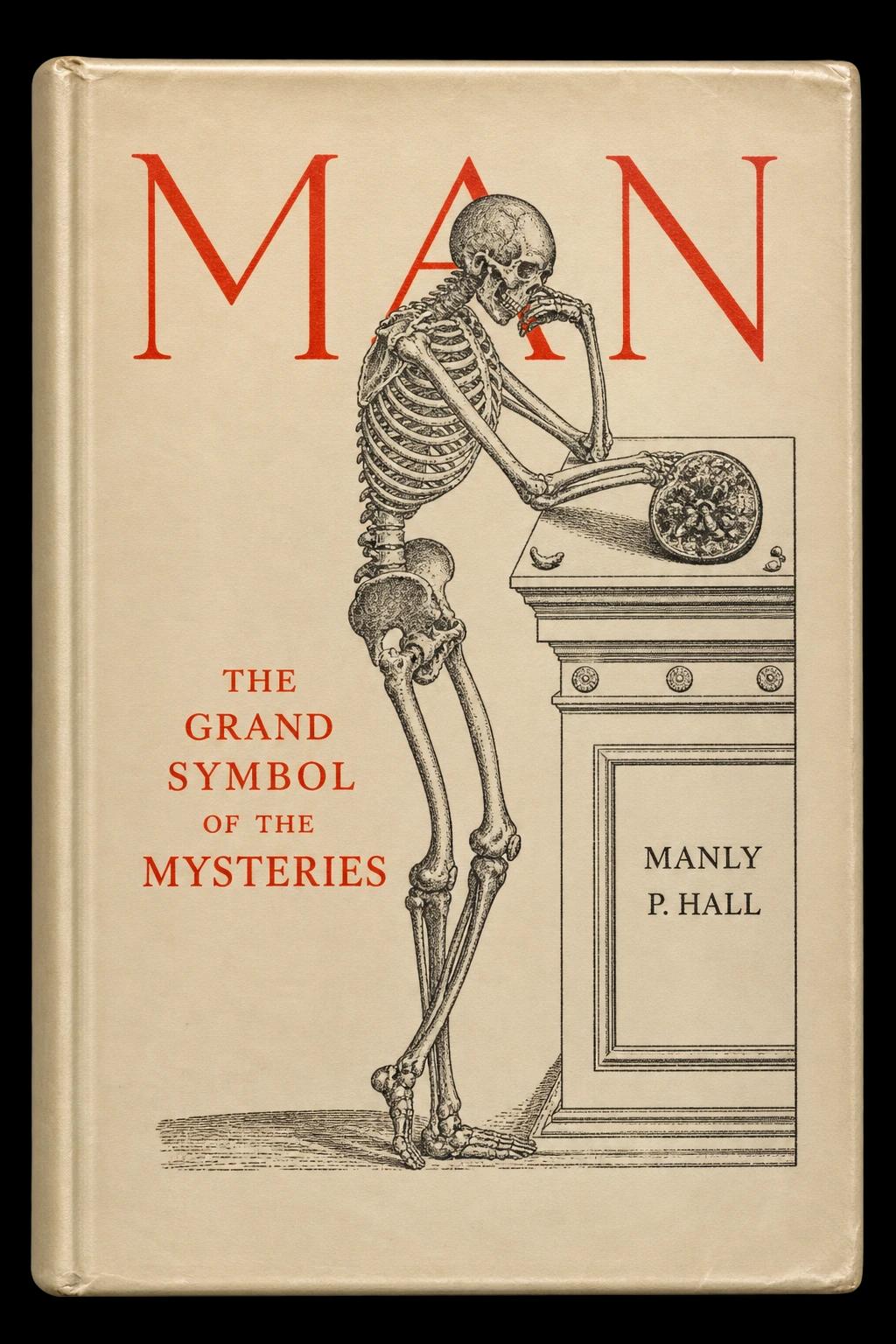
Man the Grand Symbol of the Mysteries
Reading note
The separately titled account draws on exact passages in the consulted Library edition.
Sources
See references (7)
- Tree of the sefirot on the title page of Porta Lucis ↗Joseph Gikatilla, Porta Lucis, abridged Latin translation by Paulus Ricius (Johann Miller, Augsburg, 1516). University Library of Nijmegen, via Wikimedia Commons.
- Sha’arei Kedusha, part 3, gate 1 ↗Chaim Vital, Sha’arei Kedusha, part 3, gate 1. Sefaria.
- Man the Grand Symbol of the Mysteries, printed p. 129, Reader page 127Manly P. Hall, Man the Grand Symbol of the Mysteries, Fourth Edition, The Philosophers Press, Los Angeles, 1937. Lumitheca Library edition IMJ-0603-E001.Read this page in Man the Grand Symbol of the Mysteries ↗
- Man the Grand Symbol of the Mysteries, printed p. 130, Reader page 128Manly P. Hall, Man the Grand Symbol of the Mysteries, Fourth Edition, The Philosophers Press, Los Angeles, 1937. Lumitheca Library edition IMJ-0603-E001.Read this page in Man the Grand Symbol of the Mysteries ↗
- Man the Grand Symbol of the Mysteries, printed p. 128, Reader page 126Manly P. Hall, Man the Grand Symbol of the Mysteries, Fourth Edition, The Philosophers Press, Los Angeles, 1937. Lumitheca Library edition IMJ-0603-E001.Read this page in Man the Grand Symbol of the Mysteries ↗
- Man the Grand Symbol of the Mysteries, printed p. 132, Reader page 130Manly P. Hall, Man the Grand Symbol of the Mysteries, Fourth Edition, The Philosophers Press, Los Angeles, 1937. Lumitheca Library edition IMJ-0603-E001.Read this page in Man the Grand Symbol of the Mysteries ↗
- Man the Grand Symbol of the Mysteries, printed p. 133, Reader page 131Manly P. Hall, Man the Grand Symbol of the Mysteries, Fourth Edition, The Philosophers Press, Los Angeles, 1937. Lumitheca Library edition IMJ-0603-E001.Read this page in Man the Grand Symbol of the Mysteries ↗