Four Powers of the Sphinx
The Four Powers of the Sphinx are to know, to dare, to will and to keep silence. Compare Éliphas Lévi’s formula with Crowley’s fifth power, To Go.
In this article
What are the four powers?
The Four Powers of the Sphinx are four capacities in Western esotericism: to know, to dare, to will and to keep silence. Éliphas Lévi represents them through a creature made of human and animal forms. Aleister Crowley links them with the elements and adds a fifth power, To Go. [1][2][4]
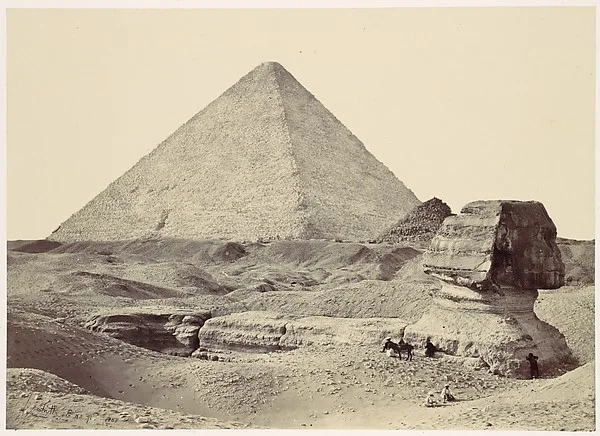
Francis Frith’s 1857 photograph of the Great Sphinx at Giza. Lévi’s sphinx has a human head and lion’s talons, along with an eagle’s wings and a bull’s flanks.
The Metropolitan Museum of Art, David Hunter McAlpin Fund, 1966, 66.640.2.6. Open Access. · Image source ↗ · CC0
Transcendental Magic by Éliphas Lévi, translated by Arthur Edward Waite
In Transcendental Magic, translated by Arthur Edward Waite, Éliphas Lévi sets out study, courage, firmness of will and discretion as qualities of the magician. On the next page he gives his sphinx a human head, an eagle’s wings, a bull’s flanks and a lion’s talons. He makes each feature stand for a different capacity. [1][2]
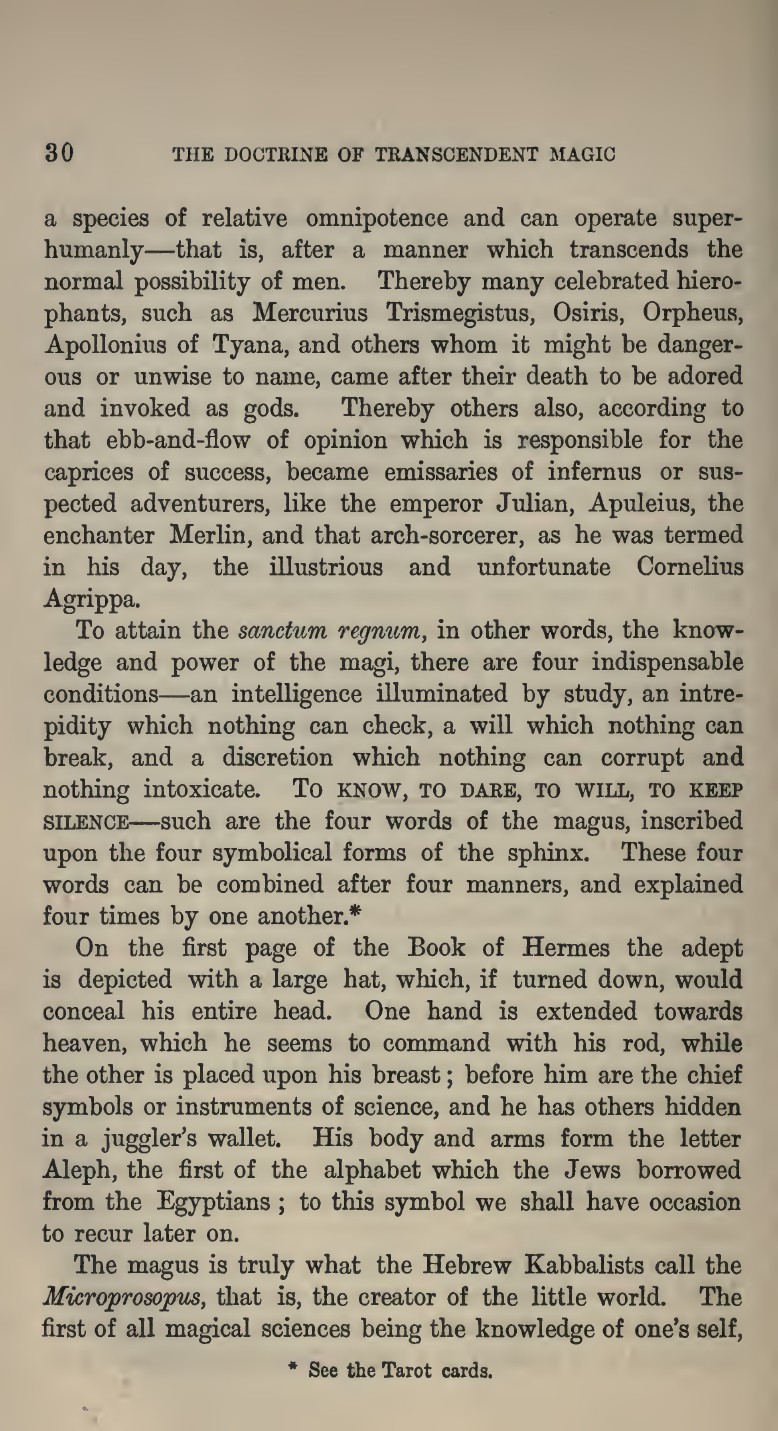
Lévi’s four powers in Arthur Edward Waite’s 1896 translation, printed page 30. The description of the composite sphinx follows on page 31.
Éliphas Lévi, translated by Arthur Edward Waite. London: George Redway, 1896. Lumitheca Library scan. · Image source ↗ · Public Domain
Magick Without Tears by Aleister Crowley
In Magick Without Tears, Aleister Crowley assigns knowing to air, willing to fire, daring to water and keeping silence to earth. He adds the Latin ire, meaning to go, and associates it with Spirit. [4]
Crowley illustrates going by interpreting the ankh as a sandal strap. The connection belongs to his symbolic reading of the sign. He uses it to make movement part of what he means by Spirit. [4]
Why Crowley adds a fifth power
Lévi introduces four qualities a candidate is expected to develop. Crowley puts the four into an elemental scheme and adds movement. To Go extends the formula beyond the four features of Lévi’s sphinx. [1][2][4]
Read further in the library
Transcendental Magic
Reading note
Separately attributed primary Library account, cited on exact verified Reader leaves.
Magick Without Tears
Reading note
The separately titled account draws on exact passages in the consulted Library edition.
Sources
See references (4)
- Transcendental Magic, printed p. 30, Reader page 56Éliphas Lévi, translated by Arthur Edward Waite. London: George Redway, 1896.Read this page in Transcendental Magic ↗Return to text ↑
- Transcendental Magic, printed p. 31, Reader page 57Éliphas Lévi, translated by Arthur Edward Waite. London: George Redway, 1896.Read this page in Transcendental Magic ↗Return to text ↑
- Francis Frith, The Sphynx and Great Pyramid, Geezeh, 1857 ↗The Metropolitan Museum of Art, David Hunter McAlpin Fund, 1966, 66.640.2.6.
- Magick Without Tears, Reader page 150Aleister Crowley, Magick Without Tears, undated digital Library edition IMJ-0641-E001. Links use the current Library Reader sequence.Read this page in Magick Without Tears ↗Return to text ↑