The Four Noble Truths and the Noble Eightfold Path
Read the four truths and their four tasks, then explore all eight path factors. Trace the connection both ways through the early Buddhist discourses.
In this article
Read the chart in both directions
Follow the fourth truth to the eight factors. Then use right view to return from the factors to the four truths.
Four truths and their tasks
- 1. Dukkha
- Understand it fully.
- 2. Origin
- Abandon the craving that gives rise to dukkha.
- 3. Cessation
- Realise the release from that craving.
- 4. The way
- Develop the Noble Eightfold Path.
The eight factors
- Right view
- Knowledge of the four truths. Return to the four tasks.
- Right intention
- Renunciation, non-ill will and harmlessness.
- Right speech
- Refrain from false, divisive, harsh and idle speech.
- Right action
- Refrain from killing, taking what is not given and sexual misconduct.
- Right livelihood
- Earn a living without relying on wrong livelihood.
- Right effort
- Guard against and let go of unskillful qualities, cultivate and sustain skillful ones.
- Right mindfulness
- Attend to body, feeling, mind and mental qualities.
- Right concentration
- Follow the four jhānas described in the analysis.
Where the four truths appear
SN 56.11 places the teaching in the Deer Park at Isipatana, traditionally associated with Sarnath. It begins with two approaches the speaker rejects, indulgence and self-mortification, and describes a middle way. That middle way is the Noble Eightfold Path. The discourse then states the four truths and returns to the same path in the fourth. [1][2]
The Met’s sculpture comes from a much later setting. The teaching gesture makes the story’s wheel recognisable as a sign of giving the teaching. The Library’s narrative retelling offers another way of encountering the first teaching. Use the two English translations for the wording of the discourse. [5][6][1][2]
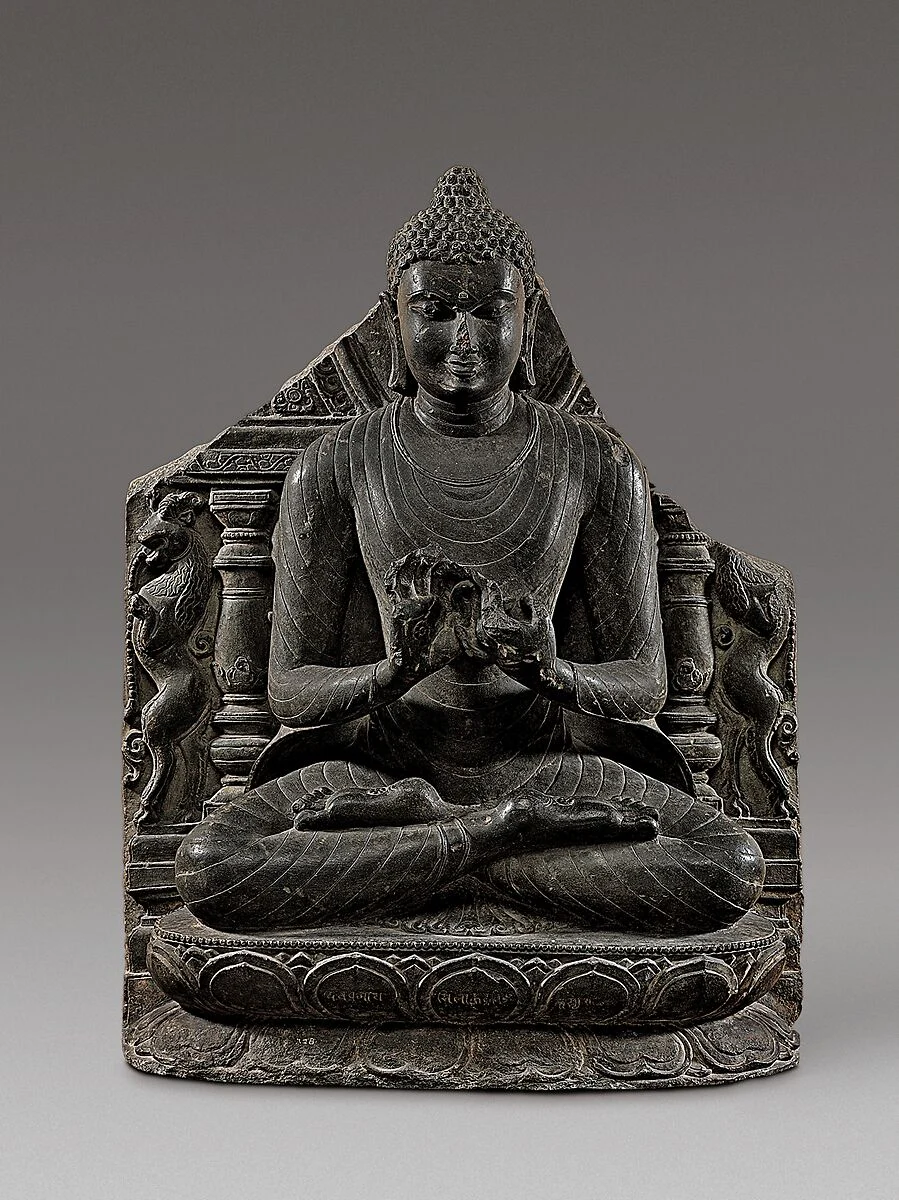
Buddha Preaching the First Sermon at Sarnath, 11th century, Bihar. The Met identifies the gesture with turning the wheel of the teaching.
The Metropolitan Museum of Art, Rogers Fund, 1920. 20.43. · Image source ↗ · Public Domain
Dukkha and the craving that gives rise to it
The first truth names distress in birth, ageing, illness, death and separation. Its closing summary also points to the five aggregates subject to clinging. Dukkha is often translated as suffering or stress. The lists show why a single English word can seem narrower than the discourse. The task attached to this truth is to understand it fully. [1][2]
The second truth names craving. The discourse singles out craving for sensual pleasure, for becoming and for non-becoming. This list is more precise than a blanket statement about wanting anything. It directs attention towards the forms of craving named in the text and gives the task of abandoning them. [1][2]
Cessation, the path and the four tasks
The third truth describes cessation in terms of releasing that craving. Its task is to realise cessation. The fourth truth identifies the way to it and gives the task of developing that way. The fourth truth is where the full list of eight factors enters the discourse for the second time. [1][2]
The discourse describes knowing each truth, knowing what to do in regard to it and knowing that the task has been completed. Four truths approached in those three ways give twelve aspects. If you are learning the list for the first time, read the four verbs aloud in order with their own truth: understand, abandon, realise, develop. [1][2]
Wisdom: right view and right intention
SN 45.8 defines right view through knowledge of the same four truths. This is how the path leads back to the truths. Right intention, also translated as right resolve, is described with renunciation, non-ill will and harmlessness. Dhammadinnā groups these two under discernment in MN 44. [3][4]
Conduct: speech, action and livelihood
The analysis names kinds of harmful speech and action to refrain from and connects livelihood with giving up a wrong means of living. MN 44 groups these three together as virtue. Read the items as descriptions of conduct. They give concrete content to the path for someone whose first encounter was the list of names in the sermon. [3][4]
Cultivation: effort, mindfulness and concentration
Right effort distinguishes what has or has not arisen, in both helpful and harmful cases. Right mindfulness considers body, feeling, mind and mental qualities. Right concentration is explained through four jhānas in SN 45.8. MN 44 places effort, mindfulness and concentration together. To read the three with precision, follow the analysis rather than substituting a familiar modern meaning for each word. [3][4]
Read further in the library
Myths of the Hindus and Buddhists
Reading note
The library’s retelling offers a separate account of the first teaching.
Sources
See references (6)
- SN 56.11 · Setting the Wheel of Dhamma in Motion ↗Thanissaro Bhikkhu’s English translation of Dhammacakkappavattana Sutta.Return to text ↑
- SN 56.11 · The four truths and their tasks ↗Bhikkhu Bodhi’s English translation, SuttaCentral.Return to text ↑
- SN 45.8 · An Analysis of the Path ↗Thanissaro Bhikkhu’s English translation of Magga-Vibhaṅga Sutta.Return to text ↑
- MN 44 · Virtue, concentration and discernment ↗Thanissaro Bhikkhu’s English translation of Cūḷavedalla Sutta, Dhammadinnā’s account of the groups.Return to text ↑
- Buddha Preaching the First Sermon at Sarnath ↗The Metropolitan Museum of Art, Pala period, 11th century.Return to text ↑
- Myths of the Hindus and Buddhists: The Hermits of Benares, Reader page 322Ananda K. Coomaraswamy and Sister Nivedita; historical literary retelling, printed page 273Return to text ↑
Examine the original Library page
This historical retelling describes the Buddha travelling to teach his former companions. The visible page confirms the cited words. Read it as a literary reception of the traditional narrative, alongside the translated discourse cited above.
intending to instruct the five hermits
Open the original page in Myths of the Hindus and Buddhists ↗Scan leaf 331 · Sister Nivedita and Ananda K. Coomaraswamy