Who Are the Four Heavenly Kings in Buddhism?
Meet the Four Heavenly Kings of Buddhism and their directions. Learn why their names and attributes matter in texts, paintings and temple images.
In this article
Who are the Four Heavenly Kings?
The Four Heavenly Kings are Buddhist guardians of the cardinal directions. Dhṛtarāṣṭra guards the east, Virūḍhaka the south, Virūpākṣa the west and Vaiśravaṇa the north. In Japan the group is called the Shitennō. Armour often identifies them as guardians, while their implements and positions help tell them apart. [1][3][4][5]
The Gods of Northern Buddhism by Alice Getty
Alice Getty follows the kings through stories of the Buddha’s life and around the sides of Buddhist shrines. She also records variations in their attributes. Vaiśravaṇa carries a banner in one list and a small shrine in some East Asian depictions. [1][2][3]
Getty’s Japanese table reverses two names. At Tōdaiji, as documented in the Met’s account of Akira Yamaguchi’s works based on those sculptures, Zōchōten guards the south and Kōmokuten the west. [3][6]
The kings at four gates in The Tantra of Great Gaṇapati
In Adam C. Krug’s translation of the Tantra of Great Gaṇapati, the four kings guard separate gates and each carries a jewel and sword. Getty records another convention in which the eastern guardian carries a stringed instrument. The objects make sense within the arrangement a particular source describes. [4][1][3]
The kings in a Japanese painting of the Buddha
In the Japanese painting, the Buddha teaches from a lotus seat. The Met identifies the armoured figures near King Bimbisāra and his attendants as the Four Heavenly Kings. The small Dharma wheels overhead mark them out within the larger assembly. [5][1]
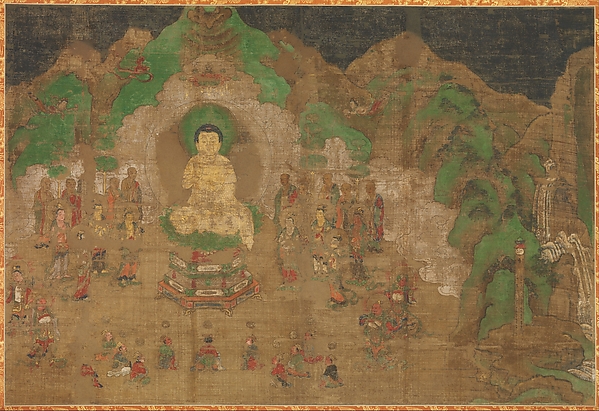
Scene from the Life of the Buddha, Japan, early 15th century. The Met identifies the Four Heavenly Kings among the figures attending the conversion of King Bimbisāra.
The Metropolitan Museum of Art. Japan, Muromachi period, early 15th century. Gift of Alvin E. Friedman-Kien, 1993. Accession 1993.478.4. · Image source ↗ · CC0
In the library
The Gods of Northern Buddhism
Reading note
Read Alice Getty’s illustrated discussion of Four Heavenly Kings.
Sources
See references (6)
- The Gods of Northern Buddhism, Reader page 213Alice Getty, The Gods of Northern Buddhism, 1928 revised second edition, Munshiram Manoharlal reprint. Lumitheca Library edition IMJ-0597-E001.Read this page in The Gods of Northern Buddhism ↗
- The Gods of Northern Buddhism, printed p. 167, Reader page 214Alice Getty, The Gods of Northern Buddhism, 1928 revised second edition, Munshiram Manoharlal reprint. Lumitheca Library edition IMJ-0597-E001.Read this page in The Gods of Northern Buddhism ↗
- The Gods of Northern Buddhism, printed p. 168, Reader page 215Alice Getty, The Gods of Northern Buddhism, 1928 revised second edition, Munshiram Manoharlal reprint. Lumitheca Library edition IMJ-0597-E001.Read this page in The Gods of Northern Buddhism ↗
- The Tantra of Great Gaṇapati, Toh 666, § 1.101 ↗The Tantra of Great Gaṇapati, Toh 666, § 1.101. Source credit: Adam C. Krug, Dharmachakra Translation Committee, 84000.
- Scene from the Life of the Buddha ↗The Metropolitan Museum of Art. Japan, Muromachi period, early 15th century. Gift of Alvin E. Friedman-Kien, 1993. Accession 1993.478.4.
- Shitennō (Jikokuten, Zochoten, Tamonten, Komokuten) ↗The Metropolitan Museum of Art, catalogue interpretation of Akira Yamaguchi’s 2006 work and its Tōdaiji precedents.