Former Heaven and Later Heaven in Daoist Alchemy
Former Heaven names an original condition from which the changing world emerges. Later Heaven names life as it appears in that changing world. Daoist alchemy uses this distinction to explain how ordinary functions can lead back toward their source.
In this article
What are Former Heaven and Later Heaven?
Former Heaven, or xiantian (先天), names an original condition before things take differentiated form. Later Heaven, or houtian (後天), names the condition in which they take shape and change. Daoist alchemists use the distinction for the body as well as the cosmos. Ordinary breathing, for example, can be understood in relation to the power from which it arises. [6][2][5]
Former and Later Heaven in The Secret of the Golden Flower
In the text translated by Richard Wilhelm and rendered into English by Cary F. Baynes, primordial spirit belongs to a condition before polar opposites. The text calls seed-water the single power of Former Heaven. Its account of the developing body shows how that original condition relates to the conscious life that follows. [1][2][3]
The Far Journey chapter links the power of Former Heaven to inhalation and exhalation in Later Heaven. It pictures the return to origins as a waterwheel turning until power returns to its roots. Breathing gives the distinction a concrete place in the alchemical account. [4][5]
See references (5)
- The Secret of the Golden Flower, printed p. 27, Reader page 34
- The Secret of the Golden Flower, printed p. 28, Reader page 35
- The Secret of the Golden Flower, printed p. 32, Reader page 37
- The Secret of the Golden Flower, Far Journey chapter, movement of Heaven, Reader page 64
- The Secret of the Golden Flower, printed p. 68, Reader page 67
The two breaths in the Mirror for Compounding the Medicine
In Fabrizio Pregadio’s translation of Wang Jie’s commentary on the Mirror for Compounding the Medicine, precelestial breath is the ancestral source. Postcelestial breath is the breath that comes and goes. Wang Jie describes the latter returning to the former, explaining why ordinary breath matters in a practice concerned with origins. [7][5]
The cosmos alongside the body
The Universal Illumination woodcut gathers cosmological emblems around a seated body. It shows how Daoist alchemical art could give the body a place within a larger order of signs. The Golden Flower also relates processes in the body to patterns described by trigrams. [8][6][4]
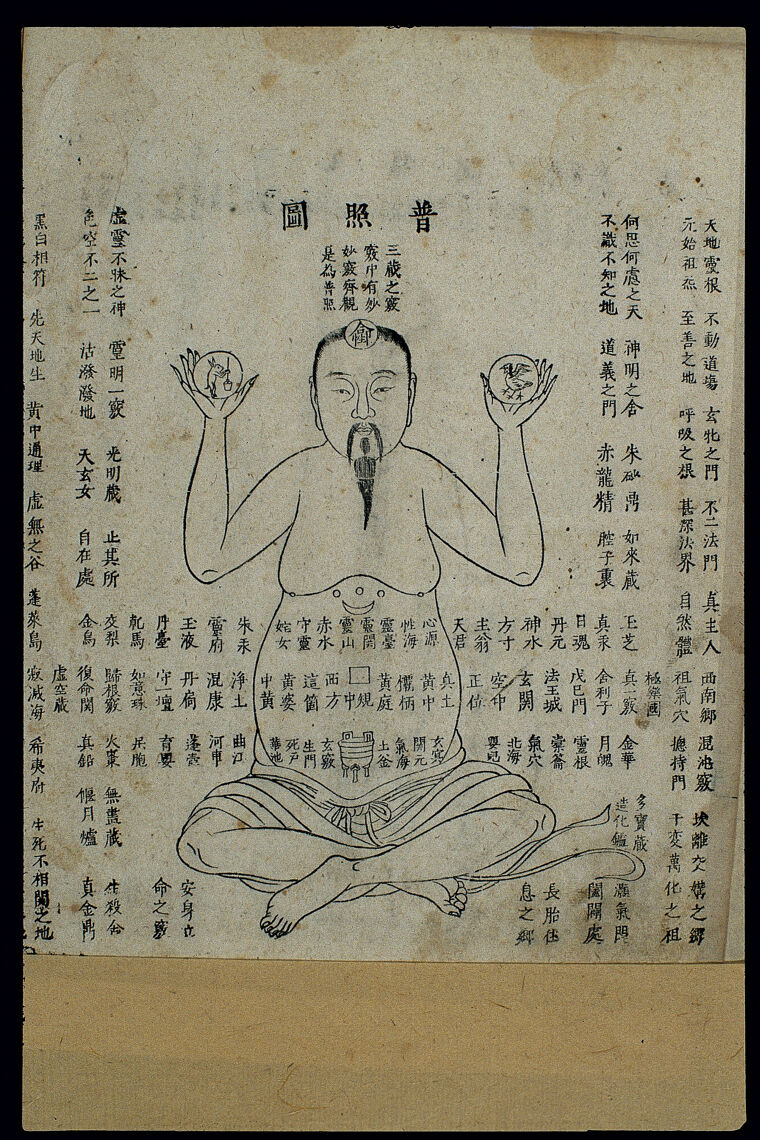
Universal Illumination, Xingming guizhi, published in 1615. This other Daoist work places symbols of the wider cosmos alongside features of the body.
Wellcome Collection, Chinese woodcut: Daoist internal alchemy (1). Public Domain Mark. · Image source ↗ · Public Domain
In the library
The Secret of the Golden Flower
Reading note
Read the account of Former and Later Heaven in the Wilhelm and Baynes edition.
Sources
See references (8)
- The Secret of the Golden Flower, printed p. 27, Reader page 34The Secret of the Golden Flower: A Chinese Book of Life. Chinese text translated and explained by Richard Wilhelm, English translation by Cary F. Baynes, with separate commentary by C. G. Jung. London, Kegan Paul, Trench, Trubner & Co. Lumitheca Library edition IMJ-0596-E001.Read this page in The Secret of the Golden Flower ↗
- The Secret of the Golden Flower, printed p. 28, Reader page 35The Secret of the Golden Flower: A Chinese Book of Life. Chinese text translated and explained by Richard Wilhelm, English translation by Cary F. Baynes, with separate commentary by C. G. Jung. London, Kegan Paul, Trench, Trubner & Co. Lumitheca Library edition IMJ-0596-E001.Read this page in The Secret of the Golden Flower ↗
- The Secret of the Golden Flower, printed p. 32, Reader page 37The Secret of the Golden Flower: A Chinese Book of Life. Chinese text translated and explained by Richard Wilhelm, English translation by Cary F. Baynes, with separate commentary by C. G. Jung. London, Kegan Paul, Trench, Trubner & Co. Lumitheca Library edition IMJ-0596-E001.Read this page in The Secret of the Golden Flower ↗
- The Secret of the Golden Flower, Far Journey chapter, movement of Heaven, Reader page 64The Secret of the Golden Flower: A Chinese Book of Life. Chinese text translated and explained by Richard Wilhelm, English translation by Cary F. Baynes, with separate commentary by C. G. Jung. London, Kegan Paul, Trench, Trubner & Co. Lumitheca Library edition IMJ-0596-E001.Read this page in The Secret of the Golden Flower ↗
- The Secret of the Golden Flower, printed p. 68, Reader page 67The Secret of the Golden Flower: A Chinese Book of Life. Chinese text translated and explained by Richard Wilhelm, English translation by Cary F. Baynes, with separate commentary by C. G. Jung. London, Kegan Paul, Trench, Trubner & Co. Lumitheca Library edition IMJ-0596-E001.Read this page in The Secret of the Golden Flower ↗
- Awakening to Reality (Wuzhen pian), introduction, section 3, “The Elixir” ↗Fabrizio Pregadio, Golden Elixir Press.
- Mirror for Compounding the Medicine, poem I and commentary, p. 46 ↗Text attributed to Cui Xifan, commentary by Wang Jie, translated by Fabrizio Pregadio in Taoist Internal Alchemy: An Anthology of Neidan Texts.
- Universal Illumination ↗Wellcome Collection, Chinese woodcut: Daoist internal alchemy (1). Public Domain Mark.