Fludd’s World Cell
See the 1617 engraving Manly P. Hall compared with an ovum and learn why he called Robert Fludd’s diagram a World Cell.
In this article
A cosmos compared with an egg cell
Fludd’s World Cell is Manly P. Hall’s name for a cosmic engraving that he compared with an image of an egg cell. Robert Fludd’s original diagram depicts the structure of the universe. Its rings and radiating outer edge gave Hall the basis for the comparison. [3][4][2]
Utriusque cosmi historia by Robert Fludd
In Utriusque cosmi historia, Robert Fludd uses concentric rings to arrange elemental and celestial regions around the central Earth. The heading identifies the subject as the structure of the macrocosm. [2]
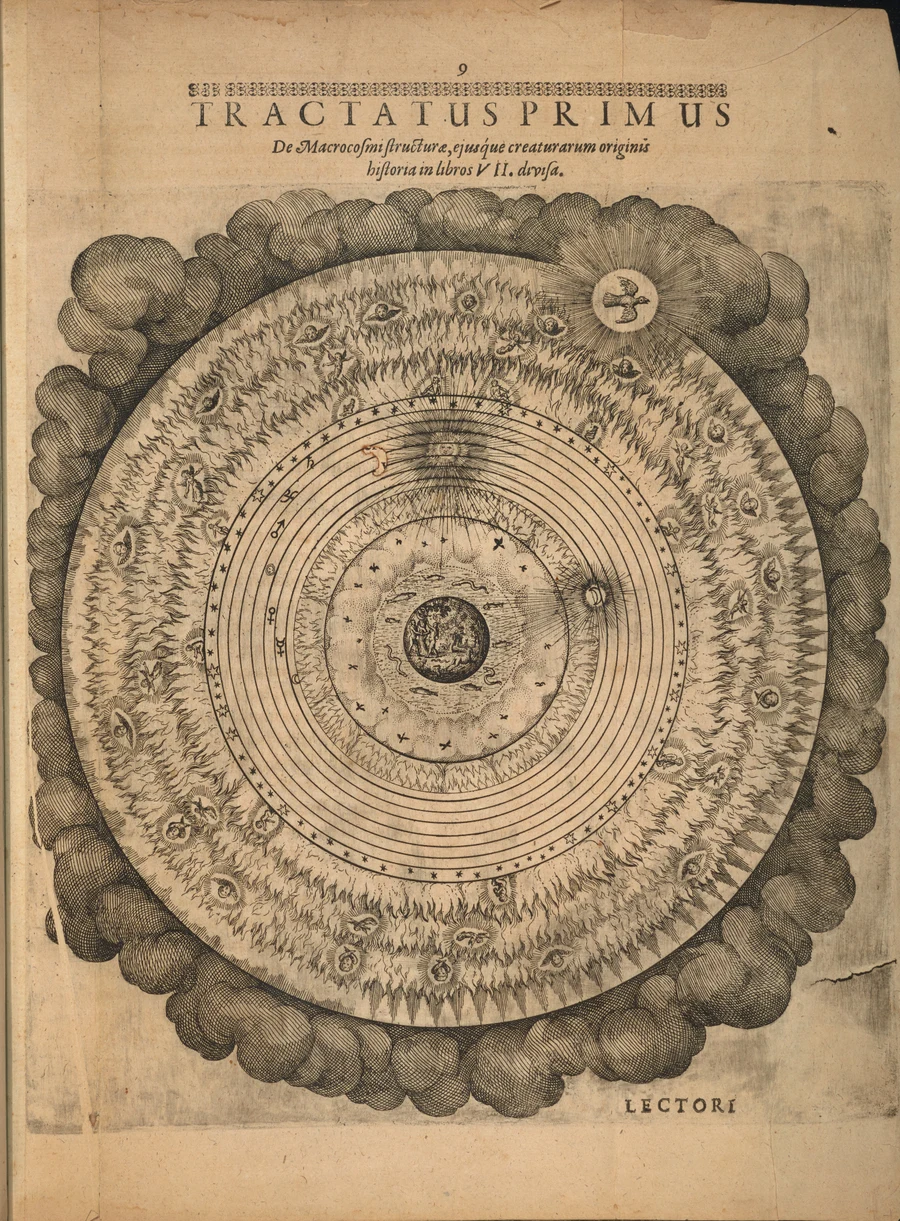
Fludd’s engraving depicts the structure of the macrocosm. The radiating border and successive rings are the features Hall later compared with an ovum.
Robert Fludd, Utriusque cosmi historia, volume I, 1617, p. 9. Wikimedia Commons, via Source Library. CC0. · Image source ↗ · CC0
Man the Grand Symbol of the Mysteries by Manly P. Hall
In Man the Grand Symbol of the Mysteries, Hall sets the engraving beside an ovum illustration from the 1929 edition of Piersol’s Normal Histology. He pairs the ring of cells around the ovum, the corona radiata, with Fludd’s ring of flames. He likens the next layer inward, the zona pellucida, to the circle of fixed stars. [5][3][4]
Reading inward, Hall compares the planet-bearing bands with regions of the ovum and its centre with the nucleus. The arrangement lets him illustrate his belief that a similar order appears at different scales. [6][3][4]
How an old engraving acquired a new meaning
Fludd’s rings set out a cosmology. The histology illustration shows an ovum. The World Cell is the image Hall made by putting the two prints together and assigning a cellular counterpart to each part of the cosmic design. [5][3][4][2]
In the library
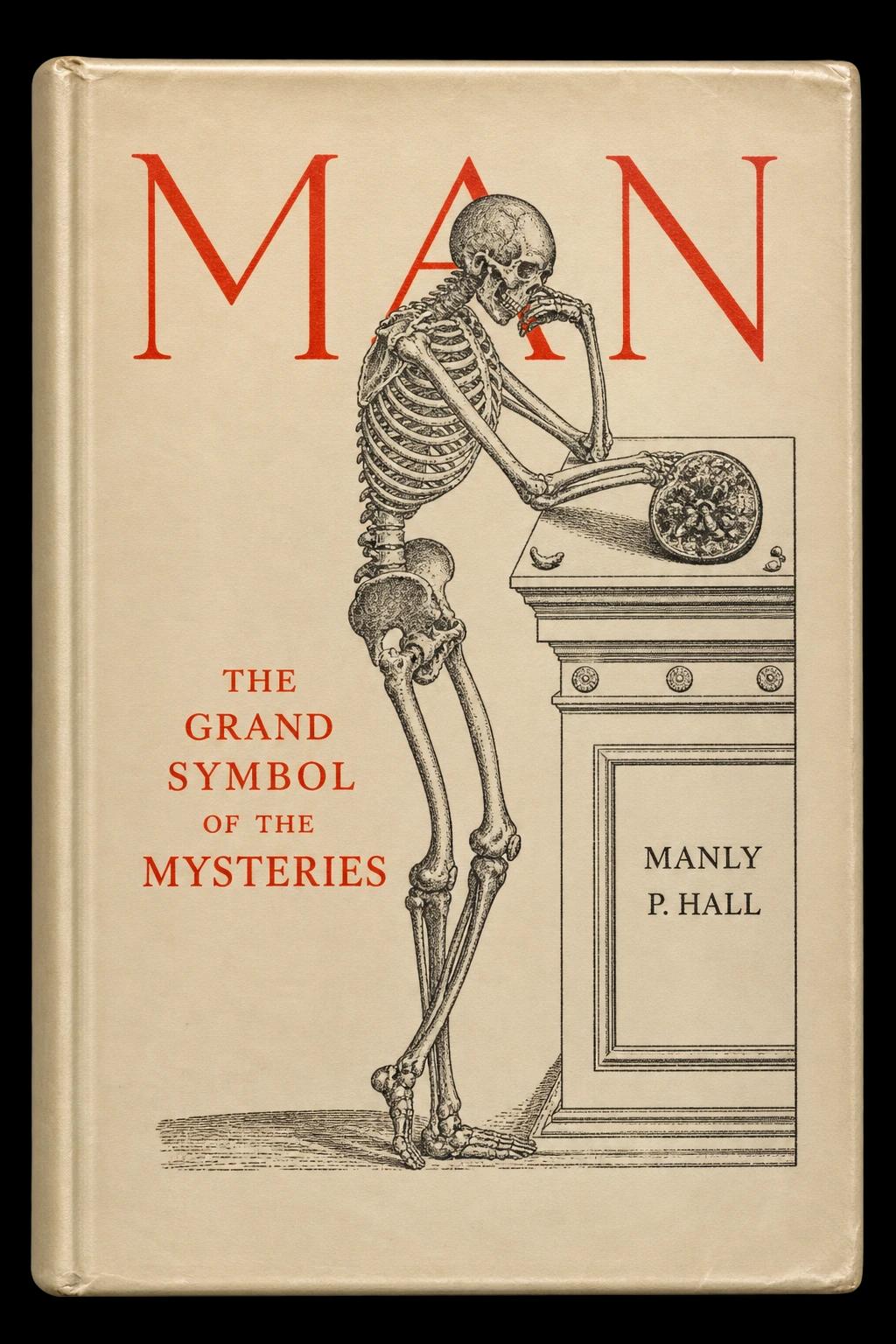
Man the Grand Symbol of the Mysteries
Reading note
The separately titled account draws on exact passages in the consulted Library edition.
Sources
See references (6)
- Utriusque cosmi historia, De macrocosmi structura ↗Robert Fludd, Utriusque cosmi historia, volume I, 1617, p. 9. Wikimedia Commons, via Source Library. CC0.
- Utriusque cosmi historia, p. 9, De macrocosmi structura ↗Robert Fludd, Utriusque cosmi historia, volume I, 1617, p. 9. Digital facsimile.
- Man the Grand Symbol of the Mysteries, printed p. 157, Reader page 154Manly P. Hall, Man the Grand Symbol of the Mysteries, Fourth Edition, The Philosophers Press, Los Angeles, 1937. Lumitheca Library edition IMJ-0603-E001.Read this page in Man the Grand Symbol of the Mysteries ↗
- Man the Grand Symbol of the Mysteries, printed p. 158, Reader page 155Manly P. Hall, Man the Grand Symbol of the Mysteries, Fourth Edition, The Philosophers Press, Los Angeles, 1937. Lumitheca Library edition IMJ-0603-E001.Read this page in Man the Grand Symbol of the Mysteries ↗
- Man the Grand Symbol of the Mysteries, printed p. 156, Reader page 153Manly P. Hall, Man the Grand Symbol of the Mysteries, Fourth Edition, The Philosophers Press, Los Angeles, 1937. Lumitheca Library edition IMJ-0603-E001.Read this page in Man the Grand Symbol of the Mysteries ↗
- Man the Grand Symbol of the Mysteries, printed p. 132, Reader page 130Manly P. Hall, Man the Grand Symbol of the Mysteries, Fourth Edition, The Philosophers Press, Los Angeles, 1937. Lumitheca Library edition IMJ-0603-E001.Read this page in Man the Grand Symbol of the Mysteries ↗