The Flatland Thought Experiment
What would a world limited to two dimensions be like? Compare Abbott’s Flatland with Bragdon’s disc-world and see what a plane inhabitant could infer.
In this article
What a world confined to a plane could learn
The Flatland thought experiment asks what someone who lives entirely in a plane could learn about a third direction. If a solid passed through the plane, the observer would see the part that met their world. A series of changing sections might give them clues to the shape they could never see all at once. [3][4][5][6][2]
Flatland by Edwin A. Abbott
In Edwin A. Abbott’s Flatland, a visitor appears to the Square first as a circle that changes size. The Sphere then lifts the Square out of the plane. The change of viewpoint lets him see a direction that had been hard to grasp through explanation alone. [2][12][13]
A Primer of Higher Space by Claude Bragdon
In A Primer of Higher Space, Claude Bragdon imagines a thin disc with inhabitants held to its rim by a force like gravity. They can move along the disc or toward and away from its centre. Bragdon asks how they might infer a direction that would take them out through its face. [3][4][5][7][6]
In Man the Square, Bragdon follows a reflective inhabitant named Planewisdom. Figures appear, change and disappear as unseen cubes move through the film of his world. Bragdon uses those traces to tell a parable about how much of a person a single appearance can reveal. [8][9][10][11]
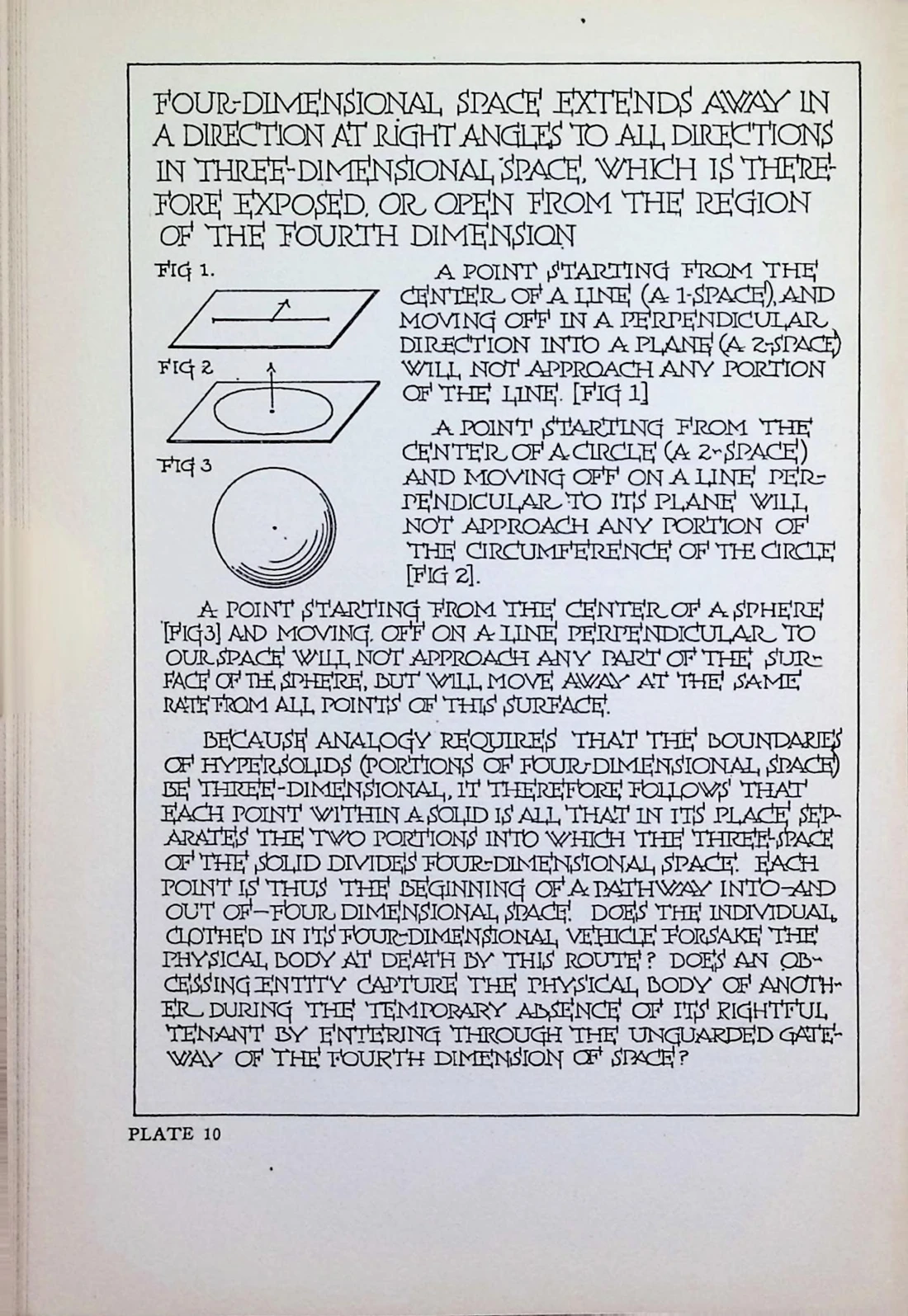
Plate 10 shows motion out of a line and then out of a plane. Bragdon uses the same rule to describe a fourth direction.
Claude Bragdon, A Primer of Higher Space, The Manas Press, 1913. Stickley Museum scan via Internet Archive. · Image source ↗ · Public Domain
See references (9)
- A Primer of Higher Space, printed p. 9, Reader page 16
- A Primer of Higher Space, printed p. 10, Reader page 17
- A Primer of Higher Space, printed p. 11, Reader page 18
- A Primer of Higher Space, Plate 10, Reader page 39
- A Primer of Higher Space, printed p. 12, Reader page 19
- A Primer of Higher Space, printed p. 63, Reader page 66
- A Primer of Higher Space, printed p. 67, Reader page 70
- A Primer of Higher Space, printed p. 68, Reader page 71
- A Primer of Higher Space, printed p. 75, Reader page 78
What each observer gets to see
Abbott lets the Square leave the plane and look back. Bragdon’s Planewisdom begins with a narrower kind of evidence: the appearances left by cubes as they pass through his world. [4][5][9][10][2][13]
See references (6)
- Flatland, second edition, Part II, section 16, the Sphere appears
- A Primer of Higher Space, printed p. 10, Reader page 17
- A Primer of Higher Space, printed p. 11, Reader page 18
- A Primer of Higher Space, printed p. 67, Reader page 70
- A Primer of Higher Space, printed p. 68, Reader page 71
- Flatland, second edition, Part II, section 18, the Square looks back into Flatland
In the library
A Primer of Higher Space
Reading note
The separately titled account draws on exact passages in the consulted Library edition.
Sources
See references (13)
- Plate 10, directions outside a line or plane ↗Claude Bragdon, A Primer of Higher Space, The Manas Press, 1913. Stickley Museum scan via Internet Archive.
- Flatland, second edition, Part II, section 16, the Sphere appears ↗Edwin A. Abbott, Flatland: A Romance of Many Dimensions, Part II, sections 16–18, Project Gutenberg eBook 201.
- A Primer of Higher Space, printed p. 9, Reader page 16Claude Bragdon, A Primer of Higher Space (The Fourth Dimension), The Manas Press, Rochester, New York, 1913. Lumitheca Library edition IMJ-0599-E001.Read this page in A Primer of Higher Space ↗
- A Primer of Higher Space, printed p. 10, Reader page 17Claude Bragdon, A Primer of Higher Space (The Fourth Dimension), The Manas Press, Rochester, New York, 1913. Lumitheca Library edition IMJ-0599-E001.Read this page in A Primer of Higher Space ↗
- A Primer of Higher Space, printed p. 11, Reader page 18Claude Bragdon, A Primer of Higher Space (The Fourth Dimension), The Manas Press, Rochester, New York, 1913. Lumitheca Library edition IMJ-0599-E001.Read this page in A Primer of Higher Space ↗
- A Primer of Higher Space, Plate 10, Reader page 39Claude Bragdon, A Primer of Higher Space (The Fourth Dimension), The Manas Press, Rochester, New York, 1913. Lumitheca Library edition IMJ-0599-E001.Read this page in A Primer of Higher Space ↗
- A Primer of Higher Space, printed p. 12, Reader page 19Claude Bragdon, A Primer of Higher Space (The Fourth Dimension), The Manas Press, Rochester, New York, 1913. Lumitheca Library edition IMJ-0599-E001.Read this page in A Primer of Higher Space ↗
- A Primer of Higher Space, printed p. 63, Reader page 66Claude Bragdon, A Primer of Higher Space (The Fourth Dimension), The Manas Press, Rochester, New York, 1913. Lumitheca Library edition IMJ-0599-E001.Read this page in A Primer of Higher Space ↗
- A Primer of Higher Space, printed p. 67, Reader page 70Claude Bragdon, A Primer of Higher Space (The Fourth Dimension), The Manas Press, Rochester, New York, 1913. Lumitheca Library edition IMJ-0599-E001.Read this page in A Primer of Higher Space ↗
- A Primer of Higher Space, printed p. 68, Reader page 71Claude Bragdon, A Primer of Higher Space (The Fourth Dimension), The Manas Press, Rochester, New York, 1913. Lumitheca Library edition IMJ-0599-E001.Read this page in A Primer of Higher Space ↗
- A Primer of Higher Space, printed p. 75, Reader page 78Claude Bragdon, A Primer of Higher Space (The Fourth Dimension), The Manas Press, Rochester, New York, 1913. Lumitheca Library edition IMJ-0599-E001.Read this page in A Primer of Higher Space ↗
- Flatland, second edition, Part II, section 17, the Sphere demonstrates the third direction ↗Edwin A. Abbott, Flatland: A Romance of Many Dimensions, Part II, sections 16–18, Project Gutenberg eBook 201.
- Flatland, second edition, Part II, section 18, the Square looks back into Flatland ↗Edwin A. Abbott, Flatland: A Romance of Many Dimensions, Part II, sections 16–18, Project Gutenberg eBook 201.