The Five Wisdom Buddhas and Their Directions
Who are the Five Wisdom Buddhas? Learn their usual directions and colours, why mandalas can vary, and how a Tibetan ritual crown depicts the group.
In this article
Who are the Five Wisdom Buddhas?
The Five Wisdom Buddhas are five awakened figures in Esoteric Buddhism. In one common mandala, Vairocana is at the centre, Akṣobhya in the east, Ratnasambhava in the south, Amitābha in the west and Amoghasiddhi in the north. Their positions connect each Buddha with a family and a quality of awakened wisdom. [1][3][4]
The Gods of Northern Buddhism by Alice Getty
Alice Getty calls them the Dhyāni-Buddhas, or Buddhas of Meditation. She describes Nepalese caityas, Buddhist shrines where four Buddhas occupy niches at the compass points. Vairocana may be understood to occupy the interior, or may also be shown outside near Akṣobhya. [1][3]
Getty also describes one system in which the primordial Buddha brings forth the five and a scheme in which Vajrasattva presides over them. These accounts relate the group to figures beyond the five shown in the directional arrangement. [1][2]
The five families in the Caitya Dhāraṇī glossary
The translators’ glossary to the Dhāraṇī for a Caitya pairs the five directions with the tathāgata, vajra, jewel, lotus and action families. It also records a variation in Mahāyoga mandalas, where Vairocana and Akṣobhya exchange places. The map belongs to the tradition using it. [4][3]
Five Buddhas on a Tibetan crown
This Tibetan crown puts the group on five panels worn around the head. The Met identifies the figures by colour. Look for white Vairocana, blue Akṣobhya, yellow Ratnasambhava, red Amitābha and green Amoghasiddhi. The crown brings the same group into an object worn in ritual. [5][3]
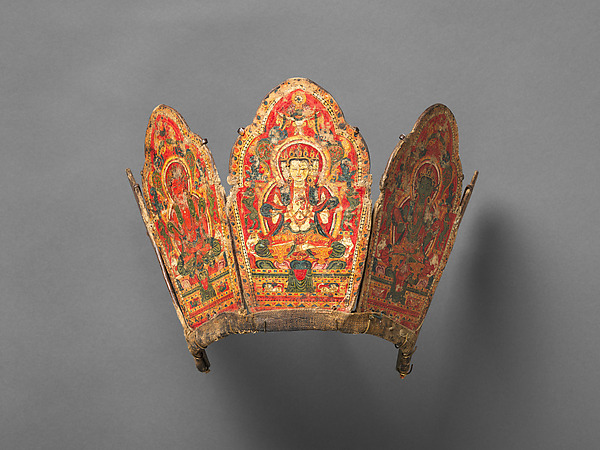
Tibetan ritual crown with the Five Transcendent Buddhas. The other two panels turn away from this view.
The Metropolitan Museum of Art. Tibet, late 14th to early 15th century. Gift of Jeffrey Kossak, The Kronos Collections, 1985. Accession 1985.391. · Image source ↗ · CC0
In the library
The Gods of Northern Buddhism
Reading note
Read Alice Getty’s illustrated discussion of Five Wisdom Buddhas.
Sources
See references (5)
- The Gods of Northern Buddhism, printed p. 27, Reader page 79Alice Getty, The Gods of Northern Buddhism, 1928 revised second edition, Munshiram Manoharlal reprint. Lumitheca Library edition IMJ-0597-E001.Read this page in The Gods of Northern Buddhism ↗
- The Gods of Northern Buddhism, printed p. 28, Reader page 80Alice Getty, The Gods of Northern Buddhism, 1928 revised second edition, Munshiram Manoharlal reprint. Lumitheca Library edition IMJ-0597-E001.Read this page in The Gods of Northern Buddhism ↗
- The Gods of Northern Buddhism, printed p. 30, Reader page 82Alice Getty, The Gods of Northern Buddhism, 1928 revised second edition, Munshiram Manoharlal reprint. Lumitheca Library edition IMJ-0597-E001.Read this page in The Gods of Northern Buddhism ↗
- The Dhāraṇī for a Caitya, Toh 601 and Toh 884, glossary entry g.15 on the five buddha families ↗The Dhāraṇī for a Caitya, Toh 601 and Toh 884, glossary entry g.15 on the five buddha families. Source credit: 84000 translation and glossary.
- Ritual Crown with the Five Transcendent Buddhas ↗The Metropolitan Museum of Art. Tibet, late 14th to early 15th century. Gift of Jeffrey Kossak, The Kronos Collections, 1985. Accession 1985.391.