Fitness in Babbitt’s Theory of Design
Babbitt’s principle of fitness asks what a design is meant to do. Compare his Gothic arches and buttresses with John Ruskin’s account of structural truth.
In this article
Form and purpose
Fitness is how well a form suits its purpose. An arch can have an attractive outline and be a poor choice for a particular load. Edwin D. Babbitt treats strength and visual character as parts of the same design decision. [3]
The Principles of Light and Color by Edwin D. Babbitt
In The Principles of Light and Color, Edwin D. Babbitt praises Gothic buttresses for bracing walls and giving them a more varied outline. He admires the ogee, a curve that reverses direction before meeting in a point, but judges it weaker than the ordinary Gothic arch. [3]
Babbitt also makes fitness part of an argument about providence. He compares apparent disharmony in nature to a musical discord that heightens what follows. The comparison shows how he moves from a principle of design to a claim about the purposes of nature. [4]
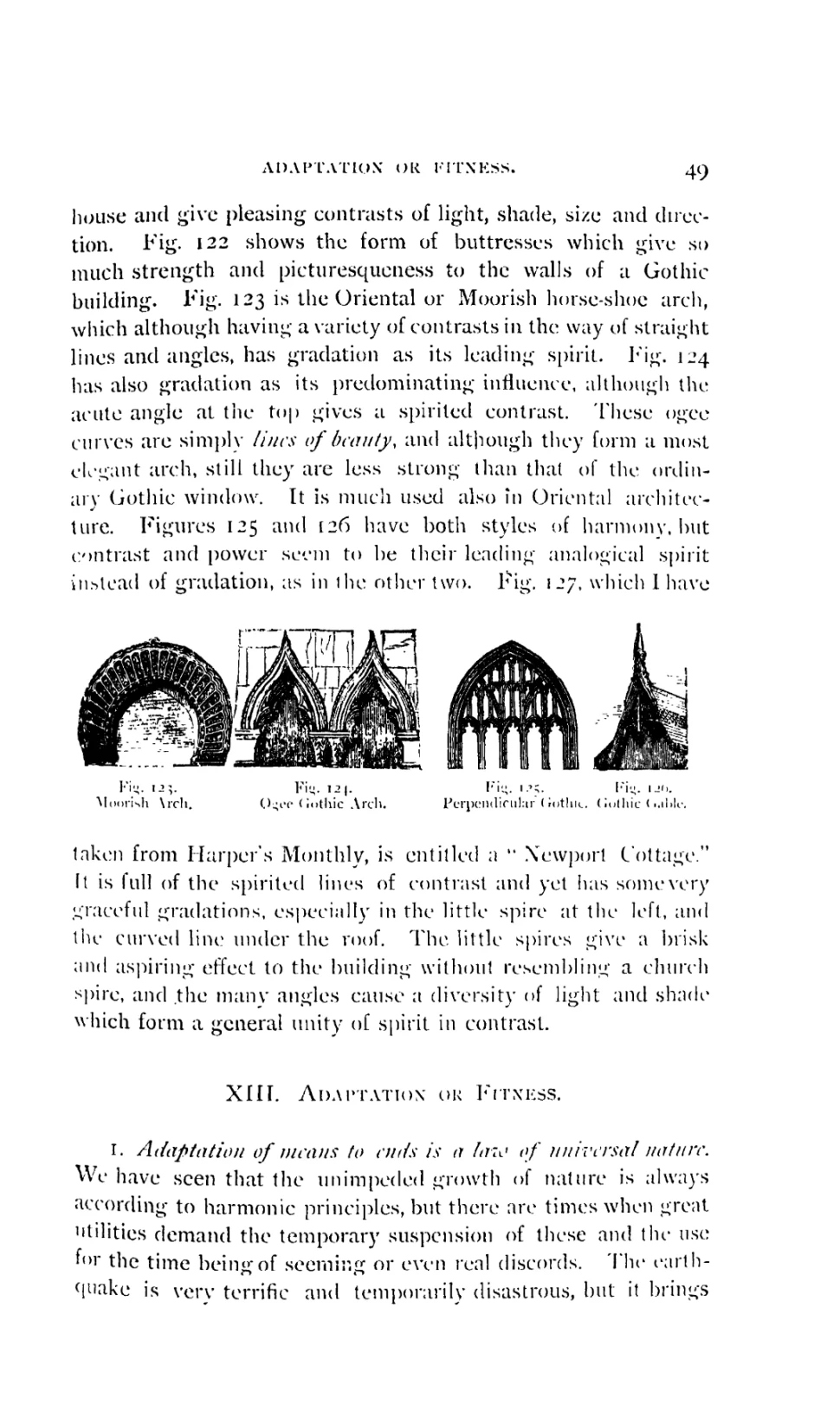
Babbitt’s engravings set four arches side by side. Compare the broad horseshoe curve with the reversed curves and point of the ogee.
Edwin D. Babbitt, The Principles of Light and Color, second edition, 1896. Lumitheca Library facsimile. · Image source ↗ · Public Domain
The Seven Lamps of Architecture by John Ruskin
In The Seven Lamps of Architecture, John Ruskin praises the flying buttresses in the choir at Beauvais. He explains how their slopes carry support to outer piers. He allows a pinnacle to be decorative and criticises a buttress whose shape suggests it carries a load it cannot meaningfully support. [2]
A structural test and a wider claim
Ruskin traces where a buttress can carry force. Babbitt asks whether a form suits its purpose, then uses that idea to interpret events as well as buildings. Architectural fitness can be examined in the structure itself. Babbitt’s theological extension depends on his account of providence. [3][4][2]
In the library
The Principles of Light and Color
Reading note
Separately attributed primary Library account, cited on exact verified Reader leaves.
Sources
See references (4)
- Figures 123 to 126, architectural arches, printed p. 49, Reader page 56Edwin D. Babbitt, The Principles of Light and Color, second edition, 1896. Lumitheca Library facsimile.Read this page in The Principles of Light and Color ↗
- The Seven Lamps of Architecture, The Lamp of Truth, p. 64 ↗John Ruskin, The Seven Lamps of Architecture, Library Edition, vol. 8, p. 64. Lancaster University transcription.
- The Principles of Light and Color, printed p. 49, Reader page 56Edwin D. Babbitt, The Principles of Light and Color, second edition, College of Fine Forces, East Orange, New Jersey, 1896. Lumitheca Library edition IMJ-0607-E001.Read this page in The Principles of Light and Color ↗
- The Principles of Light and Color, printed p. 51, Reader page 58Edwin D. Babbitt, The Principles of Light and Color, second edition, College of Fine Forces, East Orange, New Jersey, 1896. Lumitheca Library edition IMJ-0607-E001.Read this page in The Principles of Light and Color ↗