The Finite, Dimensionless Universe in Walter Russell
How can a universe be finite yet have no boundary? Explore what Walter Russell meant by dimensionless and how his view differs from Einstein’s.
In this article
What is finite and what has dimensions?
Walter Russell calls the universe finite because he believes Mind can express only a limited range of effects. He calls the underlying substance dimensionless because size, distance and shape belong to the forms we perceive. [3][4][5][6]
The Universal One by Walter Russell
In The Universal One, Walter Russell says the ten-octave cycle exhausts what Mind can express. Heat, shape and motion belong to that range. Distance arises only when forms appear separate, so the single underlying substance has no spatial extent in his account. [3][4][5][6][7]
Russell accepts Einstein’s suggestion that a universe may be finite without presenting an edge. He objects to giving Mind itself a shape. As he sees it, dimensions describe the relations between appearances, while inward thought can approach the substance behind them. [8][4][5]
See references (6)
Relativity by Albert Einstein
In Relativity, Albert Einstein imagines beings confined to the surface of a sphere. Their world has finite area and no edge. He uses their two-dimensional world to help readers imagine what finite, unbounded three-dimensional space could be like. [2]
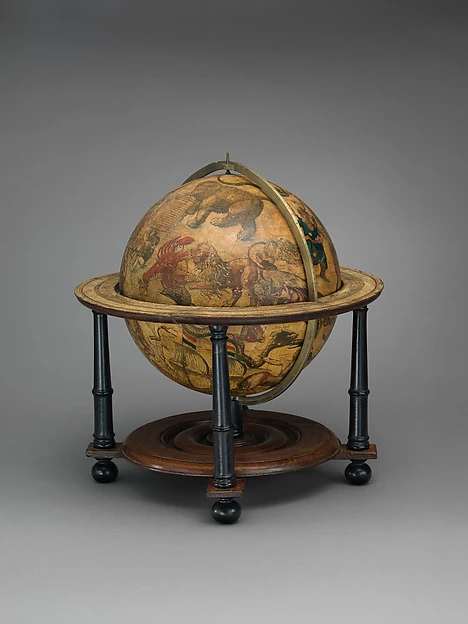
This celestial globe gives the sky a curved surface on which positions can be marked. Einstein’s model also uses a curved surface, with geometry of its own.
Willem Jansz Blaeu, Celestial Globe. The Metropolitan Museum of Art. Purchase, Friends of European Sculpture and Decorative Arts Gifts, 1990. · Image source ↗ · CC0
A geometry and a theory of appearances
A sphere’s surface still has measurable distances. Einstein is describing the geometry of a possible space. Russell’s dimensionless Mind belongs to an account in which distance arises only when distinct forms appear. [3][8][4][5][2]
In the library
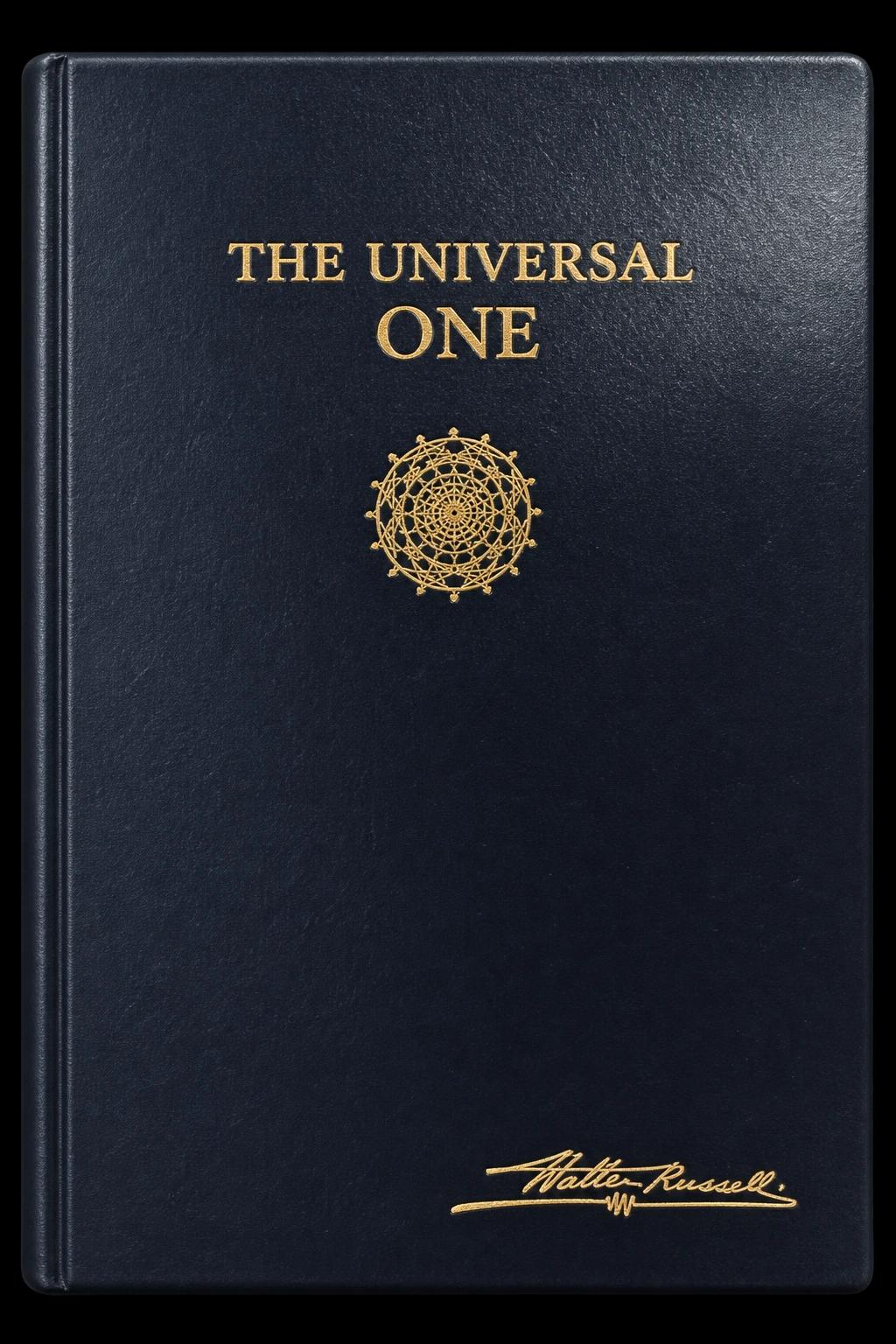
The Universal One
Reading note
The separately titled account draws on exact passages in the consulted Library edition.
Sources
See references (8)
- Willem Jansz Blaeu, Celestial Globe ↗Willem Jansz Blaeu, Celestial Globe. The Metropolitan Museum of Art. Purchase, Friends of European Sculpture and Decorative Arts Gifts, 1990.
- Relativity: The Special and General Theory, §31 ↗Albert Einstein, Relativity: The Special and General Theory, section 31, translated by Robert W. Lawson.
- The Universal One, printed p. 57, Reader page 56Walter Russell, The Universal One, edited by Louise Russell, University of Science and Philosophy, Limited Edition De Luxe. Lumitheca Library edition IMJ-0605-E001.Read this page in The Universal One ↗
- The Universal One, printed p. 59, Reader page 58Walter Russell, The Universal One, edited by Louise Russell, University of Science and Philosophy, Limited Edition De Luxe. Lumitheca Library edition IMJ-0605-E001.Read this page in The Universal One ↗
- The Universal One, printed p. 60, Reader page 59Walter Russell, The Universal One, edited by Louise Russell, University of Science and Philosophy, Limited Edition De Luxe. Lumitheca Library edition IMJ-0605-E001.Read this page in The Universal One ↗
- The Universal One, printed p. 77, Reader page 76Walter Russell, The Universal One, edited by Louise Russell, University of Science and Philosophy, Limited Edition De Luxe. Lumitheca Library edition IMJ-0605-E001.Read this page in The Universal One ↗
- The Universal One, printed p. 78, Reader page 77Walter Russell, The Universal One, edited by Louise Russell, University of Science and Philosophy, Limited Edition De Luxe. Lumitheca Library edition IMJ-0605-E001.Read this page in The Universal One ↗
- The Universal One, printed p. 58, Reader page 57Walter Russell, The Universal One, edited by Louise Russell, University of Science and Philosophy, Limited Edition De Luxe. Lumitheca Library edition IMJ-0605-E001.Read this page in The Universal One ↗