Fairy Glamour
What is fairy glamour? Compare Geoffrey Hodson’s account of enchantment at a rose hedge with C. W. Leadbeater and the Scottish ballad Tam Lin.
In this article
What is fairy glamour?
Fairy glamour is an enchantment that alters perception. It may change what someone sees or make a place or way of life seem unusually attractive. Geoffrey Hodson uses the term for an encounter in which the attraction was as important as the fairy’s appearance. [3][4][2]
The Kingdom of the Gods by Geoffrey Hodson
In The Kingdom of the Gods, Geoffrey Hodson reports encountering a fairy near a hedge of wild roses in Lancashire. He describes the figure and its surroundings, then recalls feeling invited to share the fairies’ carefree way of experiencing them. [3][4]
Hodson says he partly yielded and briefly felt the happiness he assigned to the fairies. He retained enough awareness to withdraw, and describes returning to ordinary experience as an effort. [4]
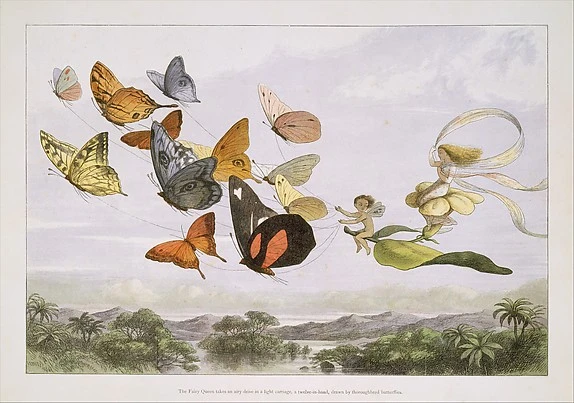
This illustration from In Fairyland gives fairy life a place among plants. Hodson describes his encounter near a hedge of wild roses.
After Richard Doyle, In Fairyland: A Series of Pictures from the Elf-World. The Metropolitan Museum of Art. Gift of Lincoln Kirstein, 1970. · Image source ↗ · CC0
The Astral Plane by Charles W. Leadbeater
In The Astral Plane, Charles W. Leadbeater says some nature spirits can project an impression onto a receptive observer. He uses this idea to account for one appearing in a shape different from the one he regards as usual. [5][6]
Tam Lin in The English and Scottish Popular Ballads
In Tam Lin, version 39A in Francis James Child’s collection, Tam Lin tells Janet to recognise him in the fairy procession and hold on after seizing him. The fairies are to change him into alarming forms. Holding on is part of how she frees him. [2]
Changed appearance and changed feeling
Tam Lin tests recognition through changing forms. Hodson makes the fairy’s attraction and the difficulty of leaving central to the encounter. [3][4][2]
Leadbeater’s account explains a projected appearance. Hodson’s description also gives the enchantment a pull on feeling and attention. [5][6][3][4]
In the library
The Kingdom of the Gods
Reading note
The separately titled account draws on exact passages in the consulted Library edition.
The Astral Plane
Reading note
Separately attributed comparison with exact previously researched Library passages.
Sources
See references (6)
- After Richard Doyle, In Fairyland: A Series of Pictures from the Elf-World ↗After Richard Doyle, In Fairyland: A Series of Pictures from the Elf-World. The Metropolitan Museum of Art. Gift of Lincoln Kirstein, 1970.
- Tam Lin, Child Ballad 39, version A ↗Tam Lin, version A, in Francis James Child, The English and Scottish Popular Ballads, no. 39, from recognition at the crossroads to release.
- The Kingdom of the Gods, Reader page 103Geoffrey Hodson, The Kingdom of the Gods, Theosophical Publishing House, first published 1952, thirteenth reprint 2007. Lumitheca Library edition IMJ-0606-E001.Read this page in The Kingdom of the Gods ↗
- The Kingdom of the Gods, Reader page 104Geoffrey Hodson, The Kingdom of the Gods, Theosophical Publishing House, first published 1952, thirteenth reprint 2007. Lumitheca Library edition IMJ-0606-E001.Read this page in The Kingdom of the Gods ↗
- The Astral Plane, printed p. 78, Reader page 75C. W. Leadbeater, The Astral Plane, third revised edition scan, circa 1900.Read this page in The Astral Plane ↗
- The Astral Plane, printed p. 79, Reader page 76C. W. Leadbeater, The Astral Plane, third revised edition scan, circa 1900.
Examine the original Library page
wonderful power which they possess of casting a glamour over those who yield themselves to their influence, so that such victims for the
Open the original page in The Astral Plane ↗Scan leaf 83 · C. W. Leadbeater