Enlightenment in esoteric training
In Steiner’s esoteric training, enlightenment means seeing what he calls spiritual light and colour. Read his exercise with a stone, an animal and a plant.
In this article
Understanding the concept
Enlightenment is the second stage in Rudolf Steiner’s outline of esoteric training. Probation develops the spiritual senses in his account. Enlightenment brings light and colour to what those senses are supposed to perceive, preparing the student for initiation. [2][3][4][5][6][7]
See references (6)
- Knowledge of the Higher Worlds and Its Attainment, Reader page 32
- Knowledge of the Higher Worlds and Its Attainment, Reader page 34
- Knowledge of the Higher Worlds and Its Attainment, Reader page 45
- Knowledge of the Higher Worlds and Its Attainment, Reader page 47
- Knowledge of the Higher Worlds and Its Attainment, Reader page 46
- Knowledge of the Higher Worlds and Its Attainment, Reader page 49
Steiner’s exercise
Knowledge of the Higher Worlds by Rudolf Steiner
Rudolf Steiner begins with a stone and an animal. He attributes the animal’s movement and bodily organization to desire or instinct and the stone’s form to forces without desire. The comparison brings feelings and thought together. A clear crystal is one possible specimen, and a footnote rules out crystal-gazing as the aim. [4][6]
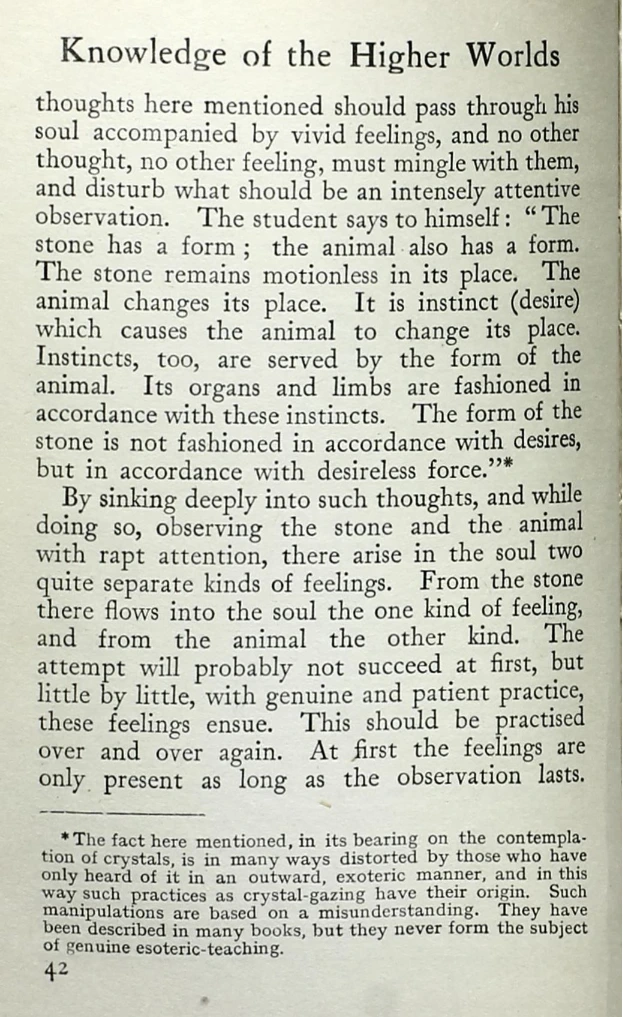
The stone and animal exercise includes a footnote about crystal-gazing. Knowledge of the Higher Worlds, printed p. 42, Library reader p. 46.
Rudolf Steiner, G. Metaxa translation, edited by Harry Collison. Historical public-domain source facsimile from the exact checksum-verified Library edition. Repository date 1932; the inspected title page is undated. · Image source ↗ · Public Domain
Spiritual colours and their meaning
A plant is introduced between the stone and the animal. Steiner says that continued practice can call up the feelings each object evokes even in its absence. He associates the stone with spiritual blue or blue-red, the animal with red or red-yellow, and the plant with green tending toward pale pink. Those are approximate descriptions of what he believes the student comes to perceive, with room for variation in each kingdom. [5][8]
Steiner also expects the student to remain observant in daily life and to develop greater sympathy for people and animals. He treats those qualities as practical conditions of the training. [7][9]
Attention in the Buddhist discourse
The Satipatthana Sutta: another account of attention
The Satipatthana Sutta describes attention to breathing and bodily posture. In Thanissaro Bhikkhu’s translation, a practitioner recognizes a long or short breath and knows when they are walking, standing, sitting or lying down. These are two exercises in the discourse’s contemplation of the body. [1]
Different purposes of attention
The Buddhist discourse gives sustained attention to bodily experience a place in its path to awakening. Steiner treats the attention paid to natural objects as a way to develop a claimed capacity for perceiving spiritual colour and light. Each account ties the act of looking to a different purpose. [1][5][7]
In Steiner’s outline, enlightenment kindles spiritual light and initiation establishes contact with higher spiritual beings. He allows the stages to overlap in practice. [2][3]
See references (5)
- Satipaṭṭhāna Sutta, MN 10, opening formula and Body §§ 1–2, translated by Ṭhānissaro Bhikkhu
- Knowledge of the Higher Worlds and Its Attainment, Reader page 32
- Knowledge of the Higher Worlds and Its Attainment, Reader page 34
- Knowledge of the Higher Worlds and Its Attainment, Reader page 47
- Knowledge of the Higher Worlds and Its Attainment, Reader page 49
Read further in the library

Knowledge of the Higher Worlds and Its Attainment
Reading note
The separately titled account draws on exact passages in the consulted Library edition.
Sources
See references (9)
- Satipaṭṭhāna Sutta, MN 10, opening formula and Body §§ 1–2, translated by Ṭhānissaro Bhikkhu ↗Early Buddhist discourse traditionally attributed to the Buddha, in Ṭhānissaro Bhikkhu’s translation. The translator’s introduction is distinguished from the discourse. Consulted opening formula, breathing and postures.Return to text ↑
- Knowledge of the Higher Worlds and Its Attainment, Reader page 32Rudolf Steiner, Knowledge of the Higher Worlds and Its Attainment, authorized English translation by G. Metaxa, edited by Harry Collison, Anthroposophic Press, New York City. Exact Library edition IMJ-0513-E001. No publication year is visible on the inspected title page; the repository assigns 1932. Claims of supersensible perception remain attributed to Steiner.Read this page in Knowledge of the Higher Worlds and Its Attainment ↗Return to text ↑
- Knowledge of the Higher Worlds and Its Attainment, Reader page 34Rudolf Steiner, Knowledge of the Higher Worlds and Its Attainment, authorized English translation by G. Metaxa, edited by Harry Collison, Anthroposophic Press, New York City. Exact Library edition IMJ-0513-E001. No publication year is visible on the inspected title page; the repository assigns 1932. Claims of supersensible perception remain attributed to Steiner.Read this page in Knowledge of the Higher Worlds and Its Attainment ↗Return to text ↑
- Knowledge of the Higher Worlds and Its Attainment, Reader page 45Rudolf Steiner, Knowledge of the Higher Worlds and Its Attainment, authorized English translation by G. Metaxa, edited by Harry Collison, Anthroposophic Press, New York City. Exact Library edition IMJ-0513-E001. No publication year is visible on the inspected title page; the repository assigns 1932. Claims of supersensible perception remain attributed to Steiner.Read this page in Knowledge of the Higher Worlds and Its Attainment ↗Return to text ↑
- Knowledge of the Higher Worlds and Its Attainment, Reader page 47Rudolf Steiner, Knowledge of the Higher Worlds and Its Attainment, authorized English translation by G. Metaxa, edited by Harry Collison, Anthroposophic Press, New York City. Exact Library edition IMJ-0513-E001. No publication year is visible on the inspected title page; the repository assigns 1932. Claims of supersensible perception remain attributed to Steiner.Read this page in Knowledge of the Higher Worlds and Its Attainment ↗Return to text ↑
- Knowledge of the Higher Worlds and Its Attainment, Reader page 46Rudolf Steiner, Knowledge of the Higher Worlds and Its Attainment, authorized English translation by G. Metaxa, edited by Harry Collison, Anthroposophic Press, New York City. Exact Library edition IMJ-0513-E001. No publication year is visible on the inspected title page; the repository assigns 1932. Claims of supersensible perception remain attributed to Steiner.Read this page in Knowledge of the Higher Worlds and Its Attainment ↗Return to text ↑
- Knowledge of the Higher Worlds and Its Attainment, Reader page 49Rudolf Steiner, Knowledge of the Higher Worlds and Its Attainment, authorized English translation by G. Metaxa, edited by Harry Collison, Anthroposophic Press, New York City. Exact Library edition IMJ-0513-E001. No publication year is visible on the inspected title page; the repository assigns 1932. Claims of supersensible perception remain attributed to Steiner.Read this page in Knowledge of the Higher Worlds and Its Attainment ↗Return to text ↑
- Knowledge of the Higher Worlds and Its Attainment, Reader page 48Rudolf Steiner, Knowledge of the Higher Worlds and Its Attainment, authorized English translation by G. Metaxa, edited by Harry Collison, Anthroposophic Press, New York City. Exact Library edition IMJ-0513-E001. No publication year is visible on the inspected title page; the repository assigns 1932. Claims of supersensible perception remain attributed to Steiner.Read this page in Knowledge of the Higher Worlds and Its Attainment ↗Return to text ↑
- Knowledge of the Higher Worlds and Its Attainment, Reader page 50Rudolf Steiner, Knowledge of the Higher Worlds and Its Attainment, authorized English translation by G. Metaxa, edited by Harry Collison, Anthroposophic Press, New York City. Exact Library edition IMJ-0513-E001. No publication year is visible on the inspected title page; the repository assigns 1932. Claims of supersensible perception remain attributed to Steiner.Read this page in Knowledge of the Higher Worlds and Its Attainment ↗Return to text ↑