Erlang Shen
Erlang Shen (二郎神, Èrláng Shén) is a Chinese protector god. In Sichuan he guards against floods. In tales of the Monkey King he matches his quarry shape for shape.
In this article
A river god in Sichuan
At Dujiangyan in Sichuan, the Min River feeds an irrigation system built under the governor Li Bing in the third century BCE. Local worship linked the work of controlling the river with Erlang, a god said to have subdued a dragon that raised floods. At the Temple of the Two Kings, Li Bing and Erlang came to be honoured together as father and son. [1][2]
In the tenth century, Erlang had a royal patron in Meng Chang, ruler of Later Shu. When the Song conquered his kingdom in 965, they took up the worship of Erlang too. Temples dedicated to him appeared in the Song capital and far beyond Sichuan. [2]
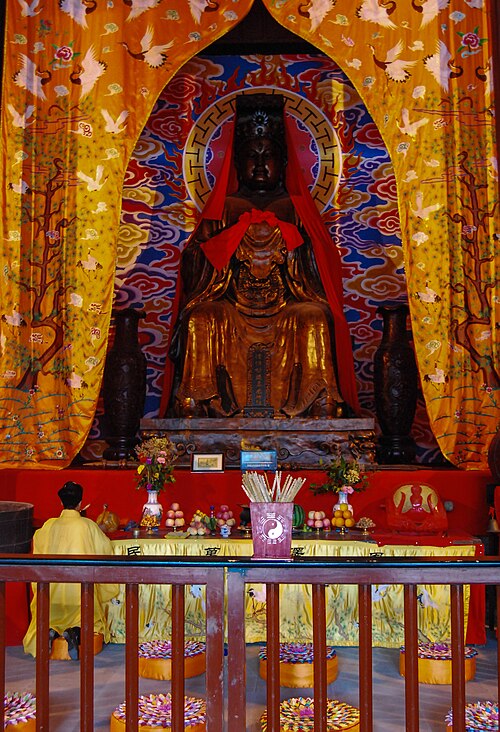
Erlang at Dujiangyan. A worshipper faces the seated god across an altar laid with offerings.
Photograph by Shizhao, 2011. Resized. · Image source ↗ · CC BY-SA 3.0
See references (2)
In The Chinese Fairy Book
Richard Wilhelm’s The Chinese Fairy Book, translated by Frederick H. Martens, calls him Yang Oerlang. In one tale he lifts the Wu-I hills to free his mother. When he goes to fetch her water, the ten suns burn her to death. In grief he takes a mountain on each shoulder and crushes nine suns between them. The last hides under a plant until a messenger from heaven intervenes. [4][5]
The tale leaves us with a portrait of the hunter. His eyebrows slant sharply, his sword has three points, and two attendants hold his falcon and hound. When a creature acquires magical powers and threatens people, these are the animals he takes after it. [6]
In the Monkey King tale, Guanyin calls on Erlang after heaven’s army fails to capture Sun Wukong. Erlang asks for the net over the battlefield to be lifted and for a spirit mirror to be held ready. Then the chase begins. The Monkey King becomes a sparrow perched in a tree. Erlang spots him, casts aside his weapons and dives at him as a sparrowhawk. [7][8]
Two stories of the ten suns
Who brought down the nine suns? In a passage preserved in the Chinese anthology Yiwen leiju, the ruler Yao sends the archer Yi to shoot them. Wilhelm draws attention to the resemblance. The weapon and the motive both change in Erlang’s tale. Yi takes up his bow at a ruler’s command. Erlang reaches for the mountains because he has lost his mother. [9][5][6]
The demon hunt in painting
Painters in China had begun to picture Erlang’s mountain hunt by the tenth century. Seven centuries later, Zheng Zhong painted it on a handscroll. A viewer would unroll a stretch at a time, following the hunters through the mountain landscape as each new part of the pursuit came into view. [2]
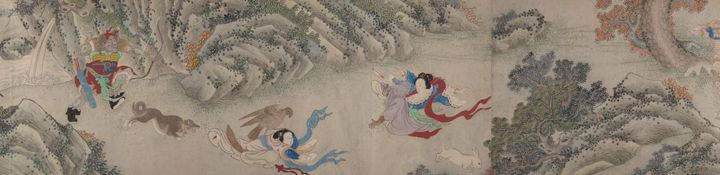
A detail of Zheng Zhong’s Searching the Mountains for Demons, a seventeenth-century handscroll depicting Erlang’s demon hunt.
Zheng Zhong. Searching the Mountains for Demons. 17th century. The Metropolitan Museum of Art. Purchase, Bequest of Dorothy Graham Bennett, 1991. Public Domain. · Image source ↗ · Public Domain
In the library
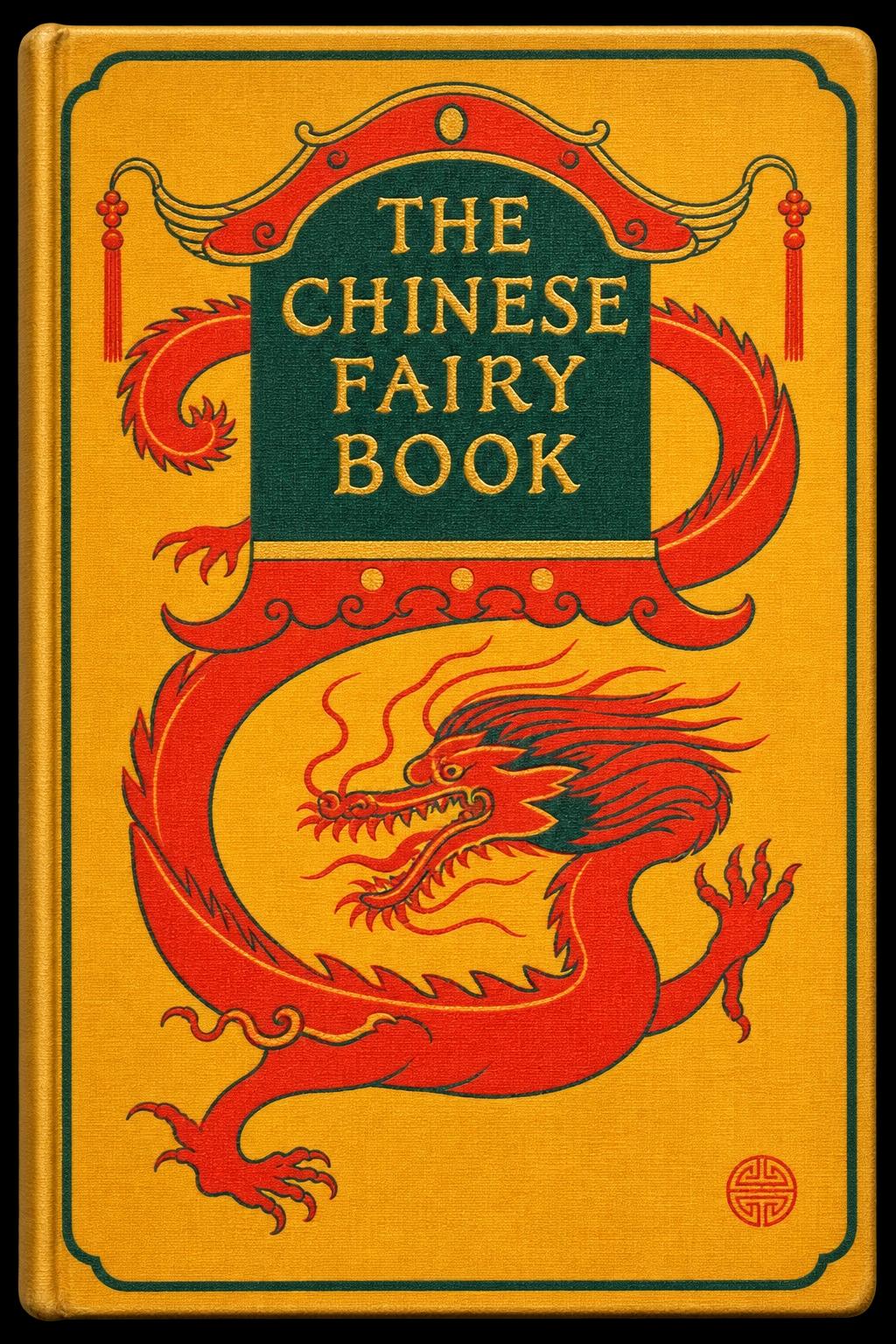
The Chinese Fairy Book
Reading note
Read “Yang Oerlang” on Library Reader pages 54 to 56 and the encounter with the Monkey King on pages 343 and 344.
Sources
See references (9)
- Erlang at Dujiangyan ↗China World Cultural Heritage Monitoring Centre
- Searching the Mountains for Demons ↗Zheng Zhong. Searching the Mountains for Demons. 17th century. The Metropolitan Museum of Art. Purchase, Bequest of Dorothy Graham Bennett, 1991. Public Domain.
- Statue of Erlang at Dujiangyan ↗Shizhao, photograph, 2011. CC BY-SA 3.0.
- The Chinese Fairy Book, Library Reader page 54Richard Wilhelm, editor. Frederick H. Martens, translator. The Chinese Fairy Book. Frederick A. Stokes Company, New York, 1921. Lumitheca Library edition IMJ-0478-E002.Read this page in The Chinese Fairy Book ↗
- The Chinese Fairy Book, Library Reader page 55Richard Wilhelm, editor. Frederick H. Martens, translator. The Chinese Fairy Book. Frederick A. Stokes Company, New York, 1921. Lumitheca Library edition IMJ-0478-E002.Read this page in The Chinese Fairy Book ↗
- The Chinese Fairy Book, Library Reader page 56Richard Wilhelm, editor. Frederick H. Martens, translator. The Chinese Fairy Book. Frederick A. Stokes Company, New York, 1921. Lumitheca Library edition IMJ-0478-E002.Read this page in The Chinese Fairy Book ↗
- The Chinese Fairy Book, Library Reader page 343Richard Wilhelm, editor. Frederick H. Martens, translator. The Chinese Fairy Book. Frederick A. Stokes Company, New York, 1921. Lumitheca Library edition IMJ-0478-E002.Read this page in The Chinese Fairy Book ↗
- The Chinese Fairy Book, Library Reader page 344Richard Wilhelm, editor. Frederick H. Martens, translator. The Chinese Fairy Book. Frederick A. Stokes Company, New York, 1921. Lumitheca Library edition IMJ-0478-E002.Read this page in The Chinese Fairy Book ↗
- Yi and the ten suns in the Yiwen leiju ↗Chinese Text Project