The Eight Immortals
The Eight Immortals are Daoist figures whose stories imagine many ways to gain long life. An iron crutch, a fan or another emblem can stand in for each person.
In this article
Who are the Eight Immortals?
The Eight Immortals, or Baxian, are legendary figures in Chinese Daoism. They gain long life and supernatural abilities in different ways. Sometimes a single object is enough to tell you which immortal is meant. An iron crutch can stand for Li Tieguai even when the person himself is absent. [2][3][4]
The eight are Zhongli Quan, Zhang Guolao, Lü Dongbin, Cao Guojiu, Lan Caihe, Li Tieguai, Han Xiangzi and He Xiangu. Older translations spell many of their names differently, so the objects they carry can help you recognise them from one account to another. [5][6][7][8][4][3]
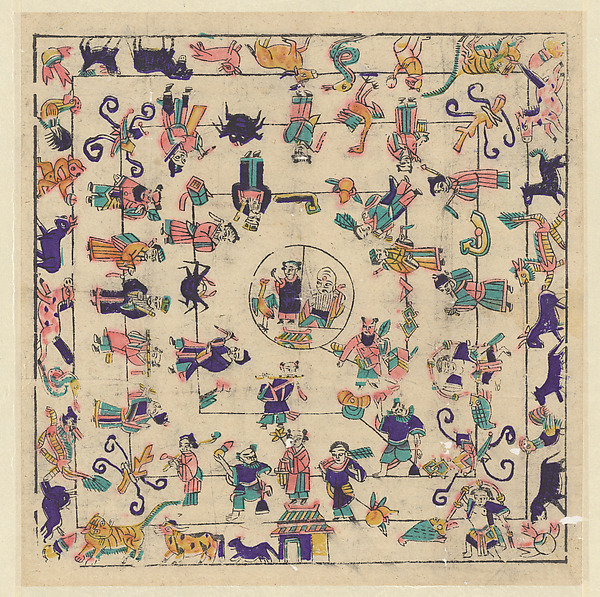
An eighteenth-century woodblock print gathers the Eight Immortals alongside the zodiac animals. The group also appears on much earlier Ming objects.
Eight Immortals and Twelve Zodiac Animals. 18th century. The Metropolitan Museum of Art. Purchase, Bequest of Robert West, by exchange, 2025. Public domain. · Image source ↗ · Public Domain
See references (7)
In The Chinese Fairy Book
Richard Wilhelm’s The Chinese Fairy Book, translated by Frederick H. Martens, first introduces the immortals through individual stories. Zhang Guolao travels on a mount he can fold away. Lü Dongbin is associated with a sword and with numbered oracle sticks in a temple. Li Tieguai’s gourd and iron crutch identify him, while the note connects He Xiangu’s rice spoon with the shape of a lotus. [5][9][6][7][8][4]
In a second tale a field god tells a poor man where to find the immortals. Li Tieguai takes him to Penglai. There the group leaps into the sea, but the man cannot bring himself to follow. Li gives him a chip of stone that turns out to be silver. It pays for the man’s journey home. [4][10]
See references (7)
- The Chinese Fairy Book, Library Reader page 96
- The Chinese Fairy Book, Library Reader page 90
- The Chinese Fairy Book, Library Reader page 92
- The Chinese Fairy Book, Library Reader page 93
- The Chinese Fairy Book, Library Reader page 95
- The Chinese Fairy Book, Library Reader page 91
- The Chinese Fairy Book, Library Reader page 97
How old is the group?
Wilhelm’s note dates the group to the Manchu dynasty. A Ming tray and a Ming porcelain box at the Met show all eight together in the sixteenth century, before that dynasty began. [8][1][2]
In the library
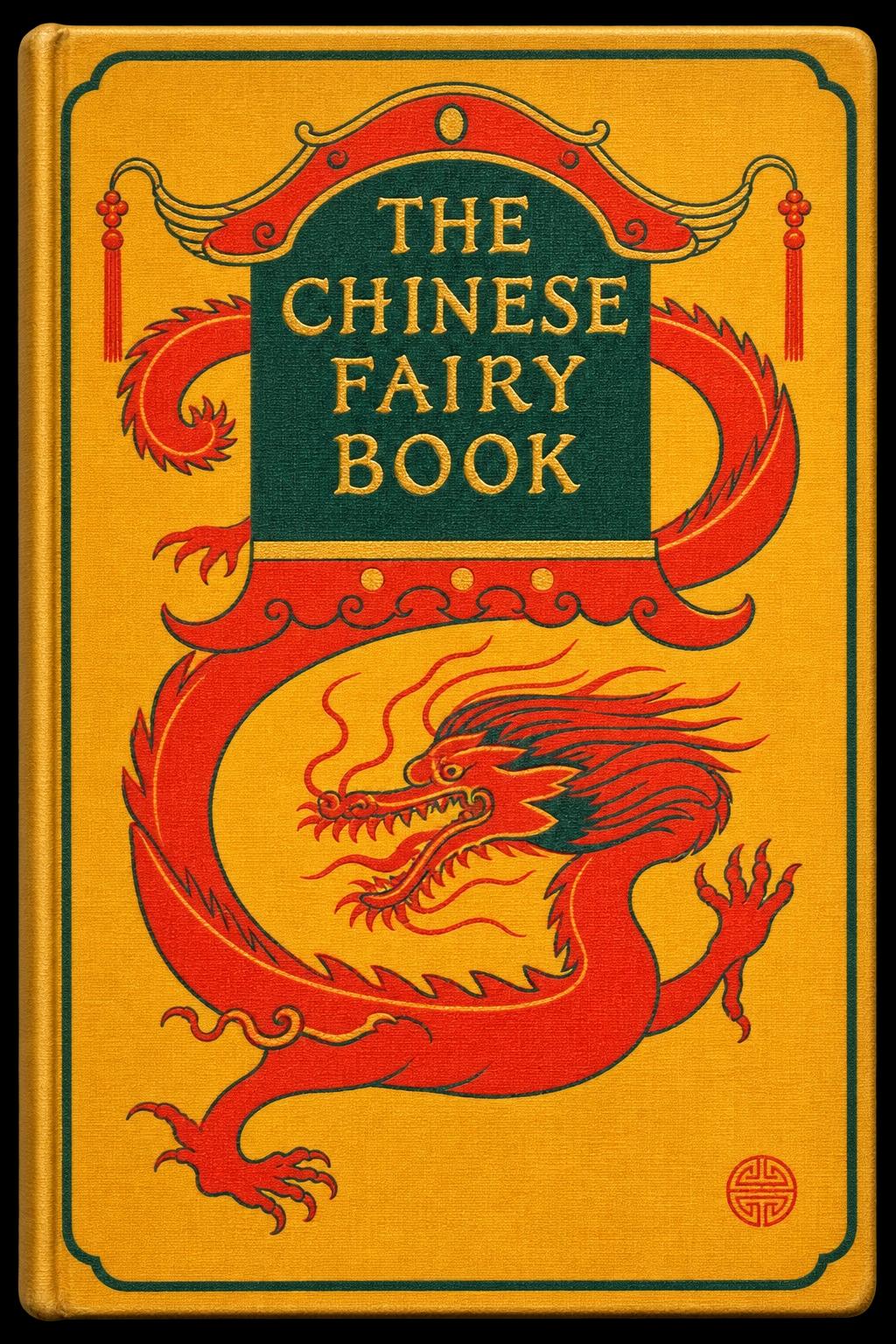
The Chinese Fairy Book
Reading note
Read the portraits of individual immortals, then follow the poor man to their gathering at Penglai.
Sources
See references (10)
- Tray with Daoist figures ↗The Metropolitan Museum of Art
- Box with Daoist Immortals ↗The Metropolitan Museum of Art
- Eight Immortals and Twelve Zodiac Animals ↗Eight Immortals and Twelve Zodiac Animals. 18th century. The Metropolitan Museum of Art. Purchase, Bequest of Robert West, by exchange, 2025. Public domain.
- The Chinese Fairy Book, Library Reader page 96Richard Wilhelm, editor. Frederick H. Martens, translator. The Chinese Fairy Book. Frederick A. Stokes Company, New York, 1921. Lumitheca Library edition IMJ-0478-E002.Read this page in The Chinese Fairy Book ↗
- The Chinese Fairy Book, Library Reader page 90Richard Wilhelm, editor. Frederick H. Martens, translator. The Chinese Fairy Book. Frederick A. Stokes Company, New York, 1921. Lumitheca Library edition IMJ-0478-E002.Read this page in The Chinese Fairy Book ↗
- The Chinese Fairy Book, Library Reader page 92Richard Wilhelm, editor. Frederick H. Martens, translator. The Chinese Fairy Book. Frederick A. Stokes Company, New York, 1921. Lumitheca Library edition IMJ-0478-E002.Read this page in The Chinese Fairy Book ↗
- The Chinese Fairy Book, Library Reader page 93Richard Wilhelm, editor. Frederick H. Martens, translator. The Chinese Fairy Book. Frederick A. Stokes Company, New York, 1921. Lumitheca Library edition IMJ-0478-E002.Read this page in The Chinese Fairy Book ↗
- The Chinese Fairy Book, Library Reader page 95Richard Wilhelm, editor. Frederick H. Martens, translator. The Chinese Fairy Book. Frederick A. Stokes Company, New York, 1921. Lumitheca Library edition IMJ-0478-E002.Read this page in The Chinese Fairy Book ↗
- The Chinese Fairy Book, Library Reader page 91Richard Wilhelm, editor. Frederick H. Martens, translator. The Chinese Fairy Book. Frederick A. Stokes Company, New York, 1921. Lumitheca Library edition IMJ-0478-E002.Read this page in The Chinese Fairy Book ↗
- The Chinese Fairy Book, Library Reader page 97Richard Wilhelm, editor. Frederick H. Martens, translator. The Chinese Fairy Book. Frederick A. Stokes Company, New York, 1921. Lumitheca Library edition IMJ-0478-E002.Read this page in The Chinese Fairy Book ↗