Dusii
Dusii is a Gaulish name for spirits reported by Augustine. Compare the passage in The City of God with its reuse in Magica Sexualis.
In this article
Understanding dusii
Dusii is a name Augustine attributes to the Gauls for spirits said to assault women. His account places them beside fauns and sylvans called incubi. The consulted English translation gives the name as Duses. Augustine’s report gives the name a regional setting but says little about the beings’ appearance or place in Gaulish tradition. [1][3][4]
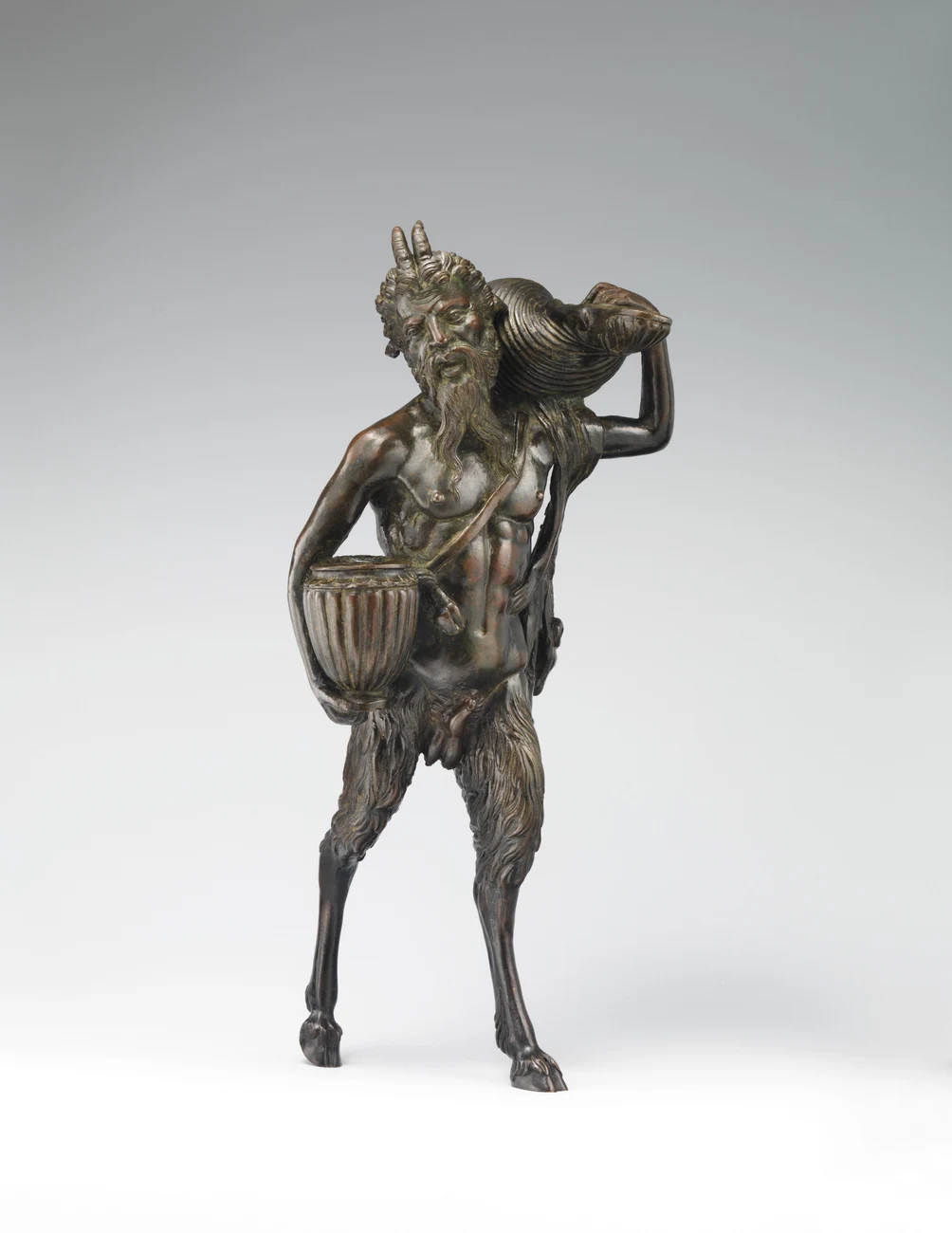
Striding Pan, Andrea Briosco, called Riccio. The Met identifies the figure as probably Pan, a classical parallel for the woodland spirits named by Augustine.
The Metropolitan Museum of Art, 1982.45. Purchase, Gifts of Irwin Untermyer, Ogden Mills and George Blumenthal, Bequest of Julia H. Manges and Frederick C. Hewitt Fund, by exchange; and Rogers and Pfeiffer Funds, 1982. CC0 Open Access. · Image source ↗ · CC0
The City of God by Augustine
In The City of God, Book XV, chapter 23, Augustine cites reports he considers credible about fauns, sylvans and beings called Duses. He then leaves open whether spirits could possess aerial bodies capable of bodily intercourse. His main concern in the passage is the reading of angels, human descent and giants in Genesis. [1]
Magica Sexualis by Émile Laurent and Paul Nagour
In Magica Sexualis, Émile Laurent and Paul Nagour call the dusii a Gaulish class of incubi. They cite Augustine and place the name among forest spirits and then alongside Scandinavian and Greek figures in the chapter on incubi and succubi. That grouping reflects the compilers’ comparison. [5][3][4][6]
A Gaulish name in two accounts
Augustine gives readers a name and the kind of encounter attached to it. Laurent and Nagour make the name part of a larger classification. The association with classical woodland beings explains why Pan makes a useful visual parallel, while the surviving passage offers too little to describe how a dusii was pictured. [3][4][6][1][2]
See references (5)
- Augustine, The City of God, Book XV, chapter 23: incubi, the Gaulish name and the interpretation of Genesis
- The Metropolitan Museum of Art, Striding Pan, Andrea Briosco, called Riccio, 1530–1539, 1982.45
- Magica Sexualis, Reader page 27
- Magica Sexualis, printed p. 20, Reader page 28
- Magica Sexualis, Reader page 46
Read further in the library
Magica Sexualis
Reading note
The separately titled account draws on exact passages in the consulted Library edition.
Sources
See references (6)
- Augustine, The City of God, Book XV, chapter 23: incubi, the Gaulish name and the interpretation of Genesis ↗Augustine, The City of God, Book XV, chapter 23. Directly consulted chapter in Marcus Dods’s translation, Nicene and Post-Nicene Fathers, First Series, volume 2 (1887), as revised for New Advent. The chapter’s reports, uncertainty about aerial embodiment and interpretation of Genesis are read together. Chapter locator only; no Library edition, printed page or original Latin inspection claimed.Return to text ↑
- The Metropolitan Museum of Art, Striding Pan, Andrea Briosco, called Riccio, 1530–1539, 1982.45 ↗Direct museum object page and Collection API object 206918. Bronze, Italian, Padua, 1530–1539, 1982.45. Museum identifies the figure as most probably Pan. API isPublicDomain true; CC0 Open Access. Actual asset inspected. Renaissance classical imagery, not an identified Gaulish dusii image.Return to text ↑
- Magica Sexualis, Reader page 27Émile Laurent and Paul Nagour, Magica Sexualis, privately printed by Falstaff Press Inc., New York, undated inspected edition. Exact original Library edition IMJ-0105-E001. The work is a historical compilation; its quoted fiction, trial allegations and medical interpretations are not treated as independently verified facts. Current Reader positions are mapped separately from printed pagination.Read this page in Magica Sexualis ↗Return to text ↑
- Magica Sexualis, printed p. 20, Reader page 28Émile Laurent and Paul Nagour, Magica Sexualis, privately printed by Falstaff Press Inc., New York, undated inspected edition. Exact original Library edition IMJ-0105-E001. The work is a historical compilation; its quoted fiction, trial allegations and medical interpretations are not treated as independently verified facts. Current Reader positions are mapped separately from printed pagination.Read this page in Magica Sexualis ↗Return to text ↑
- Magica Sexualis, Reader page 26Émile Laurent and Paul Nagour, Magica Sexualis, privately printed by Falstaff Press Inc., New York, undated inspected edition. Exact original Library edition IMJ-0105-E001. The work is a historical compilation; its quoted fiction, trial allegations and medical interpretations are not treated as independently verified facts. Current Reader positions are mapped separately from printed pagination.Read this page in Magica Sexualis ↗Return to text ↑
- Magica Sexualis, Reader page 46Émile Laurent and Paul Nagour, Magica Sexualis, privately printed by Falstaff Press Inc., New York, undated inspected edition. Exact original Library edition IMJ-0105-E001. The work is a historical compilation; its quoted fiction, trial allegations and medical interpretations are not treated as independently verified facts. Current Reader positions are mapped separately from printed pagination.Read this page in Magica Sexualis ↗Return to text ↑