Dowsing
Dowsing uses the movement of a rod or pendulum to infer what is hidden. Explore mining woodcuts, the Jacques Aymar controversy and the evidence for water dowsing.
In this article
What is dowsing?
Dowsing uses the movement of a rod, pendulum or similar object to look for hidden water, minerals or other targets. Early modern mining books show people prospecting with forked rods. The woodcuts preserve what the practice looked like. [3][4][5][1][2]
For finding water today, the U.S. Geological Survey points out that shallow groundwater is common in many places. A successful well after a dowser has chosen a site can appear more convincing than it is. The Survey recommends using geological and hydrological evidence to locate groundwater. [2]
Witchcraft Magic & Alchemy by Grillot de Givry
Grillot de Givry reproduces a cutaway mine credited to Sebastian Münster, with a dowser standing above ground. In a woodcut from Georg Agricola’s De re metallica, prospectors use rods while workers dig test pits nearby. De Givry’s figure comes from a 1571 edition. The first edition appeared in Basel in 1556. [3][4][5][1]
De Givry also recounts the case of Jacques Aymar, who claimed to track murder suspects with a rod in 1692. The physician Pierre Garnier explained the motion as a response to particles left behind. Theologians cited a different cause, attributing similar movements to demons. [5][6][7]
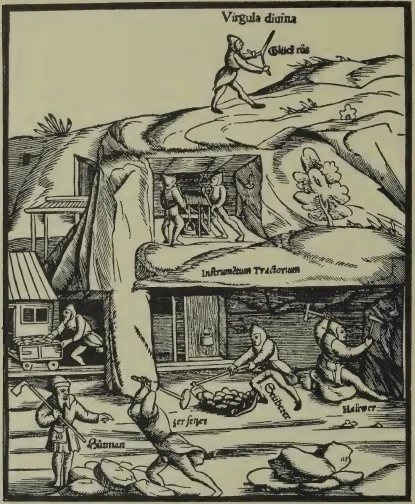
A woodcut credited to Sebastian Münster’s Cosmographia universalis. The prospector appears above the mine workings.
Sebastian Münster, Cosmographia universalis, Basel, 1544, as credited by De Givry. · Image source ↗ · Public Domain
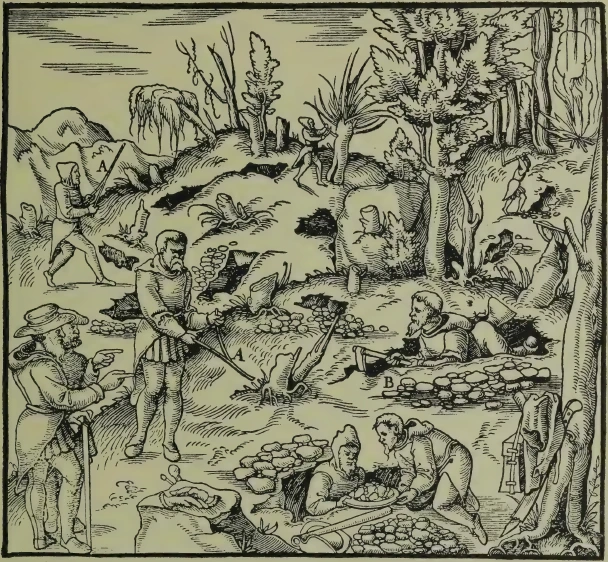
Prospecting in Georg Agricola’s De re metallica. De Givry reproduces this woodcut from a 1571 edition.
Georg Agricola, De re metallica, Basel, 1571 edition identified by De Givry. · Image source ↗ · Public Domain
See references (6)
- De re metallica, Basel, 1556
- Witchcraft Magic & Alchemy, printed p. 312, Reader page 308
- Witchcraft Magic & Alchemy, printed p. 313, Reader page 309
- Witchcraft Magic & Alchemy, printed p. 314, Reader page 310
- Witchcraft Magic & Alchemy, printed p. 315, Reader page 311
- Witchcraft Magic & Alchemy, printed p. 317, Reader page 313
From prospecting to criminal investigation
The mining images show rods alongside digging and inspection of the ground. In the Aymar story, the movement of a rod was treated as a clue to someone’s past route. That made the judgement of witnesses and investigators part of the case. [3][4][5][6]
In the library
Witchcraft Magic and Alchemy
Reading note
The separately titled account draws on exact passages in the consulted Library edition.
Sources
See references (7)
- De re metallica, Basel, 1556 ↗Georg Agricola. Science History Institute Digital Collections, first edition.
- Water Dowsing ↗United States Geological Survey, Water Science School.
- Witchcraft Magic & Alchemy, printed p. 312, Reader page 308Grillot de Givry, Witchcraft Magic & Alchemy, translated by J. Courtenay Locke. Boston and New York, Houghton Mifflin Company, 1931.Read this page in Witchcraft Magic and Alchemy ↗
- Witchcraft Magic & Alchemy, printed p. 313, Reader page 309Grillot de Givry, Witchcraft Magic & Alchemy, translated by J. Courtenay Locke. Boston and New York, Houghton Mifflin Company, 1931.Read this page in Witchcraft Magic and Alchemy ↗
- Witchcraft Magic & Alchemy, printed p. 314, Reader page 310Grillot de Givry, Witchcraft Magic & Alchemy, translated by J. Courtenay Locke. Boston and New York, Houghton Mifflin Company, 1931.Read this page in Witchcraft Magic and Alchemy ↗
- Witchcraft Magic & Alchemy, printed p. 315, Reader page 311Grillot de Givry, Witchcraft Magic & Alchemy, translated by J. Courtenay Locke. Boston and New York, Houghton Mifflin Company, 1931.Read this page in Witchcraft Magic and Alchemy ↗
- Witchcraft Magic & Alchemy, printed p. 317, Reader page 313Grillot de Givry, Witchcraft Magic & Alchemy, translated by J. Courtenay Locke. Boston and New York, Houghton Mifflin Company, 1931.Read this page in Witchcraft Magic and Alchemy ↗