Dimensional Freedom and Metamorphosis
Why does Bragdon compare higher dimensions to a butterfly taking flight? Read his analogy for freedom of movement and the limits of perception.
In this article
When movement gains a new direction
Dimensional freedom is the number of independent directions in which something can move. A body with length, width and thickness can still be confined to a path or a surface. Claude Bragdon uses the passage from crawling to flight to make that distinction visible. [2][3][4][5][6]
A Primer of Higher Space by Claude Bragdon
In A Primer of Higher Space, Claude Bragdon imagines a grub working upward, a caterpillar moving on a surface and a butterfly flying out into the air. He gives each stage a wider range of movement. In the related drawing, stems and leaves restrict movement even though they have thickness. [2][3][4][5]
Bragdon then draws on Carl du Prel’s idea that the threshold of perception can shift. He imagines a fourth direction being as unfamiliar to us as flight would be to a creature whose experience was confined to a surface. [4][5]
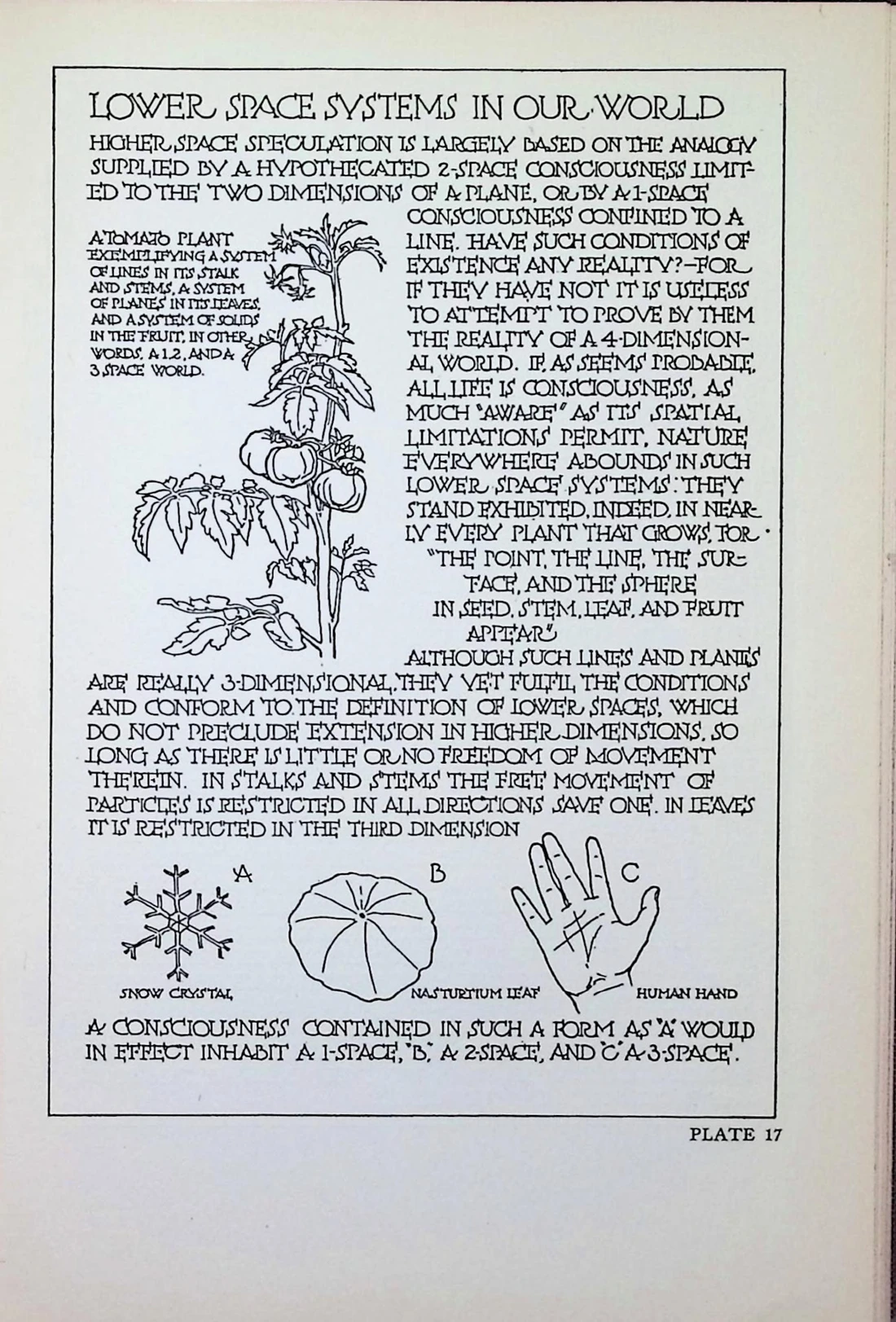
In Plate 17, Bragdon uses a stem and leaf to represent movement constrained to one or two directions.
Claude Bragdon, A Primer of Higher Space, The Manas Press, 1913. Stickley Museum scan via Internet Archive. · Image source ↗ · Public Domain
The example and the extrapolation
The butterfly’s flight takes place in the same three-dimensional world as the caterpillar’s movement. Bragdon takes the change in freedom as an analogy for what gaining a further spatial direction might feel like. [2][5][6]
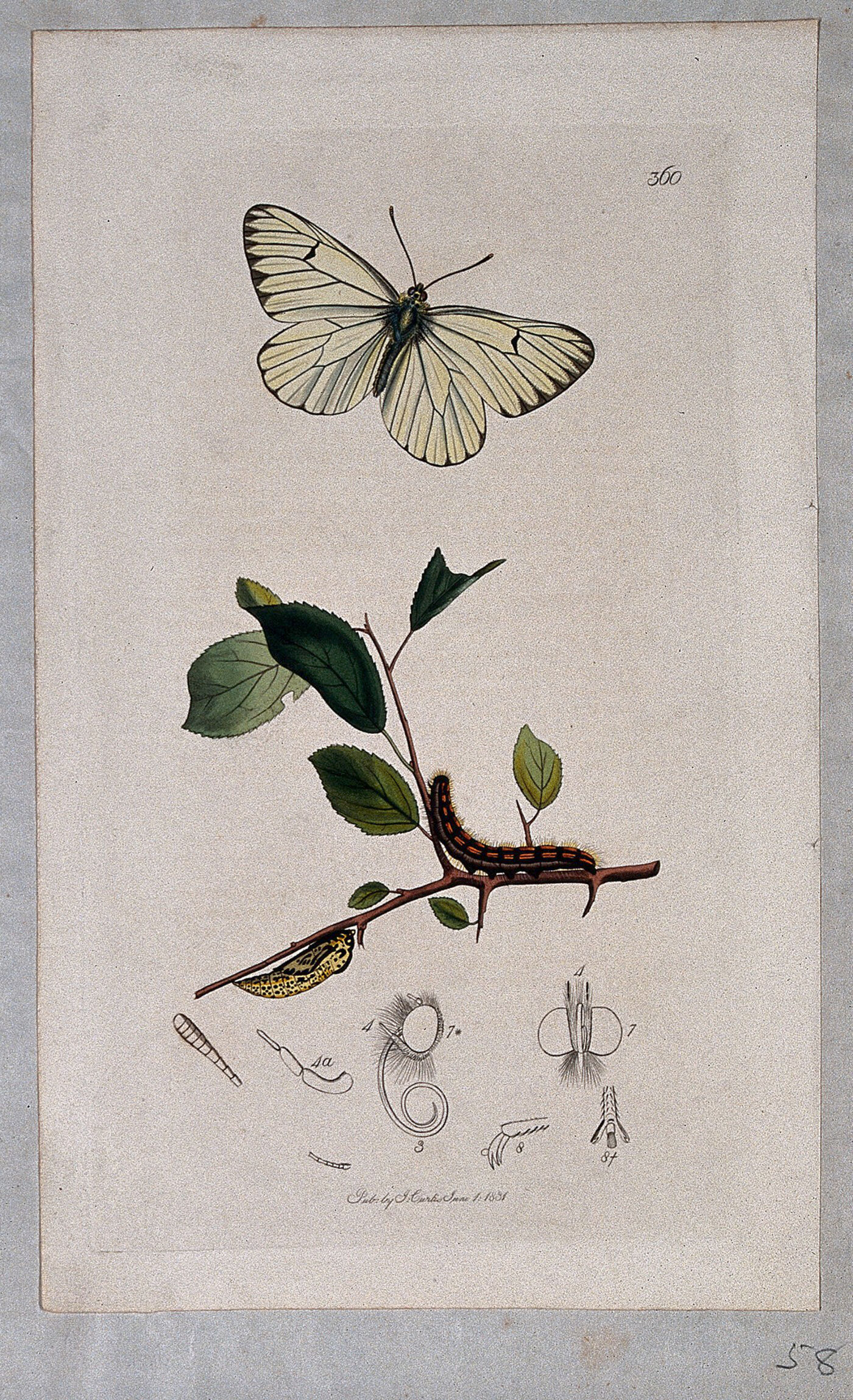
This 1831 etching shows a butterfly, caterpillar and chrysalis beside a hawthorn twig. Bragdon uses metamorphosis to picture a change in freedom of movement.
Wellcome Collection, 24205i, image V0044007EL. Public Domain Mark. · Image source ↗ · Public Domain
In the library
A Primer of Higher Space
Reading note
The separately titled account draws on exact passages in the consulted Library edition.
Sources
See references (7)
- Plate 17, lower-space systems in nature ↗Claude Bragdon, A Primer of Higher Space, The Manas Press, 1913. Stickley Museum scan via Internet Archive.
- A Primer of Higher Space, printed p. 6, Reader page 13Claude Bragdon, A Primer of Higher Space (The Fourth Dimension), The Manas Press, Rochester, New York, 1913. Lumitheca Library edition IMJ-0599-E001.Read this page in A Primer of Higher Space ↗
- A Primer of Higher Space, printed p. 13, Reader page 20Claude Bragdon, A Primer of Higher Space (The Fourth Dimension), The Manas Press, Rochester, New York, 1913. Lumitheca Library edition IMJ-0599-E001.Read this page in A Primer of Higher Space ↗
- A Primer of Higher Space, printed p. 14, Reader page 21Claude Bragdon, A Primer of Higher Space (The Fourth Dimension), The Manas Press, Rochester, New York, 1913. Lumitheca Library edition IMJ-0599-E001.Read this page in A Primer of Higher Space ↗
- A Primer of Higher Space, printed p. 15, Reader page 22Claude Bragdon, A Primer of Higher Space (The Fourth Dimension), The Manas Press, Rochester, New York, 1913. Lumitheca Library edition IMJ-0599-E001.Read this page in A Primer of Higher Space ↗
- A Primer of Higher Space, Plate 17, Reader page 46Claude Bragdon, A Primer of Higher Space (The Fourth Dimension), The Manas Press, Rochester, New York, 1913. Lumitheca Library edition IMJ-0599-E001.Read this page in A Primer of Higher Space ↗
- A hawthorn twig (Crataegus species) with an associated butterfly, its caterpillar, chrysalis and anatomical segments. Coloured etching, c. 1831. ↗Wellcome Collection, 24205i, image V0044007EL. Public Domain Mark.