Dimensional Analogy
How do lines, squares and cubes help explain a fourth spatial dimension? Follow Bragdon’s visual method and compare it with Abbott’s Flatland.
In this article
How a familiar shape helps us reason about an unseen one
Dimensional analogy uses the relation between familiar shapes to reason about a new dimension. A square’s boundary has four line segments. A cube’s boundary has six squares. Extending the rule lets us ask what shape could have cubes as its boundary. [3][4][5][6][2]
A Primer of Higher Space by Claude Bragdon
In A Primer of Higher Space, Claude Bragdon makes the same progression by motion. A point traces a line segment. Slide that segment at a right angle by its own length to make a square. Move the square the same way out of its plane and it sweeps out a cube. [3][4][5][6]
Bragdon carries the construction one step further by giving the cube a new direction at right angles to its own three. His plane-world analogy explains why someone limited to three dimensions could follow the rule without being able to picture that movement directly. [4][7][8][9][6]
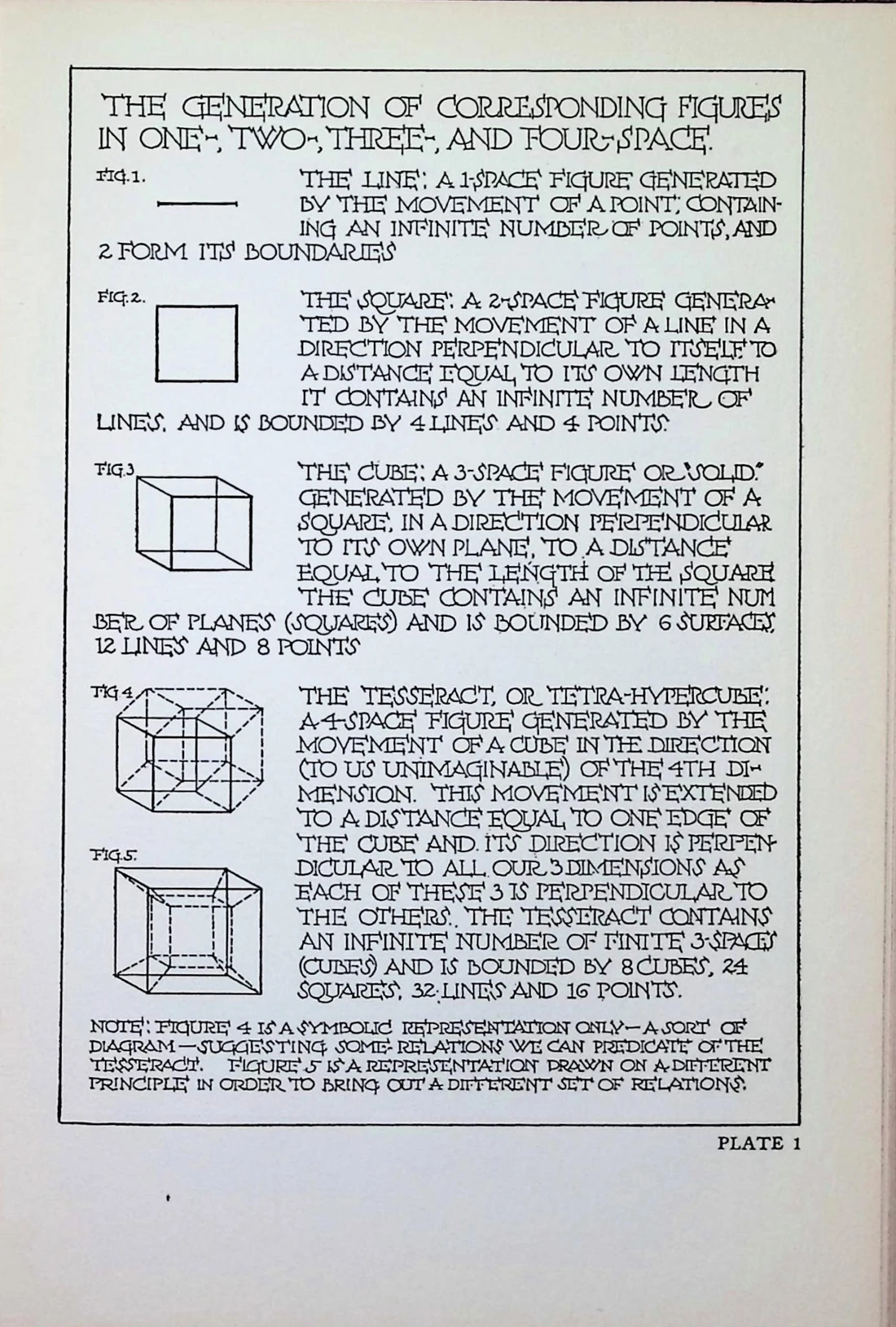
Plate 1 shows how motion perpendicular to each shape produces the next one, from a line through to a tesseract.
Claude Bragdon, A Primer of Higher Space, The Manas Press, 1913. Stickley Museum scan via Internet Archive. · Image source ↗ · Public Domain
See references (7)
- A Primer of Higher Space, printed p. 1, Reader page 8
- A Primer of Higher Space, printed p. 2, Reader page 9
- A Primer of Higher Space, printed p. 9, Reader page 16
- A Primer of Higher Space, Plate 1, Reader page 30
- A Primer of Higher Space, printed p. 3, Reader page 10
- A Primer of Higher Space, printed p. 10, Reader page 17
- A Primer of Higher Space, printed p. 12, Reader page 19
Flatland by Edwin A. Abbott
In Edwin A. Abbott’s Flatland, the Sphere asks the Square to compare a line with a plane figure, then a plane figure with a solid. Their conversation shows how a next step can be reasoned about before it can be experienced. [2]
A drawing and a conversation
Abbott puts the problem inside a conversation between people with different experiences of space. Bragdon gives the reader a repeatable construction and draws the result at each stage. [3][4][6][2]
In the library
A Primer of Higher Space
Reading note
The separately titled account draws on exact passages in the consulted Library edition.
Sources
See references (9)
- Plate 1, figures in one through four dimensions ↗Claude Bragdon, A Primer of Higher Space, The Manas Press, 1913. Stickley Museum scan via Internet Archive.
- Flatland, Part II, section 16, the Sphere and dimensional analogy ↗Edwin A. Abbott, Flatland: A Romance of Many Dimensions, Part II, section 16. Project Gutenberg eBook 201.
- A Primer of Higher Space, printed p. 1, Reader page 8Claude Bragdon, A Primer of Higher Space (The Fourth Dimension), The Manas Press, Rochester, New York, 1913. Lumitheca Library edition IMJ-0599-E001.Read this page in A Primer of Higher Space ↗
- A Primer of Higher Space, printed p. 2, Reader page 9Claude Bragdon, A Primer of Higher Space (The Fourth Dimension), The Manas Press, Rochester, New York, 1913. Lumitheca Library edition IMJ-0599-E001.Read this page in A Primer of Higher Space ↗
- A Primer of Higher Space, printed p. 9, Reader page 16Claude Bragdon, A Primer of Higher Space (The Fourth Dimension), The Manas Press, Rochester, New York, 1913. Lumitheca Library edition IMJ-0599-E001.Read this page in A Primer of Higher Space ↗
- A Primer of Higher Space, Plate 1, Reader page 30Claude Bragdon, A Primer of Higher Space (The Fourth Dimension), The Manas Press, Rochester, New York, 1913. Lumitheca Library edition IMJ-0599-E001.Read this page in A Primer of Higher Space ↗
- A Primer of Higher Space, printed p. 3, Reader page 10Claude Bragdon, A Primer of Higher Space (The Fourth Dimension), The Manas Press, Rochester, New York, 1913. Lumitheca Library edition IMJ-0599-E001.Read this page in A Primer of Higher Space ↗
- A Primer of Higher Space, printed p. 10, Reader page 17Claude Bragdon, A Primer of Higher Space (The Fourth Dimension), The Manas Press, Rochester, New York, 1913. Lumitheca Library edition IMJ-0599-E001.Read this page in A Primer of Higher Space ↗
- A Primer of Higher Space, printed p. 12, Reader page 19Claude Bragdon, A Primer of Higher Space (The Fourth Dimension), The Manas Press, Rochester, New York, 1913. Lumitheca Library edition IMJ-0599-E001.Read this page in A Primer of Higher Space ↗