Dharmapāla, the Buddhist Dharma Protector
What is a dharmapāla? See why Buddhist protectors can look fierce, how Alice Getty groups them and what Mahākāla vows to guard.
In this article
What is a dharmapāla?
A dharmapāla is a Buddhist protector of the Dharma. A protector can guard a teaching, its practitioners or the community where it is practised. In Tibetan Buddhist art, a fierce face or formidable object can express the power to confront obstacles. [1][2][5][6]
The Gods of Northern Buddhism by Alice Getty
Alice Getty describes a Tibetan grouping of eight protectors that includes Lha-mo, Yama, Mahākāla and Yamāntaka. She notes that a fierce form of Vajrapāṇi can take the place of one of the usual figures. A fixed list or a skull crown alone can leave the figure’s identity uncertain. [1][2][3]
Getty records several forms of Mahākāla. He can guard a community and can also serve as a yidam, a deity used in meditation. The same name can therefore appear in different settings and with different attributes. [4]
What Mahākāla vows to protect
In Adam Krug’s translation of The Dhāraṇī of Glorious Mahākāla, Mahākāla approaches Śākyamuni after his awakening. He pledges to guard temples and mandalas and protect the teaching of the Three Jewels. The vow gives a specific example of what a Dharma protector undertakes to guard. [5][2][4]
The gong of the Tent Protector
Look across the crooks of Mahākāla’s arms for the horizontal object. The Met identifies it as a gaṇḍī gong, used to summon monks, and connects it with his vow to guard the monastic community. It is a clue to this form of Mahākāla, the Tent Protector. [6][4]
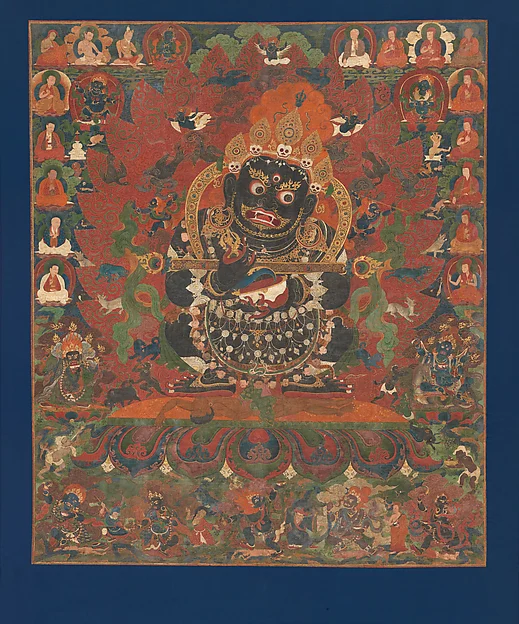
Mahākāla, Protector of the Tent, Central Tibet, circa 1500. The Met identifies the gong as a sign of his vow to protect the monastic community.
The Metropolitan Museum of Art. Central Tibet, circa 1500. Zimmerman Family Collection, Gift of the Zimmerman Family, 2012. Accession 2012.444.4. · Image source ↗ · CC0
In the library
The Gods of Northern Buddhism
Reading note
Read Alice Getty’s illustrated discussion of Dharmapāla.
Sources
See references (6)
- The Gods of Northern Buddhism, table XIII, Reader page 195Alice Getty, The Gods of Northern Buddhism, 1928 revised second edition, Munshiram Manoharlal reprint. Lumitheca Library edition IMJ-0597-E001.Read this page in The Gods of Northern Buddhism ↗
- The Gods of Northern Buddhism, Reader page 196Alice Getty, The Gods of Northern Buddhism, 1928 revised second edition, Munshiram Manoharlal reprint. Lumitheca Library edition IMJ-0597-E001.Read this page in The Gods of Northern Buddhism ↗
- The Gods of Northern Buddhism, printed p. 149, Reader page 197Alice Getty, The Gods of Northern Buddhism, 1928 revised second edition, Munshiram Manoharlal reprint. Lumitheca Library edition IMJ-0597-E001.Read this page in The Gods of Northern Buddhism ↗
- The Gods of Northern Buddhism, printed p. 161, Reader page 208Alice Getty, The Gods of Northern Buddhism, 1928 revised second edition, Munshiram Manoharlal reprint. Lumitheca Library edition IMJ-0597-E001.Read this page in The Gods of Northern Buddhism ↗
- The Dhāraṇī of Glorious Mahākāla, Toh 668 and 1085, §§ 1.1–1.4 ↗The Dhāraṇī of Glorious Mahākāla, Toh 668 and 1085, §§ 1.1–1.4. Source credit: Adam Krug, Dharmachakra Translation Committee, 84000.
- Mahakala, Protector of the Tent ↗The Metropolitan Museum of Art. Central Tibet, circa 1500. Zimmerman Family Collection, Gift of the Zimmerman Family, 2012. Accession 2012.444.4.