Demonic possession
Demonic possession is a religious interpretation of control by an evil spirit. Explore Christian accounts, historical accusations and the limits of their evidence.
In this article
What is demonic possession?
Demonic possession is the belief that an evil spirit inhabits or controls a person. The Christian sources here attribute it to a hostile spiritual agent. In the stories, people may experience fear, involuntary movement or a troubling presence before anyone agrees on what it means. [4][5][6][7]
A person’s report, a witness’s description and the identity assigned to a supposed agent are different parts of the record. Lee’s accounts preserve some disagreements between observers and show the consequences of choosing one interpretation. [8][9][10][11]
Other esoteric writers distinguish the influence of deceased people from influences they attribute to other kinds of beings or forms. These classifications have different purposes from Lee’s Christian explanation of possession. [4][6][7][14][15]
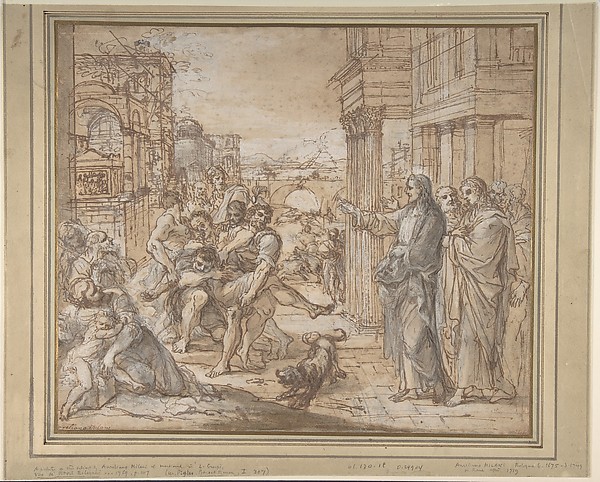
Aureliano Milani, Christ Healing a Possessed Man. Gesture and movement give the Gospel subject its drama in this drawing.
Aureliano Milani. The Metropolitan Museum of Art, Rogers Fund, 1961; 61.130.18. Public Domain. Exact composition date not established here. · Image source ↗ · Public Domain
See references (10)
- The Other World, Reader page 60
- The Other World, Reader page 61
- The Other World, Reader page 64
- The Other World, Reader page 65
- The Other World, Reader page 86
- The Other World, Reader page 87
- The Other World, Reader page 88
- The Other World, Reader page 89
- Gone West, printed p. 172, Reader page 185
- Gone West, printed p. 173, Reader page 186
Clinical assessment and religious discernment
An unnamed physician quoted by Lee attributes some cases of epilepsy and mental disturbance to possession. The NHS describes epilepsy as a condition of the brain that causes seizures. The two accounts come from very different ways of deciding what might explain a person’s symptoms. [2][7][10]
The USCCB calls for medical, psychological and psychiatric assessment as part of its process for considering alleged possession. The assessments address a person’s health and sit within a separate religious process for deciding whether a rite is appropriate. [1]
The Other World, edited by Frederick George Lee
Frederick George Lee’s The Other World presents possession as a possibility supported by Scripture and by the Church’s claimed power to expel evil spirits. He links it to the devil and subordinate spirits, while placing both their activity and their limits within divine permission. The claim concerns a supernatural agent acting through a human body. [4][5][6][7]
Lee extends that theology into a judgement about religious environments. He describes Christian institutions and sacred objects as restraining evil, and associates weakened faith with renewed spiritual danger. This is his confessional argument. It is not an independently established explanation of why people in a particular community experience illness or distress. [7]
One unnamed clergyman’s story begins with a young man who believes himself possessed and describes a recurring hideous figure. The perceived presence follows him across different settings and eventually appears in dreams. The minister reaches a similar conclusion after consultation and prayer. The man’s belief, his reported perception and the minister’s interpretation are separate parts of the narrative. [8][9][10]
Relatives interpret the man’s fits as epilepsy. The minister interprets them through the possession account and reports improvement after a rite. The record preserves their disagreement but gives too little clinical information to diagnose the man now. [10][11]
Elsewhere the collection preserves a religious criticism of supposed diagnostic signs. Quoting Increase Mather, Lee records the objection that a reaction to an accused person’s touch can vary, and that an innocent person’s touch may produce the same effect. Mather also questions why a healing gift should be attached to a supposed witch as an infallible sign of guilt. Belief in evil spirits does not remove disagreement over the evidence used to accuse someone. [12][13]
Mather’s objection concerns a proposed test in a witchcraft accusation. Even within a religious account of spirits, witnesses had reason to ask whether a bodily response could identify the person alleged to have caused it. [12][13]
See references (10)
- The Other World, Reader page 60
- The Other World, Reader page 61
- The Other World, Reader page 64
- The Other World, Reader page 65
- The Other World, Reader page 86
- The Other World, Reader page 87
- The Other World, Reader page 88
- The Other World, Reader page 89
- The Other World, Reader page 202
- The Other World, Reader page 203
Witchcraft Magic & Alchemy by Grillot de Givry
Grillot de Givry introduces possession by distinguishing a person believed to call a spirit from someone believed to come under its control. He uses the woman of Endor to ask how older interpreters understood that difference. His proposal depends on a particular reading of the biblical language and gives the reader one historical interpretation of an ambiguous role. [16]
Four prints he reproduces from Abraham Palingh move among domestic and public settings. A figure collapses during a Protestant sermon and another pleads with his family against denunciation to the magistrates. The sequence shows how a bodily event, the response of witnesses and the risk of accusation could be represented together. [17]
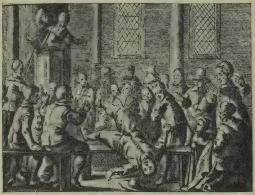
An illustration of supposed possession interrupting a Protestant sermon, from Abraham Palingh’s 1725 book. De Givry’s figure 131.
Illustration in Abraham Palingh, ’t Afgerukt Mom-Aansight der Tooverÿe, Amsterdam, 1725. Reproduced by De Givry. · Image source ↗ · Public Domain
Witnesses and accusations in de Givry
The church interior supplies witnesses and a religious setting. The scene of the man pleading with his family shifts attention to what people might do after interpreting his conduct. The pictures concern the meaning attached to distress and its consequences for the person involved. [17]
Frederick George Lee interprets possession through the activity of a hostile spirit. Ward’s account includes temporary control understood by the narrator as beneficial and assigns some other effects to empty shells. De Givry’s illustrations instead invite attention to observers and the consequences of an accusation. Across the three sources a description of control leaves the identity, motive and response open to separate questions. [4][5][14][15][16][17]
Gone West: J. S. M. Ward
J. S. M. Ward’s Gone West distinguishes an active human spirit from an empty astral shell that supposedly continues a habit without the person who once occupied it. The guide attributes only a blind instinct to the latter. In another episode, W. A. temporarily controls a sleeping man to prevent a financial fraud, and the narrated result is approved. The book’s categories therefore include different proposed agents and different moral evaluations of influence. [14][15]
What does a report establish?
Demonic possession, a frightening apparition and an accusation of witchcraft are different claims. Lee’s material can bring them together, but a report that someone saw a figure does not establish that the figure entered the body. Nor does a person’s distress establish that a named neighbour caused it. The transitions between those claims need evidence of their own. [4][9][10][12][13]
The moral vocabulary of a collector also requires attribution. Lee interprets conduct, faith and suffering through his theology. A contemporary reference article should preserve what he says without making an ill person’s character or religious allegiance an established cause of the illness. [7][9][10]
Lee’s demonic framework identifies a hostile spiritual agent, while Ward distinguishes departed people from residual forms and can judge a particular intervention favourably. The books are not simply offering rival names for one demonstrated condition. They differ over who acts, how much intelligence is involved and what makes an intervention wrong. Those differences should remain visible before any comparison is made with an actual person’s symptoms. [14][15][4][7][9][12][13]
In the library
The Other World
Reading note
The separately titled account draws on exact passages in the consulted Library edition.

Gone West
Reading note
Separately attributed comparison with exact previously researched Library passages.
Witchcraft Magic and Alchemy
Reading note
The separately titled account draws on exact passages in the consulted Library edition.
Sources
See references (17)
- United States Conference of Catholic Bishops, Exorcism: questions and answers ↗USCCB Committee on Divine Worship’s own explanatory document. Consulted for Catholic classifications, authorisation and the role of medical, psychological and psychiatric assessment.
- NHS, Epilepsy: overview and diagnosis ↗Primary public-health information. Consulted only to distinguish epilepsy as a condition affecting the brain and causing seizures from Lee’s historical supernatural interpretation. No diagnosis of a historical person is claimed.
- Aureliano Milani, Christ Healing a Possessed Man, The Met 61.130.18 ↗The Metropolitan Museum of Art, Rogers Fund, 1961. Pen and brown ink with wash and white highlights. Catalogue gives the artist’s broad 1675–1749 range, not a precise composition date. Own record and API confirm public-domain image status.
- The Other World, Reader page 60Frederick George Lee, editor, The Other World; or, Glimpses of the Supernatural, two volumes, Henry S. King and Co., London, 1875. Exact consulted Library edition IMJ-0657-E001. Narratives and embedded quotations are attributed to this compilation; an original author is not represented as independently consulted merely because Lee quotes them. Reader positions are verified separately from printed pagination.Read this page in The Other World ↗
- The Other World, Reader page 61Frederick George Lee, editor, The Other World; or, Glimpses of the Supernatural, two volumes, Henry S. King and Co., London, 1875. Exact consulted Library edition IMJ-0657-E001. Narratives and embedded quotations are attributed to this compilation; an original author is not represented as independently consulted merely because Lee quotes them. Reader positions are verified separately from printed pagination.Read this page in The Other World ↗
- The Other World, Reader page 64Frederick George Lee, editor, The Other World; or, Glimpses of the Supernatural, two volumes, Henry S. King and Co., London, 1875. Exact consulted Library edition IMJ-0657-E001. Narratives and embedded quotations are attributed to this compilation; an original author is not represented as independently consulted merely because Lee quotes them. Reader positions are verified separately from printed pagination.Read this page in The Other World ↗
- The Other World, Reader page 65Frederick George Lee, editor, The Other World; or, Glimpses of the Supernatural, two volumes, Henry S. King and Co., London, 1875. Exact consulted Library edition IMJ-0657-E001. Narratives and embedded quotations are attributed to this compilation; an original author is not represented as independently consulted merely because Lee quotes them. Reader positions are verified separately from printed pagination.Read this page in The Other World ↗
- The Other World, Reader page 86Frederick George Lee, editor, The Other World; or, Glimpses of the Supernatural, two volumes, Henry S. King and Co., London, 1875. Exact consulted Library edition IMJ-0657-E001. Narratives and embedded quotations are attributed to this compilation; an original author is not represented as independently consulted merely because Lee quotes them. Reader positions are verified separately from printed pagination.Read this page in The Other World ↗
- The Other World, Reader page 87Frederick George Lee, editor, The Other World; or, Glimpses of the Supernatural, two volumes, Henry S. King and Co., London, 1875. Exact consulted Library edition IMJ-0657-E001. Narratives and embedded quotations are attributed to this compilation; an original author is not represented as independently consulted merely because Lee quotes them. Reader positions are verified separately from printed pagination.Read this page in The Other World ↗
- The Other World, Reader page 88Frederick George Lee, editor, The Other World; or, Glimpses of the Supernatural, two volumes, Henry S. King and Co., London, 1875. Exact consulted Library edition IMJ-0657-E001. Narratives and embedded quotations are attributed to this compilation; an original author is not represented as independently consulted merely because Lee quotes them. Reader positions are verified separately from printed pagination.Read this page in The Other World ↗
- The Other World, Reader page 89Frederick George Lee, editor, The Other World; or, Glimpses of the Supernatural, two volumes, Henry S. King and Co., London, 1875. Exact consulted Library edition IMJ-0657-E001. Narratives and embedded quotations are attributed to this compilation; an original author is not represented as independently consulted merely because Lee quotes them. Reader positions are verified separately from printed pagination.Read this page in The Other World ↗
- The Other World, Reader page 202Frederick George Lee, editor, The Other World; or, Glimpses of the Supernatural, two volumes, Henry S. King and Co., London, 1875. Exact consulted Library edition IMJ-0657-E001. Narratives and embedded quotations are attributed to this compilation; an original author is not represented as independently consulted merely because Lee quotes them. Reader positions are verified separately from printed pagination.Read this page in The Other World ↗
- The Other World, Reader page 203Frederick George Lee, editor, The Other World; or, Glimpses of the Supernatural, two volumes, Henry S. King and Co., London, 1875. Exact consulted Library edition IMJ-0657-E001. Narratives and embedded quotations are attributed to this compilation; an original author is not represented as independently consulted merely because Lee quotes them. Reader positions are verified separately from printed pagination.Read this page in The Other World ↗
- Gone West, printed p. 172, Reader page 185J. S. M. Ward, Gone West, 1920 third impression in the 2009 Geoff Cutler digital transcription.Read this page in Gone West ↗
- Gone West, printed p. 173, Reader page 186J. S. M. Ward, Gone West, 1920 third impression in the 2009 Geoff Cutler digital transcription.Read this page in Gone West ↗
- Witchcraft Magic & Alchemy, printed p. 153, Reader page 145Grillot de Givry, Witchcraft Magic & Alchemy, translated by J. Courtenay Locke. Boston and New York, Houghton Mifflin Company, 1931.Read this page in Witchcraft Magic and Alchemy ↗
- Witchcraft Magic & Alchemy, printed p. 154, Reader page 146Grillot de Givry, Witchcraft Magic & Alchemy, translated by J. Courtenay Locke. Boston and New York, Houghton Mifflin Company, 1931.Read this page in Witchcraft Magic and Alchemy ↗