Death and the ebb tide
In a coastal belief, death comes with the outgoing tide. Read the New England account and compare its version of Barkis’s death with Dickens’s David Copperfield.
In this article
Understanding death and the ebb tide
Death and the ebb tide is a coastal belief that links a person’s death with the outgoing sea. In the New England account J. R. Francis prints, surviving until the incoming tide is taken to mean the sick person will live until the next ebb. [2]
The belief gives those keeping vigil a change to watch for outside the room. The same image gives Charles Dickens a way to mark departure inside a fictional death scene. [2][4]
The Encyclopaedia of Death and Life, Volume I, compiled by J. R. Francis
J. R. Francis collects the belief under a heading about tides and dying. The passage places it on Cape Cod and elsewhere along the New England coast. People keeping watch are said to follow the movements of the water. [2]
The compiler explicitly calls it a superstition, even while saying that educated coastal residents are not entirely free of it. This is an important difference from the volume’s confident assertions about spirit life: Francis does not endorse every item he collects in the same way. [2]
The printed passage refers to Barkis’s death in David Copperfield, but calls it high water. Dickens’s chapter gives low water. The difference is easy to miss because both writers connect the death with the movement of the tide. [2]
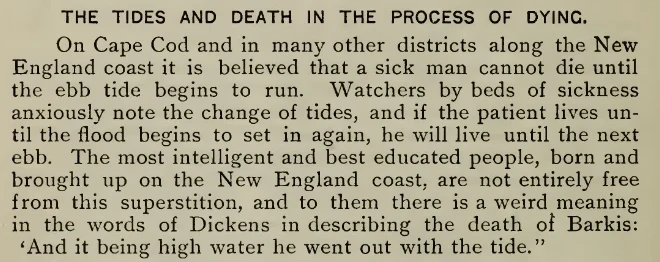
Source facsimile detail: the tides paragraph on printed p. 250 (1903). The high-water wording is visible here; the Dickens passage says low water. The exact Reader link opens the full page.
The Encyclopaedia of Death and Life in the Spirit-World, Volume I, fourth edition, 1903. Public-domain historical page extracted from the checksum-verified Library PDF. · Image source ↗ · Public Domain
David Copperfield by Charles Dickens
In David Copperfield, chapter XXX, Barkis briefly recognises David. Mr Peggotty has explained the belief that a person nearing death holds on until the ebb. The narrator marks the death at low water, bringing the scene back to the words spoken beside the bed. [1][4]
The novel gives the belief to a character who is trying to make sense of a death. Francis’s allusion to high water changes the timing at the point where the chapter is most specific. [1]
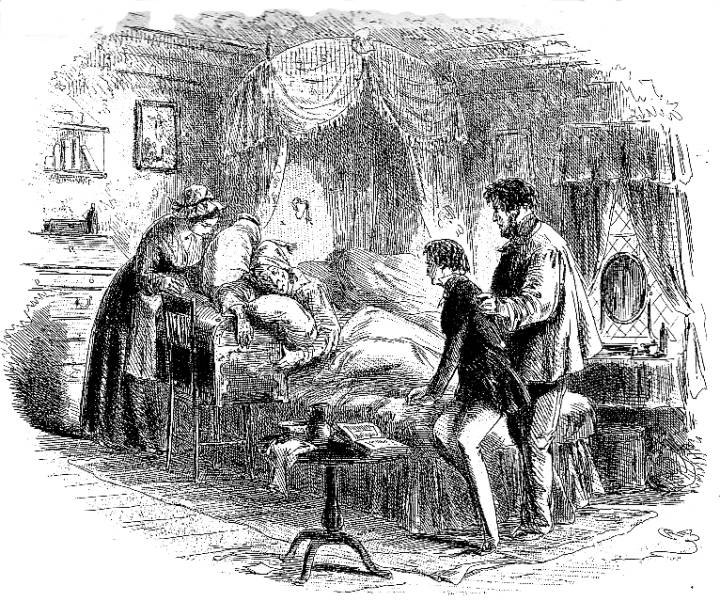
Phiz (Hablot Knight Browne), I find Mr. Barkis going out with the tide, 1850. Barkis’s bedside in chapter XXX of David Copperfield.
Hablot Knight Browne (1815–1882), 1850; scan by Philip V. Allingham, Victorian Web, from the 1911 Centenary Edition. Original artwork Public Domain. Educational reuse permitted with this credit and the linked source. · Image source ↗ · Public Domain
A coastal belief at a fictional bedside
The anthology records a local expectation about when a death will happen. Dickens makes it part of the way a family understands a death already under way. Their uses meet at the bedside, and the tide’s exact stage matters to what the scene says. [2]
Read further in the library
The Encyclopaedia of Death and Life in the Spirit-World, Volume I
Reading note
The separately titled account draws on exact passages in the consulted Library edition.
Sources
See references (4)
- David Copperfield, chapter XXX: Barkis and the tide ↗Charles Dickens, David Copperfield, chapter XXX, quoted with Phiz’s illustration by Philip V. Allingham, Victorian Web. The page identifies the 1911 Centenary Edition. Primary literary passage distinguished from modern commentary.Return to text ↑
- The Encyclopaedia of Death and Life in the Spirit-World, Volume I, printed p. 250, Reader page 249J. R. Francis (compiler), The Encyclopaedia of Death and Life in the Spirit-World, Volume I, fourth edition. The Progressive Thinker Publishing House, Chicago, 1903. Individual authors, communicators and quoted sources identified in each account.Read this page in The Encyclopaedia of Death and Life in the Spirit-World, Volume I ↗Return to text ↑
- Phiz: I find Mr. Barkis going out with the tide (1850) ↗Hablot Knight Browne (Phiz), 1850. Scanned by Philip V. Allingham from the 1911 Centenary Edition; Victorian Web. Original artwork is public domain. The site expressly permits scholarly or educational image reuse with scanner credit and a link, both supplied.
- Charles Dickens, David Copperfield, chapter XXX, A Loss ↗Charles Dickens, David Copperfield, Project Gutenberg transcription.Return to text ↑