Courts of love
Courts of love are tribunals described in medieval literature. Explore judgments on marriage, gifts and secrecy, and the debate over their existence.
In this article
Understanding courts of love
Courts of love are tribunals described in medieval writing as judging questions about lovers’ conduct, from promises and gifts to fidelity and secrecy. In Andreas Capellanus’s De amore, the legal language gives love its own rules and authorities. Whether comparable courts regularly met is a separate historical question. [1][2][5][6]
Courts in text and history
De amore by Andreas Capellanus
In De amore, Book I, chapter 6, paragraphs 395–400, Andreas Capellanus presents a letter attributed to the Countess of Champagne. It distinguishes obligations between spouses from gifts freely offered by lovers. Within the text, the letter is dated 1174 and says other ladies supported the judgement. [1]
Book II, chapter 7, paragraphs 49–51, makes secrecy part of the rules: a ring can be worn with its stone concealed, and lovers’ names are to be withheld in disputes. Chapter 8 presents the rules through a quest involving Arthur’s court and a hawk. The quest gives the rules an origin within a romance. [2][3]
Courtly romance on an ivory box
The Metropolitan Museum’s Box with Romance Scenes, made in France around 1310–30, shows courtly stories carved into an object. It gives a material example of the culture that circulated these romances. [4]
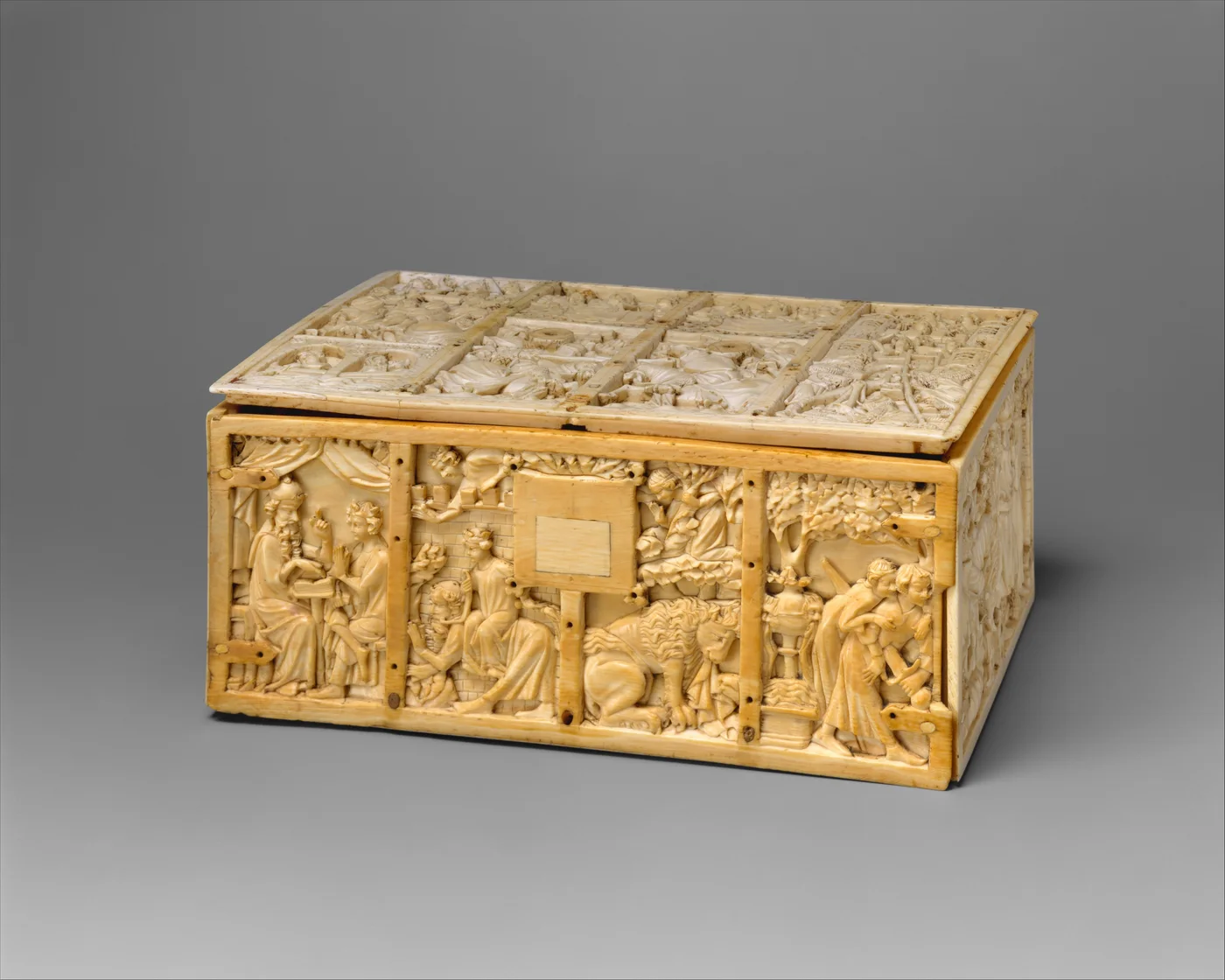
Box with Romance Scenes, France, ca. 1310–30. The carving depicts episodes from courtly stories.
The Metropolitan Museum of Art, 17.190.173a, b; 1988.16. Gift of J. Pierpont Morgan, 1917; The Cloisters Collection, 1988. CC0. · Image source ↗ · CC0
Magica Sexualis by Émile Laurent and Paul Nagour
In Magica Sexualis, Émile Laurent and Paul Nagour read judgments such as Andreas’s as traces of medieval institutions and give Eleanor of Aquitaine and Marie of Champagne leading roles. They report Dietz’s rejection of the courts as fiction and argue for their existence. [5][6][7]
Their chapter moves among imagined palaces, an Arthurian origin story, judgments and later poetic societies. The discussion of marriage returns to the distinction between obligation and freely offered love. [5][6][7][8][9][10][11]
A literary judgement and a claim about institutions
The distinction between freely offered gifts and marital duty appears in both texts. Andreas presents names, rules and decisions inside an authored work. Laurent and Nagour use those features to argue for a historical institution. An independently dated record of a meeting would answer a different question. [6][7][8][1][2][11]
Read further in the library
Magica Sexualis
Reading note
The separately titled account draws on exact passages in the consulted Library edition.
Sources
See references (11)
- Andreas Capellanus, De amore I.6.395–400: the Countess of Champagne’s letter ↗Andreas Capellanus, De amore, Book I, chapter VI, paragraphs 395–400 in the consulted Latin Library transcription. Original Latin directly read and paraphrased. The letter presents a judgment about love and marriage, closes with counsel of many other ladies and bears a date of 1174 within the text. No archival authentication of the letter or institutional court established by that date.Return to text ↑
- Andreas Capellanus, De amore II.7.49–51: gifts, secrecy and judgment ↗Andreas Capellanus, De amore, Book II, chapter VII, paragraphs 49–51, original Latin directly read. Gifts, a concealed ring and anonymous presentation of disputes before ladies’ judgments. Selected chapter opening and the relevant marriage judgment also read. This literary text does not by itself prove an enforceable historical tribunal.Return to text ↑
- Andreas Capellanus, De amore II.8: the Arthurian framing of love’s rules ↗Andreas Capellanus, De amore, Book II, chapter VIII, opening Arthurian quest and closing publication of the rules. Selected Latin directly read; the narrative setting is distinguished from documentary evidence. No complete additional crawl of all three books.Return to text ↑
- The Metropolitan Museum of Art: Box with Romance Scenes, ca. 1310–30 ↗French, Box with Romance Scenes, ca. 1310–30, accession 17.190.173a, b; 1988.16. Gift of J. Pierpont Morgan, 1917; The Cloisters Collection, 1988. Official museum API isPublicDomain true. Actual full object image inspected. Romance imagery is contextual; not a record of Andreas’s alleged courts or their procedures.Return to text ↑
- Magica Sexualis, Reader page 243Émile Laurent and Paul Nagour, Magica Sexualis, privately printed by Falstaff Press Inc., New York, undated inspected edition. Exact original Library edition IMJ-0105-E001. The work is a historical compilation; its quoted fiction, trial allegations and medical interpretations are not treated as independently verified facts. Current Reader positions are mapped separately from printed pagination.Read this page in Magica Sexualis ↗Return to text ↑
- Magica Sexualis, Reader page 244Émile Laurent and Paul Nagour, Magica Sexualis, privately printed by Falstaff Press Inc., New York, undated inspected edition. Exact original Library edition IMJ-0105-E001. The work is a historical compilation; its quoted fiction, trial allegations and medical interpretations are not treated as independently verified facts. Current Reader positions are mapped separately from printed pagination.Read this page in Magica Sexualis ↗Return to text ↑
- Magica Sexualis, Reader page 245Émile Laurent and Paul Nagour, Magica Sexualis, privately printed by Falstaff Press Inc., New York, undated inspected edition. Exact original Library edition IMJ-0105-E001. The work is a historical compilation; its quoted fiction, trial allegations and medical interpretations are not treated as independently verified facts. Current Reader positions are mapped separately from printed pagination.Read this page in Magica Sexualis ↗Return to text ↑
- Magica Sexualis, Reader page 246Émile Laurent and Paul Nagour, Magica Sexualis, privately printed by Falstaff Press Inc., New York, undated inspected edition. Exact original Library edition IMJ-0105-E001. The work is a historical compilation; its quoted fiction, trial allegations and medical interpretations are not treated as independently verified facts. Current Reader positions are mapped separately from printed pagination.Read this page in Magica Sexualis ↗Return to text ↑
- Magica Sexualis, Reader page 247Émile Laurent and Paul Nagour, Magica Sexualis, privately printed by Falstaff Press Inc., New York, undated inspected edition. Exact original Library edition IMJ-0105-E001. The work is a historical compilation; its quoted fiction, trial allegations and medical interpretations are not treated as independently verified facts. Current Reader positions are mapped separately from printed pagination.Read this page in Magica Sexualis ↗Return to text ↑
- Magica Sexualis, Reader page 248Émile Laurent and Paul Nagour, Magica Sexualis, privately printed by Falstaff Press Inc., New York, undated inspected edition. Exact original Library edition IMJ-0105-E001. The work is a historical compilation; its quoted fiction, trial allegations and medical interpretations are not treated as independently verified facts. Current Reader positions are mapped separately from printed pagination.Read this page in Magica Sexualis ↗Return to text ↑
- Magica Sexualis, Reader page 249Émile Laurent and Paul Nagour, Magica Sexualis, privately printed by Falstaff Press Inc., New York, undated inspected edition. Exact original Library edition IMJ-0105-E001. The work is a historical compilation; its quoted fiction, trial allegations and medical interpretations are not treated as independently verified facts. Current Reader positions are mapped separately from printed pagination.Read this page in Magica Sexualis ↗Return to text ↑