The Cosmic Pendulum in Walter Russell
The cosmic pendulum describes Walter Russell’s cycle from stability through change and back. See how generation, radiation and breath fit together.
In this article
The swing from stability to change
The cosmic pendulum is Walter Russell’s image for a repeated movement from stability through apparent change and back again. He uses a swing to picture how forms arise, persist and dissolve within one substance. [3][4][5]
The Universal One by Walter Russell
In The Universal One, Walter Russell labels the two phases inhalation and exhalation. He describes thought as a swing from the stability of Mind into apparent instability and back. Generation and radiation give the two tendencies their direction. [3][4][5][6]
Russell later introduces a cosmic clock for ordering dimensions and successive positions. The pendulum supplies the repeated motion. The clock gives that recurrence a larger framework. [4][5][7][8]
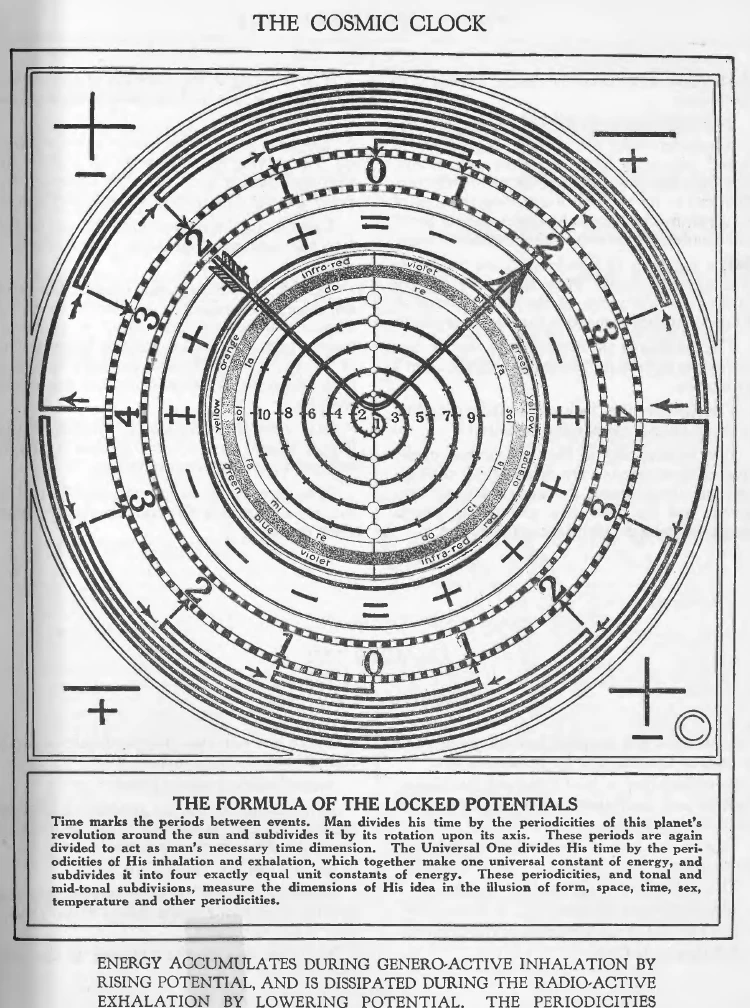
Russell’s own Cosmic Clock uses numbered rings and marked positions. It makes visible the larger framework in which he places recurring motion.
Walter Russell, The Cosmic Clock. Brieger Press, New York, copyright 1926, Library of Congress LCCN 27004508. Library of Congress, public domain. · Image source ↗ · Public Domain
Principia by Isaac Newton
In the Principia, Isaac Newton states that a body remains at rest or continues uniformly in a straight line unless impressed forces change its state. A suspended pendulum changes direction under forces, so its motion provides a familiar case to compare with the rule. [2]
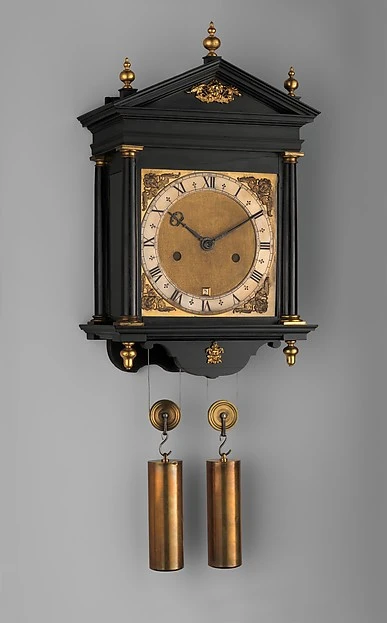
A seventeenth-century Fromanteel wall clock gives the mechanical pendulum in the comparison a historical example.
Ahasuerus I Fromanteel, Hooded Wall Clock with Calendar. The Metropolitan Museum of Art. Bequest of Irwin Untermyer, 1973. · Image source ↗ · CC0
A mechanism and a cosmological image
The swinging part in a clock has a motion that mechanics can describe. Russell borrows the swing to picture his account of changing conditions in a universal substance. [3][4][2]
In the library
The Universal One
Reading note
The separately titled account draws on exact passages in the consulted Library edition.
Sources
See references (8)
- Ahasuerus I Fromanteel, Hooded Wall Clock with Calendar ↗Ahasuerus I Fromanteel, Hooded Wall Clock with Calendar. The Metropolitan Museum of Art. Bequest of Irwin Untermyer, 1973.
- Principia, Axioms or Laws of Motion, Law I ↗Isaac Newton, The Mathematical Principles of Natural Philosophy, volume I, translated by Andrew Motte, 1729, first law of motion.
- The Universal One, printed p. 31, Reader page 30Walter Russell, The Universal One, edited by Louise Russell, University of Science and Philosophy, Limited Edition De Luxe. Lumitheca Library edition IMJ-0605-E001.Read this page in The Universal One ↗
- The Universal One, printed p. 33, Reader page 32Walter Russell, The Universal One, edited by Louise Russell, University of Science and Philosophy, Limited Edition De Luxe. Lumitheca Library edition IMJ-0605-E001.Read this page in The Universal One ↗
- The Universal One, printed p. 34, Reader page 33Walter Russell, The Universal One, edited by Louise Russell, University of Science and Philosophy, Limited Edition De Luxe. Lumitheca Library edition IMJ-0605-E001.Read this page in The Universal One ↗
- The Universal One, printed p. 35, Reader page 34Walter Russell, The Universal One, edited by Louise Russell, University of Science and Philosophy, Limited Edition De Luxe. Lumitheca Library edition IMJ-0605-E001.Read this page in The Universal One ↗
- The Universal One, printed p. 64, Reader page 63Walter Russell, The Universal One, edited by Louise Russell, University of Science and Philosophy, Limited Edition De Luxe. Lumitheca Library edition IMJ-0605-E001.Read this page in The Universal One ↗
- The Cosmic Clock ↗Walter Russell, The Cosmic Clock. Brieger Press, New York, copyright 1926, Library of Congress LCCN 27004508. Library of Congress, public domain.