The Cosmic Messengers in Challoner
Who are Challoner’s Cosmic Messengers? Explore the devas who transmit influences across the seven planes and call human beings to serve.
In this article
What the messengers carry
The Cosmic Messengers are the speaking company at the close of H. K. Challoner’s Watchers of the Seven Spheres. They carry influences between levels of creation. Their arrival gives people a choice about whether to take part in the work they describe. [4][5][6]
Watchers of the Seven Spheres by H. K. Challoner
In The Cosmic Messengers, H. K. Challoner describes the Sons of Creative Fire working through lesser beings down to the scale of atoms. The messengers receive their direction beyond familiar worlds. Once the guarded doors open, they carry a new influence and a call to act. [4][5][6]
People who hear the call remain free to refuse it. The poem connects cooperation with self-discipline and uses the image of a lost garden to describe an earlier misuse of creative power. [6][7][8]
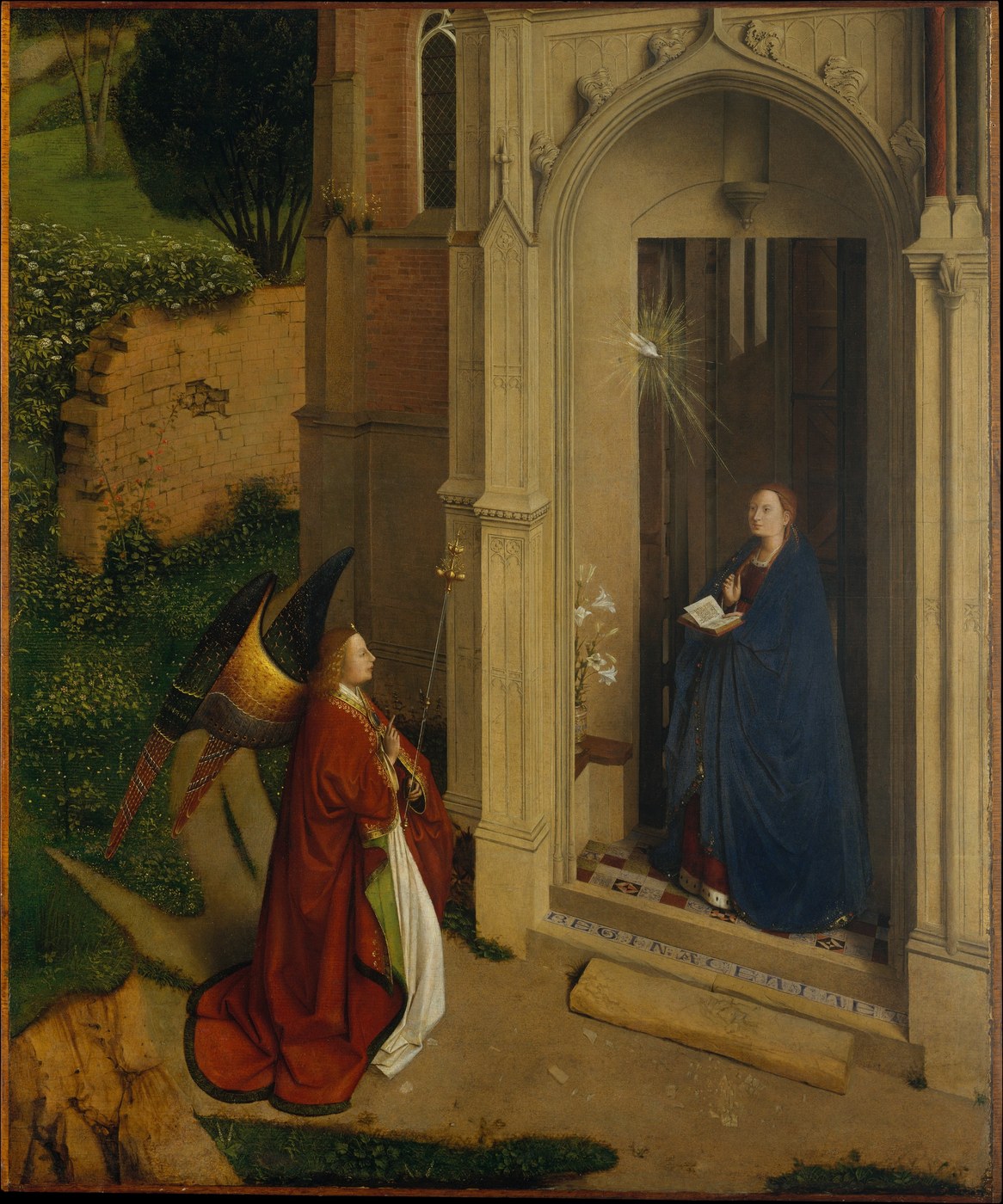
In Petrus Christus’s Annunciation, Gabriel brings a message to Mary. Challoner’s messengers carry their influence across a succession of cosmic levels.
The Metropolitan Museum of Art. The Friedsam Collection, Bequest of Michael Friedsam, 1931. Accession 32.100.35. Public Domain (CC0). · Image source ↗ · CC0
The Science of the Sacraments by Charles W. Leadbeater
In The Science of the Sacraments, Charles W. Leadbeater says the Directing Angel assigns messengers to carry the Eucharist’s help to people named in its intentions. Other angels remain to adore. [2][3]
A cosmic call and a liturgical task
Challoner’s messengers carry an influence across cosmic levels and address humanity. Leadbeater describes an assignment to particular recipients within one rite. Both accounts give the messenger a task set by another being. [4][6][8][2][3]
In the library
The Science of the Sacraments
Reading note
Separately attributed primary Library account, cited on exact verified Reader leaves.
Watchers of the Seven Spheres
Reading note
The separately titled account draws on exact passages in the consulted Library edition.
Sources
See references (8)
- The Annunciation, Petrus Christus ↗The Metropolitan Museum of Art; ca. 1445, accession 32.100.35
- The Science of the Sacraments, printed p. 161, Reader page 173Charles W. Leadbeater, The Science of the Sacraments, The St. Alban Press, 1920. Exact Library edition IMJ-0615-E001.Read this page in The Science of the Sacraments ↗
- The Science of the Sacraments, printed p. 162, Reader page 174Charles W. Leadbeater, The Science of the Sacraments, The St. Alban Press, 1920. Exact Library edition IMJ-0615-E001.Read this page in The Science of the Sacraments ↗
- Watchers of the Seven Spheres, Reader page 81H. K. Challoner, Watchers of the Seven Spheres, London, George Routledge & Sons, 1933. Lumitheca Library edition IMJ-0604-E001.Read this page in Watchers of the Seven Spheres ↗
- Watchers of the Seven Spheres, printed p. 82, Reader page 82H. K. Challoner, Watchers of the Seven Spheres, London, George Routledge & Sons, 1933. Lumitheca Library edition IMJ-0604-E001.Read this page in Watchers of the Seven Spheres ↗
- Watchers of the Seven Spheres, Reader page 83H. K. Challoner, Watchers of the Seven Spheres, London, George Routledge & Sons, 1933. Lumitheca Library edition IMJ-0604-E001.Read this page in Watchers of the Seven Spheres ↗
- Watchers of the Seven Spheres, Reader page 84H. K. Challoner, Watchers of the Seven Spheres, London, George Routledge & Sons, 1933. Lumitheca Library edition IMJ-0604-E001.Read this page in Watchers of the Seven Spheres ↗
- Watchers of the Seven Spheres, Reader page 85H. K. Challoner, Watchers of the Seven Spheres, London, George Routledge & Sons, 1933. Lumitheca Library edition IMJ-0604-E001.Read this page in Watchers of the Seven Spheres ↗