Cosmic Eros
Cosmic Eros is love understood as a principle of nature. Compare Plato’s Eryximachus, Lucretius’s Venus and the thesis of Magica Sexualis.
In this article
Understanding cosmic eros
Cosmic Eros is love or desire understood as a power at work throughout nature. The idea can explain the bringing together of opposites, the generation of living things or the continuing order of the world. These meanings appear in different settings, from a philosopher’s speech to a poet’s address to a goddess. [1][2][3]
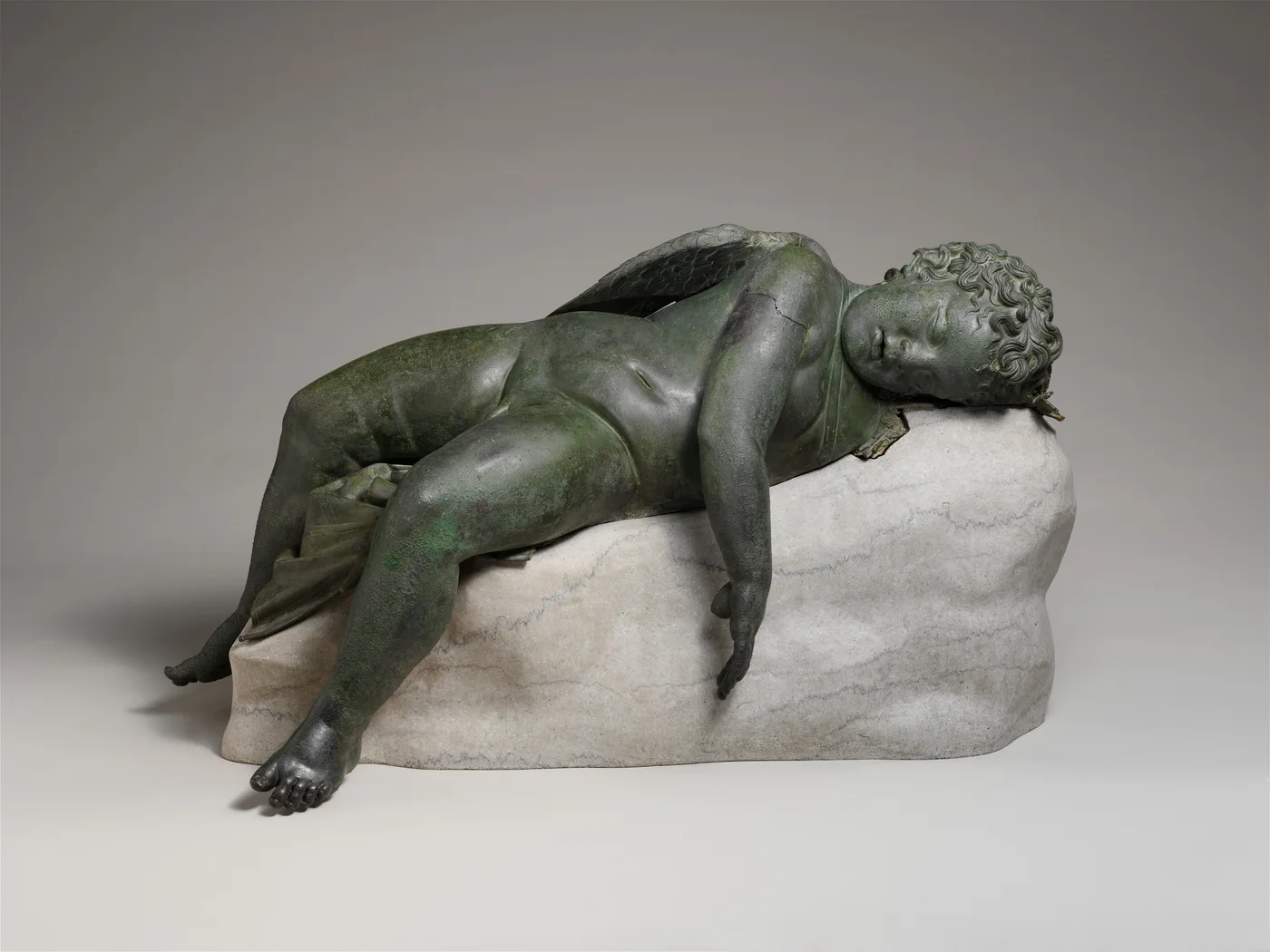
Bronze statue of Eros sleeping, in The Metropolitan Museum of Art. The sculpture gives the god a personal form.
The Metropolitan Museum of Art, 43.11.4. Rogers Fund, 1943. CC0. · Image source ↗ · CC0
Symposium by Plato: Eryximachus’s speech
In Plato’s Symposium, 186a–188e, the physician Eryximachus extends love to bodies, plants, music and the seasons. Medicine fosters the right relation of contrary elements. He distinguishes harmonious love from a disordered kind that can damage health and disrupt the seasons. The distinction belongs to his speech within the dialogue. [1]
De rerum natura by Lucretius
In On the Nature of Things, Book I, 1–49, Lucretius calls on Venus as the world comes to life in spring. Plants and animals answer her arrival, and the poet asks her to draw Mars away from war. The opening also speaks of a divine life at peace and removed from human affairs. [2]
Magica Sexualis by Émile Laurent and Paul Nagour
In Magica Sexualis, Émile Laurent and Paul Nagour describe sex as universal energy. They cite François Jollivet-Castelot to take the idea from lovers and flowers to suns and gravitation. Poetry gives the comparison breadth, and the compilers develop it into a claim about religion as well as nature. [4][5]
The compilers quote Lucretius’s address to Venus and later group Cupid and the pierced Sacred Heart among images they read through the same principle. [6][7][8]
Harmony, generation and a universal energy
Eryximachus distinguishes harmonious from destructive attraction. Lucretius uses Venus to give generation and peace a poetic form. The compilers instead make sex a single energy behind many phenomena. Their argument gives the shared imagery a wider meaning than either classical passage assigns to it. [4][5][1][6][7][8][2]
See references (7)
- Plato, Symposium 186a–188e: Eryximachus on the two loves
- Lucretius, De rerum natura I.1–49: Venus, generation and divine tranquillity
- Magica Sexualis, Reader page 250
- Magica Sexualis, Reader page 251
- Magica Sexualis, Reader page 268
- Magica Sexualis, Reader page 269
- Magica Sexualis, printed p. 268, Reader page 276
Read further in the library
Magica Sexualis
Reading note
The separately titled account draws on exact passages in the consulted Library edition.
Sources
See references (8)
- Plato, Symposium 186a–188e: Eryximachus on the two loves ↗Plato, Symposium, speech of Eryximachus, standard Stephanus locator 186a–188e. Benjamin Jowett translation in the Internet Classics Archive, MIT, directly consulted in the selected speech. The speaker’s position is not equated with every speech or Plato’s unqualified conclusion. No modern scientific validity claimed for the ancient medical framework.Return to text ↑
- Lucretius, De rerum natura I.1–49: Venus, generation and divine tranquillity ↗Titus Lucretius Carus, De rerum natura, Book I, opening lines 1–49, original Latin directly read. Own paraphrase, no copied modern translation. The inspected transcription marks lines 44–49 as a distinct passage after the invocation; no manuscript-critical conclusion claimed. The opening’s address to Venus is read alongside its statement about divine tranquillity.Return to text ↑
- The Metropolitan Museum of Art: Bronze statue of Eros sleeping ↗Bronze statue of Eros sleeping, Greek, Hellenistic, 3rd–2nd century BCE, accession 43.11.4. Rogers Fund, 1943. Official museum API isPublicDomain true; actual image inspected. Representation of a deity, not a diagram or proof of a universal physical force.Return to text ↑
- Magica Sexualis, Reader page 250Émile Laurent and Paul Nagour, Magica Sexualis, privately printed by Falstaff Press Inc., New York, undated inspected edition. Exact original Library edition IMJ-0105-E001. The work is a historical compilation; its quoted fiction, trial allegations and medical interpretations are not treated as independently verified facts. Current Reader positions are mapped separately from printed pagination.Read this page in Magica Sexualis ↗Return to text ↑
- Magica Sexualis, Reader page 251Émile Laurent and Paul Nagour, Magica Sexualis, privately printed by Falstaff Press Inc., New York, undated inspected edition. Exact original Library edition IMJ-0105-E001. The work is a historical compilation; its quoted fiction, trial allegations and medical interpretations are not treated as independently verified facts. Current Reader positions are mapped separately from printed pagination.Read this page in Magica Sexualis ↗Return to text ↑
- Magica Sexualis, Reader page 268Émile Laurent and Paul Nagour, Magica Sexualis, privately printed by Falstaff Press Inc., New York, undated inspected edition. Exact original Library edition IMJ-0105-E001. The work is a historical compilation; its quoted fiction, trial allegations and medical interpretations are not treated as independently verified facts. Current Reader positions are mapped separately from printed pagination.Read this page in Magica Sexualis ↗Return to text ↑
- Magica Sexualis, Reader page 269Émile Laurent and Paul Nagour, Magica Sexualis, privately printed by Falstaff Press Inc., New York, undated inspected edition. Exact original Library edition IMJ-0105-E001. The work is a historical compilation; its quoted fiction, trial allegations and medical interpretations are not treated as independently verified facts. Current Reader positions are mapped separately from printed pagination.Read this page in Magica Sexualis ↗Return to text ↑
- Magica Sexualis, printed p. 268, Reader page 276Émile Laurent and Paul Nagour, Magica Sexualis, privately printed by Falstaff Press Inc., New York, undated inspected edition. Exact original Library edition IMJ-0105-E001. The work is a historical compilation; its quoted fiction, trial allegations and medical interpretations are not treated as independently verified facts. Current Reader positions are mapped separately from printed pagination.Read this page in Magica Sexualis ↗Return to text ↑