Coscinomancy
Coscinomancy is divination with a sieve. See how a Renaissance woodcut and early European accounts interpreted a turn or a sudden stop.
In this article
What is coscinomancy?
Coscinomancy is divination with a sieve. Some European accounts describe people naming suspects and watching for the sieve to move. In another version, the important moment is when a spinning sieve stops. [1][2]
Witchcraft Magic & Alchemy by Grillot de Givry
Grillot de Givry reproduces a woodcut from the collected works of Cornelius Agrippa. In the passage attributed to Pietro d’Abano, two people support the pincers from which the sieve hangs. The writer credits a demon with making it turn when the culprit’s name is spoken. [1]
De Givry also describes a sieve spinning on a pivot until a name makes it stop. Jean-Baptiste Belot interprets the practice as a kind of casting lots. He appeals to the use of lots in antiquity and in the early Church. [2]
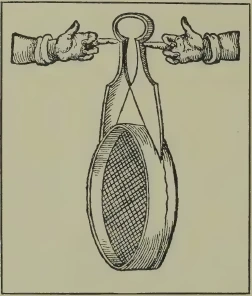
Two hands support a sieve hanging from pincers in this sixteenth-century woodcut, reproduced as figure 287.
Woodcut from the sixteenth-century Lyon Opera omnia associated with Cornelius Agrippa, reproduced by De Givry. · Image source ↗ · Public Domain
What made the movement count as an answer?
The turn and the stop have the same role in their respective accounts: they tell the participants which name to single out. The text attributed to d’Abano calls it the work of a demon. Belot treats the event as a lot whose outcome can be read. [1][2]
In the library
Witchcraft Magic and Alchemy
Reading note
The separately titled account draws on exact passages in the consulted Library edition.
Sources
See references (2)
- Witchcraft Magic & Alchemy, printed p. 300, Reader page 295Grillot de Givry, Witchcraft Magic & Alchemy, translated by J. Courtenay Locke. Boston and New York, Houghton Mifflin Company, 1931.Read this page in Witchcraft Magic and Alchemy ↗
- Witchcraft Magic & Alchemy, printed p. 301, Reader page 296Grillot de Givry, Witchcraft Magic & Alchemy, translated by J. Courtenay Locke. Boston and New York, Houghton Mifflin Company, 1931.Read this page in Witchcraft Magic and Alchemy ↗