Colour as the Fifteenth Dimension in Walter Russell
Why did Walter Russell call colour the fifteenth dimension? Read his spectral ledger and the sodium example, alongside modern spectroscopy.
In this article
Why Russell compares a spectrum to a ledger
Walter Russell calls colour the fifteenth dimension because he believes it records motion and pressure. To him a spectrum is like a ledger. Its lines are marks from which the state of matter might be read. [3][4][5][6]
The Universal One by Walter Russell
In The Universal One, Walter Russell assigns predominantly attractive conditions to the red side of the spectrum and predominantly repulsive ones to the blue. The positions belong to his theory of charging and discharging. [5][6][7][8]
Sodium’s prominent yellow line seems to conflict with his rule. Russell tries to explain it through pressure and the conditions of observation. The example shows him adjusting his reading of a line to fit his larger theory. [6][9][8]
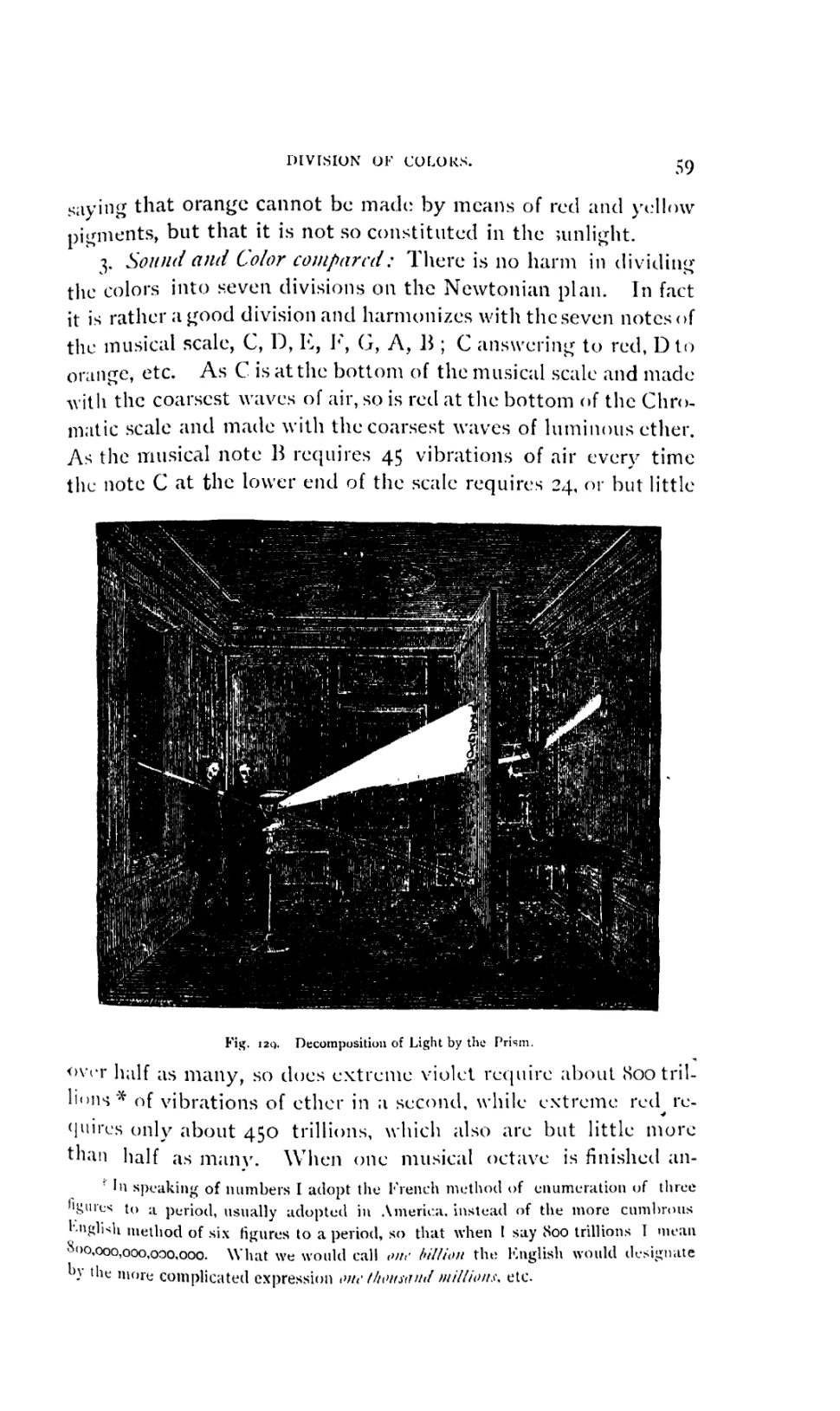
Babbitt’s prism diagram shows how a beam spreads into colours. Russell compares the lines within a spectrum to marks recording the state of matter.
Edwin D. Babbitt, The Principles of Light and Color, second edition, 1896. Lumitheca Library facsimile. · Image source ↗ · Public Domain
What a spectral line records
NIST’s Atomic Spectra Database connects wavelengths with atomic energy levels and transitions. Russell interprets recognizable lines as traces of contrary phases of motion. Both accounts start from a spectrum and assign the lines different meanings. [5][6][9][2]
In the library
The Principles of Light and Color
Reading note
Separately attributed primary Library account, cited on exact verified Reader leaves.

The Universal One
Reading note
The separately titled account draws on exact passages in the consulted Library edition.
Sources
See references (9)
- Figure 129, Decomposition of Light by the Prism, printed p. 59, Reader page 66Edwin D. Babbitt, The Principles of Light and Color, second edition, 1896. Lumitheca Library facsimile.Read this page in The Principles of Light and Color ↗
- NIST Atomic Spectra Database ↗National Institute of Standards and Technology, Atomic Spectra Database, Standard Reference Database 78.
- The Universal One, printed p. 9, Reader page 8Walter Russell, The Universal One, edited by Louise Russell, University of Science and Philosophy, Limited Edition De Luxe. Lumitheca Library edition IMJ-0605-E001.Read this page in The Universal One ↗
- The Universal One, printed p. 63, Reader page 62Walter Russell, The Universal One, edited by Louise Russell, University of Science and Philosophy, Limited Edition De Luxe. Lumitheca Library edition IMJ-0605-E001.Read this page in The Universal One ↗
- The Universal One, printed p. 250, Reader page 249Walter Russell, The Universal One, edited by Louise Russell, University of Science and Philosophy, Limited Edition De Luxe. Lumitheca Library edition IMJ-0605-E001.Read this page in The Universal One ↗
- The Universal One, printed p. 251, Reader page 250Walter Russell, The Universal One, edited by Louise Russell, University of Science and Philosophy, Limited Edition De Luxe. Lumitheca Library edition IMJ-0605-E001.Read this page in The Universal One ↗
- The Universal One, printed p. 252, Reader page 251Walter Russell, The Universal One, edited by Louise Russell, University of Science and Philosophy, Limited Edition De Luxe. Lumitheca Library edition IMJ-0605-E001.Read this page in The Universal One ↗
- The Universal One, printed p. 254, Reader page 253Walter Russell, The Universal One, edited by Louise Russell, University of Science and Philosophy, Limited Edition De Luxe. Lumitheca Library edition IMJ-0605-E001.Read this page in The Universal One ↗
- The Universal One, printed p. 253, Reader page 252Walter Russell, The Universal One, edited by Louise Russell, University of Science and Philosophy, Limited Edition De Luxe. Lumitheca Library edition IMJ-0605-E001.Read this page in The Universal One ↗