Citipati, the Dancing Skeleton Protectors
Who are the Citipati? Learn how Getty describes the dancing skeletons and what Tibetan art and an inscription say about their protective role.
In this article
Who are the Citipati?
The Citipati are a pair of skeleton protectors in Tibetan Buddhism. Their name is associated with the funeral pyre or charnel ground. In some paintings they dance so closely that their limbs overlap. They can also appear with other protective figures. [1][2][4]
The Gods of Northern Buddhism by Alice Getty
Alice Getty describes two skeletons dancing with arms and legs interlaced. In her survey they can appear with Yama or accompany a ḍākinī. Plate LXII labels one figure as Citipati, and another example in her discussion shows the pair on separate lotuses. [1][2][3]
In one origin story Getty records, two ascetics are killed while absorbed in meditation and become enemies of thieves. The episode explains why a person might call on the pair for protection against theft. [2]
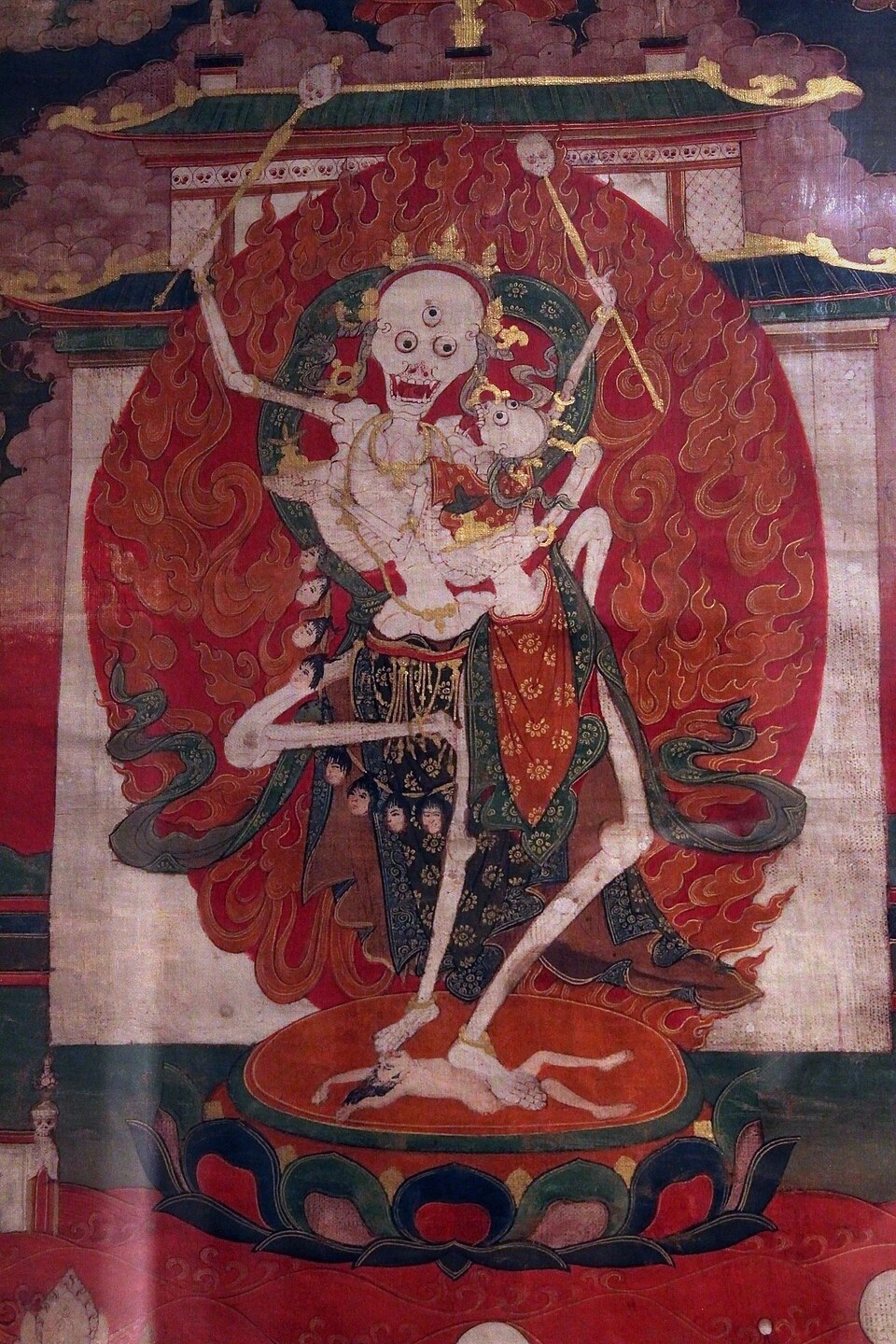
The dancing pair on a lotus base, from an eighteenth-century Tibetan painting in the Musée Guimet.
Musée Guimet, MA 5224. Photograph by Vassil, via Wikimedia Commons. · Image source ↗ · CC0
What the inscription asks the pair to guard
An inscription attached to a Rubin Museum painting asks the Lords of the Charnel Ground for protection from robbery as well as fire and water. The request against theft recalls Getty’s origin story. The inscription gives the two protectors a wider role. [4][2]
A dancer on a Tibetan ritual apron
The Met’s photograph shows components of a Tibetan ritual apron laid out together. Its object record identifies one of the carved bone plaques as a dancing Chitipati. The ornament shows how a single dancer could be incorporated into a larger ritual object. [5][2]
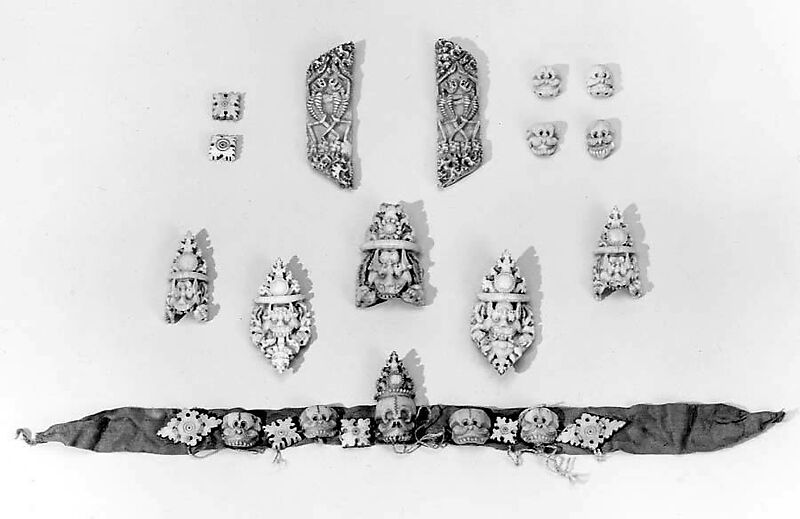
Bone plaques and other parts of a Tibetan ritual apron. The Met catalogues accession 1991.409.7 as a dancing Chitipati plaque.
The Metropolitan Museum of Art. Tibet, 16th century or later. Anonymous Gift, 1991. Accession 1991.409.7. Photograph also shows other apron components. · Image source ↗ · CC0
In the library

The Gods of Northern Buddhism
Reading note
Read Alice Getty’s illustrated discussion of Citipati.
Sources
See references (6)
- The Gods of Northern Buddhism, printed p. 153, Reader page 201Alice Getty, The Gods of Northern Buddhism, 1928 revised second edition, Munshiram Manoharlal reprint. Lumitheca Library edition IMJ-0597-E001.Read this page in The Gods of Northern Buddhism ↗
- The Gods of Northern Buddhism, printed p. 171, Reader page 218Alice Getty, The Gods of Northern Buddhism, 1928 revised second edition, Munshiram Manoharlal reprint. Lumitheca Library edition IMJ-0597-E001.Read this page in The Gods of Northern Buddhism ↗
- The Gods of Northern Buddhism, plate LXII, figure a, Reader page 329Alice Getty, The Gods of Northern Buddhism, 1928 revised second edition, Munshiram Manoharlal reprint. Lumitheca Library edition IMJ-0597-E001.Read this page in The Gods of Northern Buddhism ↗
- Lords of the Charnel Ground, Smashana Adipati, Object C2002.36.1, reverse inscription described in the collection record ↗Lords of the Charnel Ground, Smashana Adipati, Object C2002.36.1, reverse inscription described in the collection record. Source credit: Rubin Museum of Himalayan Art.
- Plaque from a Tantric Ritual Apron: Chitipati Dancing ↗The Metropolitan Museum of Art. Tibet, 16th century or later. Anonymous Gift, 1991. Accession 1991.409.7. Photograph also shows other apron components.
- Citipati, eighteenth-century Tibetan painting ↗Musée Guimet, MA 5224. Photograph by Vassil, via Wikimedia Commons.