Chromopathy in Babbitt’s Colour Theory
Chromopathy was Babbitt’s historical system of supposed healing through colour. Learn how he reasoned from colour and how that differs from clinical phototherapy.
In this article
What was chromopathy?
Chromopathy was a historical system that assigned healing powers to colours. Edwin D. Babbitt called his version chromo-therapeutics. It grew out of his belief that colours express forces with different effects on matter and the body. [3][4]
The Principles of Light and Color by Edwin D. Babbitt
In The Principles of Light and Color, Edwin D. Babbitt treats blue and violet as cool, contracting principles and assigns warm colours opposing properties. He uses that contrast to explain how he thought coloured light might affect the body. [3][4]
Babbitt believed even substances exposed to light could acquire medicinal properties. He credits Augustus James Pleasonton with popularising coloured glass, then argues for extending the idea to other parts of the spectrum. [5][6]
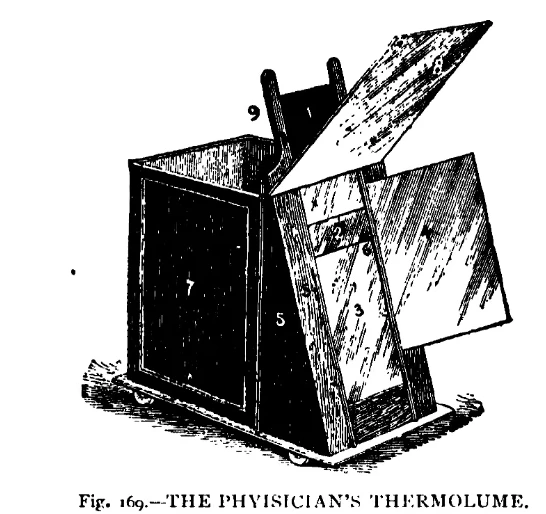
Figure 169 shows the hinged lid and pane openings of Babbitt’s solar thermolume. The cabinet was designed to expose the body to light.
Edwin D. Babbitt, The Principles of Light and Color, second edition, 1896. Lumitheca Library facsimile (detail). · Image source ↗ · Public Domain
A historical theory and clinical phototherapy
Clinical phototherapy is evaluated for a specific condition and uses defined light sources and exposure. NICE’s guidance on significant newborn jaundice distinguishes artificial phototherapy with a specified spectrum and irradiance from exposure to sunlight. Babbitt’s system rests on a broader theory of colour forces whose claimed treatments require their own evidence. [3][4][5][2]
In the library
The Principles of Light and Color
Reading note
Separately attributed primary Library account, cited on exact verified Reader leaves.
Sources
See references (6)
- Figure 169, The Physician’s Thermolume, printed p. 341, Reader page 348Edwin D. Babbitt, The Principles of Light and Color, second edition, 1896. Lumitheca Library facsimile (detail).Read this page in The Principles of Light and Color ↗
- Jaundice in newborn babies under 28 days, recommendations 1.4.7–1.4.8 ↗National Institute for Health and Care Excellence.
- The Principles of Light and Color, printed p. 279, Reader page 286Edwin D. Babbitt, The Principles of Light and Color, second edition, College of Fine Forces, East Orange, New Jersey, 1896. Lumitheca Library edition IMJ-0607-E001.Read this page in The Principles of Light and Color ↗
- The Principles of Light and Color, printed p. 299, Reader page 306Edwin D. Babbitt, The Principles of Light and Color, second edition, College of Fine Forces, East Orange, New Jersey, 1896. Lumitheca Library edition IMJ-0607-E001.Read this page in The Principles of Light and Color ↗
- The Principles of Light and Color, printed p. 324, Reader page 331Edwin D. Babbitt, The Principles of Light and Color, second edition, College of Fine Forces, East Orange, New Jersey, 1896. Lumitheca Library edition IMJ-0607-E001.Read this page in The Principles of Light and Color ↗
- The Principles of Light and Color, printed p. 368, Reader page 375Edwin D. Babbitt, The Principles of Light and Color, second edition, College of Fine Forces, East Orange, New Jersey, 1896. Lumitheca Library edition IMJ-0607-E001.Read this page in The Principles of Light and Color ↗