Babbitt’s Chromo-Electricity
Babbitt treated blue and violet as visible signs of a grade of electricity. Explore his ether-based theory alongside Faraday’s experiments on induction.
In this article
Electricity as colour
Chromo-electricity was Edwin D. Babbitt’s proposed grade of electricity that could appear as visible colour. He groups blue, indigo and violet because he associates all three with contraction. His model gives these colours a common origin in the currents and coils of the atom he imagined. [3][4][5]
The Principles of Light and Color by Edwin D. Babbitt
In The Principles of Light and Color, Edwin D. Babbitt describes electricity as a cold, contracting force. He cites reports of steel needles exposed to violet light and interprets them as evidence connecting the violet end of the spectrum with electricity. [3][4]
Babbitt also applies the model to heated metals. He proposes that more intense heating excites finer spirals, allowing blue and indigo to become prominent. The supposed coils give him a mechanism for the changing colours. [4][5]
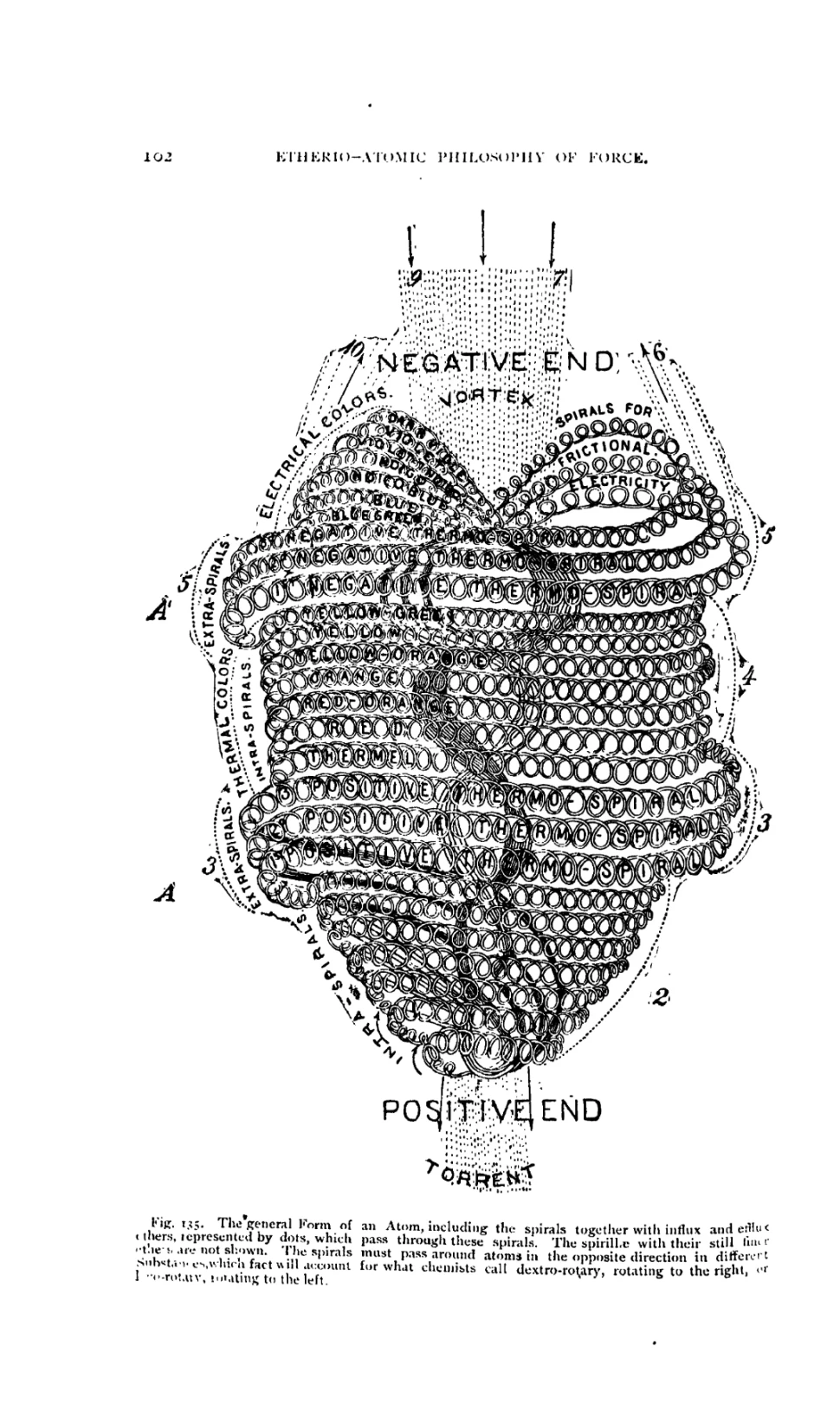
Figure 135 shows the atom’s nested coils. Babbitt uses these paths to explain how a current could give rise to the colours he calls electrical.
Edwin D. Babbitt, The Principles of Light and Color, second edition, 1896. Lumitheca Library facsimile. · Image source ↗ · Public Domain
Experimental Researches in Electricity by Michael Faraday
In Experimental Researches in Electricity, Michael Faraday winds separate coils on an iron ring. A galvanometer in one circuit registers a brief deflection when he makes or breaks the connection in the other. The response changes direction when he breaks the connection. [2]
Colour and an induced current
Babbitt treats colour as an expression of a kind of electricity. Faraday’s apparatus detects a transient electrical response when a neighbouring current changes. What Faraday measures is the deflection of an instrument in a second circuit. [3][4][2]
In the library
The Principles of Light and Color
Reading note
Separately attributed primary Library account, cited on exact verified Reader leaves.
Sources
See references (5)
- Figure 135, Babbitt’s spiral atom, printed p. 102, Reader page 109Edwin D. Babbitt, The Principles of Light and Color, second edition, 1896. Lumitheca Library facsimile.Read this page in The Principles of Light and Color ↗
- Experimental Researches in Electricity, first series, §§27–30 ↗Michael Faraday, Experimental Researches in Electricity, first series, read 24 November 1831.
- The Principles of Light and Color, printed p. 127, Reader page 134Edwin D. Babbitt, The Principles of Light and Color, second edition, College of Fine Forces, East Orange, New Jersey, 1896. Lumitheca Library edition IMJ-0607-E001.Read this page in The Principles of Light and Color ↗
- The Principles of Light and Color, printed p. 129, Reader page 136Edwin D. Babbitt, The Principles of Light and Color, second edition, College of Fine Forces, East Orange, New Jersey, 1896. Lumitheca Library edition IMJ-0607-E001.Read this page in The Principles of Light and Color ↗
- The Principles of Light and Color, printed p. 138, Reader page 145Edwin D. Babbitt, The Principles of Light and Color, second edition, College of Fine Forces, East Orange, New Jersey, 1896. Lumitheca Library edition IMJ-0607-E001.Read this page in The Principles of Light and Color ↗