Christmas in the spirit world
Christmas in A Subaltern in Spirit Land includes Midnight Mass at Ypres, gifts and a Nativity play. See why Ward’s spirits choose to follow Greenwich time.
In this article
Understanding christmas in the spirit world
In J. S. M. Ward’s A Subaltern in Spirit Land, Christmas continues as a day of worship, visits and recreation after death. Its participants can join still-living worshippers by keeping the same hour. [1][2][3]
The episode describes a Christian Spiritualist celebration. Its choice of Greenwich time lets people who experience time differently share an occasion. [1][2]
A Subaltern in Spirit Land by J. S. M. Ward
In A Subaltern in Spirit Land, J. S. M. Ward describes Rex, H. J. L. and Ward’s mother returning from Midnight Mass at the astral counterpart of Ypres Cathedral. The mother wanted a fine service. Rex wanted to see the cathedral without the circumstances that marked his wartime memory. [1][2]
Their prayers are said to join those of the living. Asked what time they follow, Rex answers Greenwich time: choosing to unite with people on earth requires temporary synchronisation. Earthly chronology is treated here as a practical relationship willingly entered for an occasion. [1][2]
Rex describes concerts, plays, games, gifts and a dance planned for the soldiers. He wonders whether the dance will go as intended. The festivities keep company and amusement at the centre of the day. He says the group has no Christmas dinner. [2][3]
He also plans to visit a Nativity play in a medieval division and later Yuletide festivities associated with another historical period. The programme brings religious observance, personal choice and Ward’s layered afterlife environments into one day. [3]
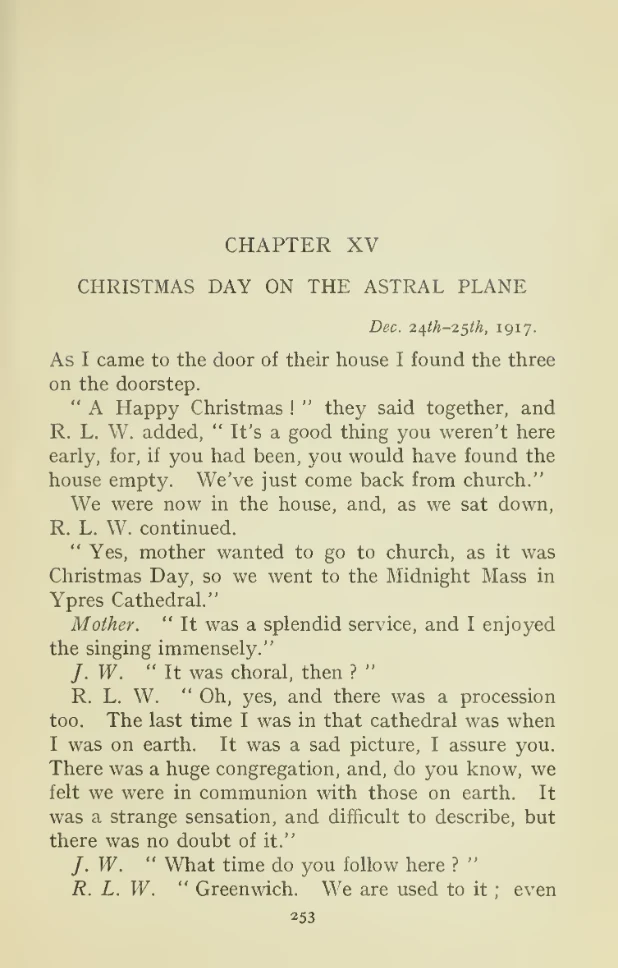
A Subaltern in Spirit Land (1920), printed p. 253, Library Reader page 268. Rex and his companions explain where they went for Midnight Mass.
J. S. M. Ward, A Subaltern in Spirit Land. William Rider & Son, 1920. Public-domain historical text and page image, extracted from the checksum-verified retained Library scan. · Image source ↗ · Public Domain
Gone West by J. S. M. Ward
In Gone West, H. J. L. experiences what seems a long period of study before learning that only three earthly days have passed. His return from the funeral likewise disrupts an ordinary comparison between elapsed time in the two conditions. [4][5]
Sharing an occasion across different clocks
The group keeps worship, gifts and recreation while leaving out the meal. In Ward’s story, a custom endures when it gives people a reason to come together. [1][2][3]
Gone West gives H. J. L. a long stretch of study during three earthly days. For Christmas, Rex follows Greenwich time so the group can pray at the same hour as the living. Ward makes the timing depend on what the participants are doing together. [2][4][5][1][3]
Rex’s wish to see the cathedral under happier conditions gives the visit a personal reason as well as a liturgical one. Frank Hurley’s 1917 photograph shows the damage to the cathedral’s exterior during the war. [1][2][6]
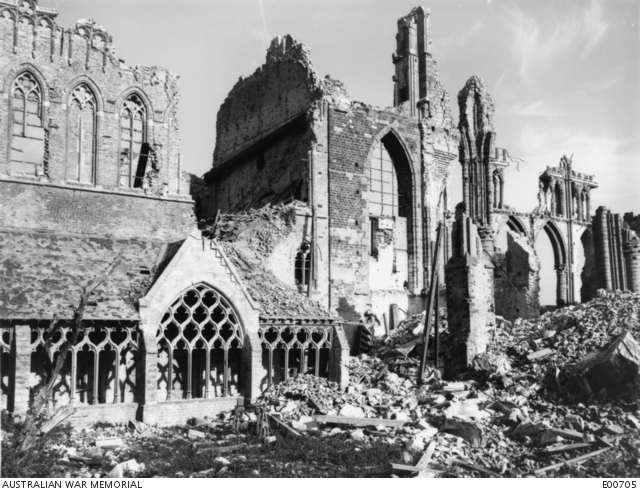
Frank Hurley’s photograph of Ypres Cathedral after wartime damage, 3 September 1917. Australian War Memorial, E00705.
Australian War Memorial, E00705. Photograph by Frank Hurley. Public Domain. · Image source ↗ · Public Domain
See references (6)
- A Subaltern in Spirit Land, printed p. 253, Reader page 268
- A Subaltern in Spirit Land, printed p. 254, Reader page 269
- A Subaltern in Spirit Land, printed p. 255, Reader page 270
- Gone West, printed p. 28, Reader page 41
- Gone West, printed p. 29, Reader page 42
- Frank Hurley, exterior of the ruins of the Cathedral at Ypres, 3 September 1917
Read further in the library
A Subaltern in Spirit Land: A Sequel to Gone West
Reading note
The separately titled account draws on exact passages in the consulted Library edition.
Gone West
Reading note
Separately attributed comparison with exact previously researched Library passages.
Sources
See references (6)
- A Subaltern in Spirit Land, printed p. 253, Reader page 268J. S. M. Ward, A Subaltern in Spirit Land: A Sequel to Gone West. William Rider & Son, London, 1920. Narrated experiences and explanations are attributed to Ward and his reported spirit contributors, especially his brother Rex (R. L. W.) and H. J. L.Read this page in A Subaltern in Spirit Land: A Sequel to Gone West ↗Return to text ↑
- A Subaltern in Spirit Land, printed p. 254, Reader page 269J. S. M. Ward, A Subaltern in Spirit Land: A Sequel to Gone West. William Rider & Son, London, 1920. Narrated experiences and explanations are attributed to Ward and his reported spirit contributors, especially his brother Rex (R. L. W.) and H. J. L.Read this page in A Subaltern in Spirit Land: A Sequel to Gone West ↗Return to text ↑
- A Subaltern in Spirit Land, printed p. 255, Reader page 270J. S. M. Ward, A Subaltern in Spirit Land: A Sequel to Gone West. William Rider & Son, London, 1920. Narrated experiences and explanations are attributed to Ward and his reported spirit contributors, especially his brother Rex (R. L. W.) and H. J. L.Read this page in A Subaltern in Spirit Land: A Sequel to Gone West ↗Return to text ↑
- Gone West, printed p. 28, Reader page 41J. S. M. Ward, Gone West: Three Narratives of After-Death Experiences, third impression, William Rider & Son, London, 1920, as reproduced in Geoff Cutler’s December 2009 digital transcription. Ward’s introduction is distinct from the supplied 1974 foreword.Read this page in Gone West ↗Return to text ↑
- Gone West, printed p. 29, Reader page 42J. S. M. Ward, Gone West: Three Narratives of After-Death Experiences, third impression, William Rider & Son, London, 1920, as reproduced in Geoff Cutler’s December 2009 digital transcription. Ward’s introduction is distinct from the supplied 1974 foreword.Read this page in Gone West ↗Return to text ↑
- Frank Hurley, exterior of the ruins of the Cathedral at Ypres, 3 September 1917 ↗Australian War Memorial, E00705. Photograph by Frank Hurley. Public Domain.Return to text ↑