Charging Poles and Discharging Bases
Explore Walter Russell’s charging poles and discharging bases, his picture of Earth as a double magnet, and how it differs from geomagnetism.
In this article
Where Russell puts concentration and release
Charging poles and discharging bases are parts of Walter Russell’s model of the region around a body. He associates the poles with concentration and the bases with release. In his diagram of Earth, the two belong to an arrangement of opposing cones. [3][4][5][6]
The Universal One by Walter Russell
In The Universal One, Walter Russell places the apices of the cones at a gravitating centre and their bases toward the inertial planes between bodies. He calls the poles channels through which changes in one body can be answered by changes in another. [3][4][5]
Russell distinguishes a bar magnet from what he calls a planetary double magnet. In his account, two electric streams meet at the planet’s centre and extend toward the ecliptic. The drawing incorporates the bulge of Earth’s equator and the tilt of its axis. [5][7][6][8]
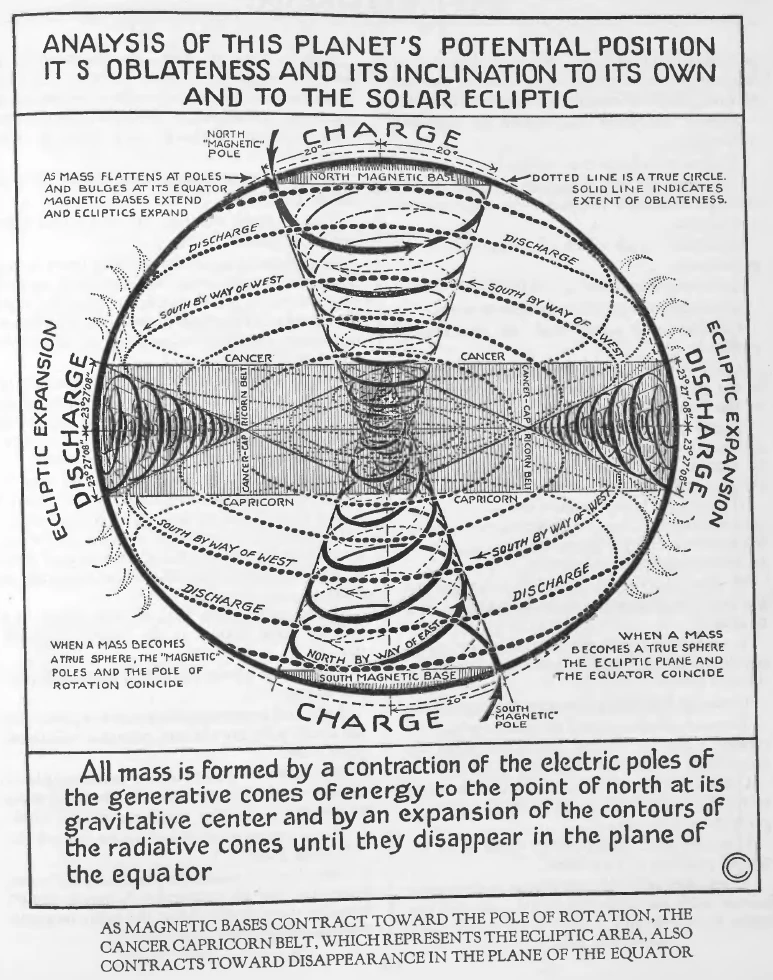
In Russell’s Earth diagram, the charging poles and discharging bases occupy different parts of opposing cones. The labels use Russell’s own terms for electrical and magnetic effects.
Walter Russell, Analysis of This Planet’s Potential Position. Brieger Press, New York, copyright 1926, Library of Congress LCCN 27004508. Library of Congress, public domain. · Image source ↗ · Public Domain
See references (6)
- The Universal One, printed p. 210, Reader page 209
- The Universal One, printed p. 215, Reader page 214
- The Universal One, printed p. 216, Reader page 215
- The Universal One, printed p. 220, Reader page 219
- The Universal One, printed p. 218, Reader page 217
- The Universal One, printed p. 223, Reader page 222
Earth’s magnetic field
The U.S. Geological Survey describes an approximately dipolar field at Earth’s surface, with important departures from that pattern. It traces the field to motion in the electrically conducting outer core. Russell’s cones and bases belong to his own account of charging and dispersal. [3][5][6][2]
In the library

The Universal One
Reading note
The separately titled account draws on exact passages in the consulted Library edition.
Sources
See references (8)
- Analysis of This Planet’s Potential Position ↗Walter Russell, Analysis of This Planet’s Potential Position. Brieger Press, New York, copyright 1926, Library of Congress LCCN 27004508. Library of Congress, public domain.
- USGS, Introduction to Geomagnetism ↗U.S. Geological Survey, Introduction to Geomagnetism.
- The Universal One, printed p. 210, Reader page 209Walter Russell, The Universal One, edited by Louise Russell, University of Science and Philosophy, Limited Edition De Luxe. Lumitheca Library edition IMJ-0605-E001.Read this page in The Universal One ↗
- The Universal One, printed p. 215, Reader page 214Walter Russell, The Universal One, edited by Louise Russell, University of Science and Philosophy, Limited Edition De Luxe. Lumitheca Library edition IMJ-0605-E001.Read this page in The Universal One ↗
- The Universal One, printed p. 216, Reader page 215Walter Russell, The Universal One, edited by Louise Russell, University of Science and Philosophy, Limited Edition De Luxe. Lumitheca Library edition IMJ-0605-E001.Read this page in The Universal One ↗
- The Universal One, printed p. 220, Reader page 219Walter Russell, The Universal One, edited by Louise Russell, University of Science and Philosophy, Limited Edition De Luxe. Lumitheca Library edition IMJ-0605-E001.Read this page in The Universal One ↗
- The Universal One, printed p. 218, Reader page 217Walter Russell, The Universal One, edited by Louise Russell, University of Science and Philosophy, Limited Edition De Luxe. Lumitheca Library edition IMJ-0605-E001.Read this page in The Universal One ↗
- The Universal One, printed p. 223, Reader page 222Walter Russell, The Universal One, edited by Louise Russell, University of Science and Philosophy, Limited Edition De Luxe. Lumitheca Library edition IMJ-0605-E001.Read this page in The Universal One ↗