Ceremonial Devas in Theosophy
What are ceremonial devas in Theosophy? Compare Challoner’s poem about prayer and worship with Leadbeater’s account of the Eucharist.
In this article
What ceremonial devas do
Ceremonial devas are beings said to take part in worship. In H. K. Challoner’s Theosophical poem, prayer, music and shared attention give the devas strength. They in turn offer a blessing to the congregation. [8][9][10]
Watchers of the Seven Spheres by H. K. Challoner
In The Devas of Ceremonial, a poem in H. K. Challoner’s Watchers of the Seven Spheres, the speakers trace their origin to the human wish for divine union. As voices, instruments and intentions come together, the devas say they grow brighter and can give more. [8][9]
The devas lament ceremonies that continue after attention and purpose have faded. They imagine new forms of worship becoming possible when people renew the desire that animated the older mysteries. [9][10][11]
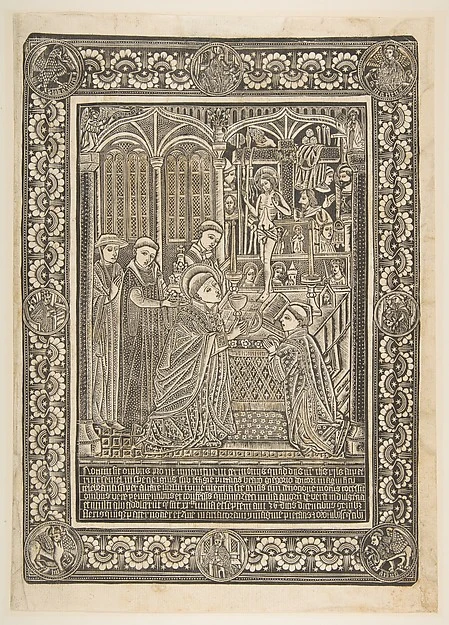
The Mass of Saint Gregory shows a Christian legend of divine presence at an altar. Challoner’s devas describe a blessing arising through the attention of worshippers.
Master of the Church Fathers’ Border, The Mass of Saint Gregory. The Metropolitan Museum of Art. Harris Brisbane Dick Fund, 1924. · Image source ↗ · CC0
The Science of the Sacraments by Charles W. Leadbeater
In The Science of the Sacraments, Charles W. Leadbeater describes a thought-edifice taking shape during the Eucharist. He follows the pavement, the bowls that form during the Kyrie and the dome as the Gloria develops. The Angel of the Eucharist is said to shape what the people and celebrant contribute. [2][3][4][5][6][7]
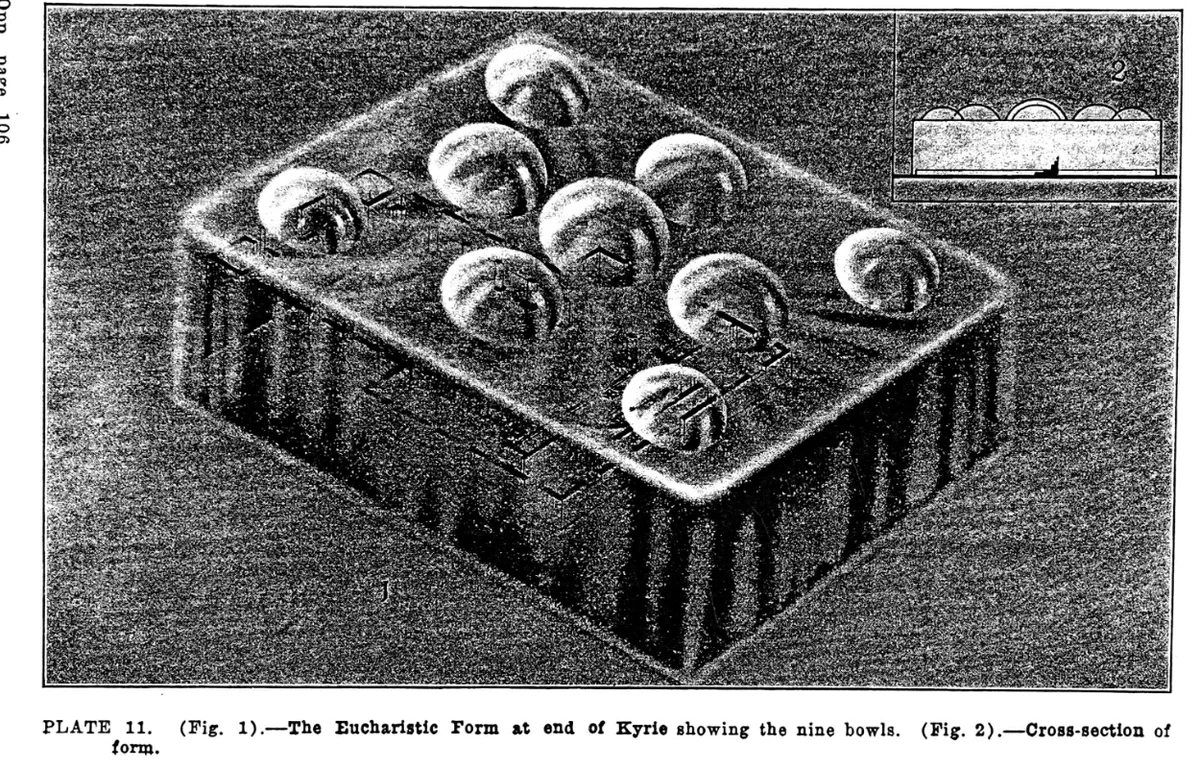
Leadbeater’s plate shows nine bowls associated with the Kyrie. The book gives each invocation a part in building the thought-edifice.
The Science of the Sacraments by Charles W. Leadbeater, The St. Alban Press, 1920. Library facsimile. · Image source ↗ · Public Domain
See references (6)
- The Science of the Sacraments, printed p. 61, Reader page 62
- The Science of the Sacraments, printed p. 63, Reader page 65
- The Science of the Sacraments, printed p. 100, Reader page 105
- The Science of the Sacraments, printed p. 103, Reader page 109
- The Science of the Sacraments, Reader page 114
- The Science of the Sacraments, printed p. 110, Reader page 119
The life of a ceremony and the shape of a rite
Challoner asks what allows a form of worship to retain or recover its power. Leadbeater follows one rite through a sequence of architectural forms. In both accounts the worshippers’ contributions affect what the devas or angels can do. [8][9][10][11][2][3][4][5][6][7]
See references (10)
- The Science of the Sacraments, printed p. 61, Reader page 62
- The Science of the Sacraments, printed p. 63, Reader page 65
- The Science of the Sacraments, printed p. 100, Reader page 105
- The Science of the Sacraments, printed p. 103, Reader page 109
- The Science of the Sacraments, Reader page 114
- The Science of the Sacraments, printed p. 110, Reader page 119
- Watchers of the Seven Spheres, Reader page 43
- Watchers of the Seven Spheres, Reader page 44
- Watchers of the Seven Spheres, printed p. 47, Reader page 45
- Watchers of the Seven Spheres, Reader page 46
In the library
The Science of the Sacraments
Reading note
Separately attributed primary Library account, cited on exact verified Reader leaves.
Watchers of the Seven Spheres
Reading note
The separately titled account draws on exact passages in the consulted Library edition.
Sources
See references (11)
- Master of the Church Fathers’ Border, The Mass of Saint Gregory ↗Master of the Church Fathers’ Border, The Mass of Saint Gregory. The Metropolitan Museum of Art. Harris Brisbane Dick Fund, 1924.
- The Science of the Sacraments, printed p. 61, Reader page 62Charles W. Leadbeater, The Science of the Sacraments, The St. Alban Press, 1920. Exact Library edition IMJ-0615-E001.Read this page in The Science of the Sacraments ↗
- The Science of the Sacraments, printed p. 63, Reader page 65Charles W. Leadbeater, The Science of the Sacraments, The St. Alban Press, 1920. Exact Library edition IMJ-0615-E001.Read this page in The Science of the Sacraments ↗
- The Science of the Sacraments, printed p. 100, Reader page 105Charles W. Leadbeater, The Science of the Sacraments, The St. Alban Press, 1920. Exact Library edition IMJ-0615-E001.Read this page in The Science of the Sacraments ↗
- The Science of the Sacraments, printed p. 103, Reader page 109Charles W. Leadbeater, The Science of the Sacraments, The St. Alban Press, 1920. Exact Library edition IMJ-0615-E001.Read this page in The Science of the Sacraments ↗
- The Science of the Sacraments, Reader page 114Charles W. Leadbeater, The Science of the Sacraments, The St. Alban Press, 1920. Exact Library edition IMJ-0615-E001.Read this page in The Science of the Sacraments ↗
- The Science of the Sacraments, printed p. 110, Reader page 119Charles W. Leadbeater, The Science of the Sacraments, The St. Alban Press, 1920. Exact Library edition IMJ-0615-E001.Read this page in The Science of the Sacraments ↗
- Watchers of the Seven Spheres, Reader page 43H. K. Challoner, Watchers of the Seven Spheres, London, George Routledge & Sons, 1933. Lumitheca Library edition IMJ-0604-E001.Read this page in Watchers of the Seven Spheres ↗
- Watchers of the Seven Spheres, Reader page 44H. K. Challoner, Watchers of the Seven Spheres, London, George Routledge & Sons, 1933. Lumitheca Library edition IMJ-0604-E001.Read this page in Watchers of the Seven Spheres ↗
- Watchers of the Seven Spheres, printed p. 47, Reader page 45H. K. Challoner, Watchers of the Seven Spheres, London, George Routledge & Sons, 1933. Lumitheca Library edition IMJ-0604-E001.Read this page in Watchers of the Seven Spheres ↗
- Watchers of the Seven Spheres, Reader page 46H. K. Challoner, Watchers of the Seven Spheres, London, George Routledge & Sons, 1933. Lumitheca Library edition IMJ-0604-E001.Read this page in Watchers of the Seven Spheres ↗