Building the Spiritual Hut
Building the spiritual hut is Steiner’s metaphor for choosing a point of reference in spiritual experience. Compare it with Franchezzo’s room in the Twilight Land.
In this article
Understanding the concept
Building the spiritual hut means choosing a point of reference for what one encounters in spiritual experience. Rudolf Steiner uses home as a metaphor for the position from which someone can understand an unfamiliar place. [1][2]
The learner starts out as a wanderer. A deliberately chosen home gives the encounters somewhere to be understood from, much as a familiar place shapes the way someone describes a city they are visiting. [1][2]
Initiation and Its Results by Rudolf Steiner
In Initiation and Its Results, Rudolf Steiner pictures an observer who feels almost inside the things they perceive. They can move from place to place. Without a settled point of comparison, they struggle to describe what makes one encounter distinct from another. [1]
The learner therefore chooses and explores a place, making it a spiritual home and setting other things in relation to it. Steiner compares this with the differing perspectives that a Berliner or Parisian might bring to London. A familiar home shapes description even when its influence is not noticed. [2]
Steiner contrasts a home chosen by the observer with a childhood home that has already shaped the observer’s outlook. He wants the learner to notice where they stand when judging something unfamiliar. [2]
After describing the hut, the chapter turns to the spiritual forces Steiner says can be seen behind a crystal or a plant. The home supplies a point of reference for going on with observation. [2][3]
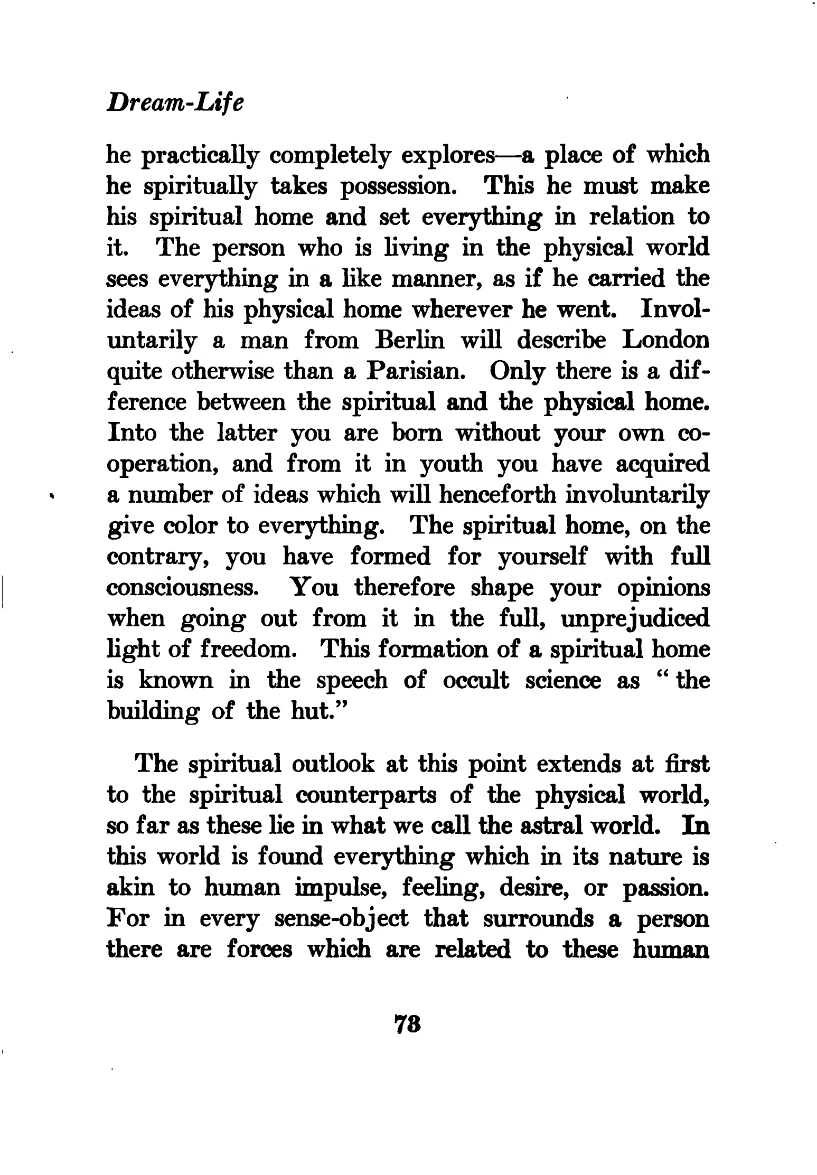
Initiation and Its Results (1909), Dream-Life, Library Reader page 71. Steiner compares a chosen spiritual home with the outlook formed by the home one grew up in.
Rudolf Steiner, Initiation and Its Results, Clifford Bax translation, First American Edition, 1909. Public-domain historical page from the checksum-verified Library PDF. · Image source ↗ · Public Domain
A Wanderer in the Spirit Lands: Franchezzo, transcribed by A. Farnese
Franchezzo’s early room in the Twilight Land, in the account transcribed by A. Farnese, contains a responsive picture and an enduring rose from his beloved. It is a place of rest and relationship amid a bare landscape, with objects earned or received through affection. [4][5]
A home for a traveller and a point of reference
Steiner treats the conscious choice of a starting point as a way to make judgment freer. The emphasis falls on knowing the position from which one is looking. [2]
Franchezzo’s room holds a picture and a rose and lets him maintain a relationship. Steiner’s hut holds the observer’s place in a field of experience. One gives a traveller somewhere to live and recover, and the other gives a learner somewhere to judge from. [1][2][4][5]
Read further in the library

Initiation and Its Results
Reading note
The separately titled account draws on exact passages in the consulted Library edition.

A Wanderer in the Spirit Lands
Reading note
Separately attributed comparison with exact previously researched Library passages.
Sources
See references (5)
- Initiation and Its Results, printed p. 72, Reader page 70Rudolf Steiner, Initiation and Its Results: A Sequel to The Way of Initiation, translated by Clifford Bax. First American Edition, 1909. Macoy Publishing and Masonic Supply Co., New York; Max Gysi, London. Claims of clairvoyant perception and subtle organs remain attributed. References identify the exact consulted Library edition.Read this page in Initiation and Its Results ↗Return to text ↑
- Initiation and Its Results, Reader page 71Rudolf Steiner, Initiation and Its Results: A Sequel to The Way of Initiation, translated by Clifford Bax. First American Edition, 1909. Macoy Publishing and Masonic Supply Co., New York; Max Gysi, London. Claims of clairvoyant perception and subtle organs remain attributed. References identify the exact consulted Library edition.Read this page in Initiation and Its Results ↗Return to text ↑
- Initiation and Its Results, printed p. 74, Reader page 72Rudolf Steiner, Initiation and Its Results: A Sequel to The Way of Initiation, translated by Clifford Bax. First American Edition, 1909. Macoy Publishing and Masonic Supply Co., New York; Max Gysi, London. Claims of clairvoyant perception and subtle organs remain attributed. References identify the exact consulted Library edition.Read this page in Initiation and Its Results ↗Return to text ↑
- A Wanderer in the Spirit Lands, printed p. 41, Reader page 50A Wanderer in the Spirit Lands, attributed to the spirit Franchezzo and transcribed by A. Farnese. W. J. Sinkins, London. Title page undated; preface dated 1896. The narrator’s experiences and the guides’ explanations are reported claims, not independently established observations.Read this page in A Wanderer in the Spirit Lands ↗Return to text ↑
- A Wanderer in the Spirit Lands, printed p. 42, Reader page 51A Wanderer in the Spirit Lands, attributed to the spirit Franchezzo and transcribed by A. Farnese. W. J. Sinkins, London. Title page undated; preface dated 1896. The narrator’s experiences and the guides’ explanations are reported claims, not independently established observations.Read this page in A Wanderer in the Spirit Lands ↗Return to text ↑