Buddhist animal memorials
Buddhist animal memorials include prayers, graves and named remembrances. Read Hearn’s account of a neighbourhood dog and a temple’s approach to pet memorials.
In this article
How animals are remembered
Buddhist animal memorials give people ways to remember animals that have died. A community may recite a sūtra, keep a name at an altar or care for the remains. These acts can express gratitude and grief, and some communities also pray for the animal’s future. [1][3][4][5][6][7]
Pet remembrance in Enkyoji Temple’s account
Seattle Choeizan Enkyoji Temple describes an altar under Kannon’s care, daily prayers, and an annual remembrance at which pets are named. The temple also describes funerals and care for ashes. Families can remember an animal by name in a shared place of practice. [1]
In Ghostly Japan by Lafcadio Hearn
In Ululation, Lafcadio Hearn writes about the old white dog that guards his gate. Children play with her, families feed her and neighbours mark her coat with the names of people willing to claim her if officials come to take her away. They describe her loyalty and affection as worthy of a better rebirth. [5][6][7][3]
The dog is still alive as he writes. Hearn expects a sūtra to be recited when she dies and a small wooden marker, or sotoba, to be placed over her grave in the temple garden. He understands the words he imagines on the marker as a hope for her eventual awakening. [3][4][5][6][7][8]
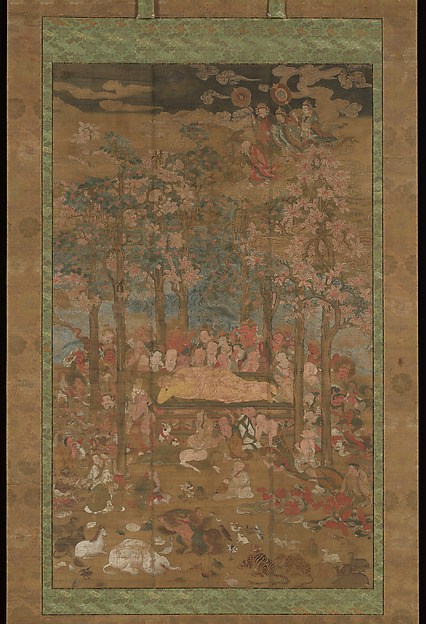
Animals appear among the mourners in Death of the Historical Buddha, a fifteenth-century Japanese painting.
The Metropolitan Museum of Art, Gift of Susan Dwight Bliss, 1944, 44.35.1. Public domain, Open Access CC0; resized and converted to JPEG. · Image source ↗ · CC0
In Ancient Tales and Folk-lore of Japan
In Richard Gordon Smith’s Ancient Tales and Folklore of Japan, Yogodayu frees a bee that later promises him help in a dream. After the battle, he buries the dead bees at a small temple he builds and returns every year to pay his respects. [10][11]
In Smith’s Kinoto story, two monkeys bring a priest food while he copies Buddhist scripture. When he finds them dead, he buries them and prays for their blessing. The gesture recalls particular help he received from the animals. [12][13]
Burial as an act of thanks
In Smith’s two stories, burial returns a kindness. In Hearn’s essay, it would continue a lifetime of care from a neighbourhood. Enkyoji gives that continuing care a communal place. [10][11][12][13][5][6][7]
See references (7)
- In Ghostly Japan, Reader page 130
- In Ghostly Japan, Reader page 131
- In Ghostly Japan, Reader page 132
- Ancient Tales and Folklore of Japan, Reader page 175
- Ancient Tales and Folklore of Japan, Reader page 177
- Ancient Tales and Folklore of Japan, Reader page 197
- Ancient Tales and Folklore of Japan, Reader page 198
A Subaltern in Spirit Land by J. S. M. Ward
In A Subaltern in Spirit Land, J. S. M. Ward recalls his family’s dog Mollie, whom Rex cared for and buried. The communicator H. J. L. considers whether their bond could make another meeting possible, but is unsure how to give Mollie an astral body for the visit. She stays behind. [9]
Prayers for the future and hopes of reunion
Hearn’s imagined funeral expresses hope for a future rebirth. Ward’s dialogue asks whether Mollie might meet someone who loved her. Each book takes seriously what people owe animals, through different accounts of what might follow death. [3][4][1][9]
Read further in the library
In Ghostly Japan
Reading note
The separately titled account draws on exact passages in the consulted Library edition.
A Subaltern in Spirit Land: A Sequel to Gone West
Reading note
Separately attributed comparison with exact previously researched Library passages.
Ancient Tales and Folk-lore of Japan
Reading note
Read Richard Gordon Smith’s separately attributed tale in its Library edition.
Sources
See references (13)
- Seattle Choeizan Enkyoji Temple: Pet memorial ↗The temple’s own explanation of pet memorial services, directly read. Only the pet-specific material is used; the separate mizuko text lower on the page is not treated as an animal memorial.Return to text ↑
- Unknown Japanese artist, Death of the Historical Buddha (Nehan-zu), 15th century ↗The Metropolitan Museum of Art, Gift of Susan Dwight Bliss, 1944, 44.35.1. Public domain, Open Access CC0; resized and converted to JPEG.
- In Ghostly Japan, Reader page 141Lafcadio Hearn, In Ghostly Japan, Little, Brown, and Company, Boston, 1899. Exact consulted Library edition IMJ-0654-E001, with title page visually checked. Persistent PageIDs and current Reader positions are verified from the supplied edition. Embedded stories, translations and quotations are attributed to Hearn’s presentation unless an original source has separately been consulted.Read this page in In Ghostly Japan ↗Return to text ↑
- In Ghostly Japan, Reader page 142Lafcadio Hearn, In Ghostly Japan, Little, Brown, and Company, Boston, 1899. Exact consulted Library edition IMJ-0654-E001, with title page visually checked. Persistent PageIDs and current Reader positions are verified from the supplied edition. Embedded stories, translations and quotations are attributed to Hearn’s presentation unless an original source has separately been consulted.Read this page in In Ghostly Japan ↗Return to text ↑
- In Ghostly Japan, Reader page 130Lafcadio Hearn, In Ghostly Japan, Little, Brown, and Company, Boston, 1899. Exact consulted Library edition IMJ-0654-E001, with title page visually checked. Persistent PageIDs and current Reader positions are verified from the supplied edition. Embedded stories, translations and quotations are attributed to Hearn’s presentation unless an original source has separately been consulted.Read this page in In Ghostly Japan ↗Return to text ↑
- In Ghostly Japan, Reader page 131Lafcadio Hearn, In Ghostly Japan, Little, Brown, and Company, Boston, 1899. Exact consulted Library edition IMJ-0654-E001, with title page visually checked. Persistent PageIDs and current Reader positions are verified from the supplied edition. Embedded stories, translations and quotations are attributed to Hearn’s presentation unless an original source has separately been consulted.Read this page in In Ghostly Japan ↗Return to text ↑
- In Ghostly Japan, Reader page 132Lafcadio Hearn, In Ghostly Japan, Little, Brown, and Company, Boston, 1899. Exact consulted Library edition IMJ-0654-E001, with title page visually checked. Persistent PageIDs and current Reader positions are verified from the supplied edition. Embedded stories, translations and quotations are attributed to Hearn’s presentation unless an original source has separately been consulted.Read this page in In Ghostly Japan ↗Return to text ↑
- In Ghostly Japan, Reader page 140Lafcadio Hearn, In Ghostly Japan, Little, Brown, and Company, Boston, 1899. Exact consulted Library edition IMJ-0654-E001, with title page visually checked. Persistent PageIDs and current Reader positions are verified from the supplied edition. Embedded stories, translations and quotations are attributed to Hearn’s presentation unless an original source has separately been consulted.Read this page in In Ghostly Japan ↗Return to text ↑
- A Subaltern in Spirit Land, printed p. 6, Reader page 21J. S. M. Ward, A Subaltern in Spirit Land: A Sequel to Gone West, William Rider & Son, 1920.Read this page in A Subaltern in Spirit Land: A Sequel to Gone West ↗Return to text ↑
- Ancient Tales and Folklore of Japan, Reader page 175Richard Gordon Smith, Ancient Tales and Folklore of Japan. A. & C. Black, London, 1908. Lumitheca Library edition IMJ-0588-E001.Read this page in Ancient Tales and Folk-lore of Japan ↗Return to text ↑
- Ancient Tales and Folklore of Japan, Reader page 177Richard Gordon Smith, Ancient Tales and Folklore of Japan. A. & C. Black, London, 1908. Lumitheca Library edition IMJ-0588-E001.Read this page in Ancient Tales and Folk-lore of Japan ↗Return to text ↑
- Ancient Tales and Folklore of Japan, Reader page 197Richard Gordon Smith, Ancient Tales and Folklore of Japan. A. & C. Black, London, 1908. Lumitheca Library edition IMJ-0588-E001.Read this page in Ancient Tales and Folk-lore of Japan ↗Return to text ↑
- Ancient Tales and Folklore of Japan, Reader page 198Richard Gordon Smith, Ancient Tales and Folklore of Japan. A. & C. Black, London, 1908. Lumitheca Library edition IMJ-0588-E001.Read this page in Ancient Tales and Folk-lore of Japan ↗Return to text ↑