Blue Glass and Plant Growth in Babbitt’s Colour Theory
Why did Babbitt think blue glass helped plants grow? Read the nineteenth-century grape trials and compare them with research on plant blue-light receptors.
In this article
Why growers tried blue glass
Blue glass changes the mix of wavelengths that reach a plant. Nineteenth-century writers debated what this could do to growth. Edwin D. Babbitt read reports of blue-glass greenhouses through his theory that colours carry distinct forces. [4][5][6]
The Principles of Light and Color by Edwin D. Babbitt
In The Principles of Light and Color, Edwin D. Babbitt gathers reports of plants grown under coloured glass and asks how the effects change across a plant’s life. He distinguishes early growth from the formation of flowers, fruit and seeds. [4][5][7]
Babbitt recounts Augustus James Pleasonton’s reported grape harvest and interprets it as evidence for the combined action of blue-filtered and ordinary sunlight. The account leaves several features of the greenhouse and growing conditions in play. [8][6]
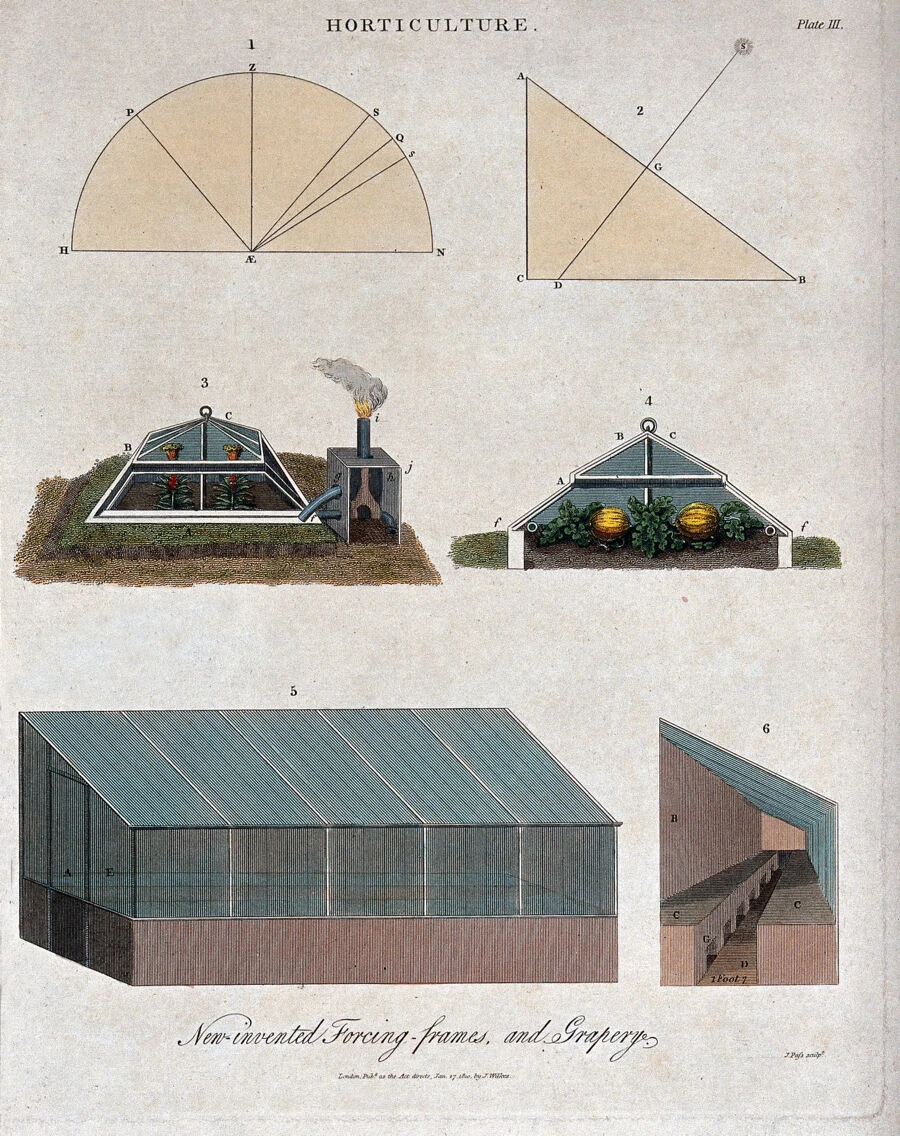
This historical print shows several kinds of greenhouse, including a grapery. It illustrates the kinds of structures in which growers experimented with glazing.
Types of greenhouse, coloured engraving. Wellcome Collection, V0025735. · Image source ↗ · Public Domain
See references (5)
- The Principles of Light and Color, printed p. 378, Reader page 385
- The Principles of Light and Color, printed p. 381, Reader page 388
- The Principles of Light and Color, printed p. 386, Reader page 393
- The Principles of Light and Color, printed p. 391, Reader page 398
- The Principles of Light and Color, printed p. 385, Reader page 392
The Influence of the Blue Ray of the Sunlight by Augustus James Pleasonton
In The Influence of the Blue Ray of the Sunlight, Augustus James Pleasonton describes planting several varieties of vine and training vines from outside into his grapery. He arranges for light passing through coloured panes to reach the foliage as the Sun moves across the sky. [2]
What a later experiment measured
A 1998 study of the Arabidopsis protein NPH1 found that it responded to blue light when expressed in insect cells. The result supports its role as a photoreceptor for growth toward light. The size of a grape harvest is a different outcome, affected by the conditions in which the vines were grown. [5][6][2][3]
In the library
The Principles of Light and Color
Reading note
The separately titled account draws on exact passages in the consulted Library edition.
Sources
See references (8)
- Types of Greenhouse, coloured engraving ↗Types of greenhouse, coloured engraving. Wellcome Collection, V0025735.
- The Influence of the Blue Ray of the Sunlight, p. 6 ↗Augustus James Pleasonton, Philadelphia, 1876.
- Arabidopsis NPH1, Science 282, pp. 1698–1701 (1998) ↗J. M. Christie and colleagues, Science 282, pp. 1698–1701, 1998.
- The Principles of Light and Color, printed p. 378, Reader page 385Edwin D. Babbitt, The Principles of Light and Color, second edition, College of Fine Forces, East Orange, New Jersey, 1896. Lumitheca Library edition IMJ-0607-E001.Read this page in The Principles of Light and Color ↗
- The Principles of Light and Color, printed p. 381, Reader page 388Edwin D. Babbitt, The Principles of Light and Color, second edition, College of Fine Forces, East Orange, New Jersey, 1896. Lumitheca Library edition IMJ-0607-E001.Read this page in The Principles of Light and Color ↗
- The Principles of Light and Color, printed p. 386, Reader page 393Edwin D. Babbitt, The Principles of Light and Color, second edition, College of Fine Forces, East Orange, New Jersey, 1896. Lumitheca Library edition IMJ-0607-E001.Read this page in The Principles of Light and Color ↗
- The Principles of Light and Color, printed p. 391, Reader page 398Edwin D. Babbitt, The Principles of Light and Color, second edition, College of Fine Forces, East Orange, New Jersey, 1896. Lumitheca Library edition IMJ-0607-E001.Read this page in The Principles of Light and Color ↗
- The Principles of Light and Color, printed p. 385, Reader page 392Edwin D. Babbitt, The Principles of Light and Color, second edition, College of Fine Forces, East Orange, New Jersey, 1896. Lumitheca Library edition IMJ-0607-E001.Read this page in The Principles of Light and Color ↗