Black dogs and spectral hounds
Black dogs and spectral hounds haunt particular places in folklore. Compare the 1577 Bungay pamphlet with stories of Peel Castle and Hergest.
In this article
What are spectral hounds?
A spectral hound is a dog-shaped figure in a haunting or omen story. The black dog is one especially familiar form. Its story may belong to a place, such as a church or castle, or to a family that links the figure with a death. [1][2][3][4]
The shape leaves the identity open. The hound can be an ordinary animal’s ghost, a dead person appearing as a dog or an apparition given a different explanation. The setting and what happens at the encounter often tell us more than its colour. [1][5][2][3][6]
Fleming’s black dog at Bungay
Abraham Fleming’s 1577 pamphlet reports an apparition in the shape of a black dog during a violent storm at Bungay church. It also recounts a similar appearance at Blythburgh. Fleming considers whether the figure might be the devil in that likeness. His account belongs to the East Anglian tradition now associated with Black Shuck. [11][10]
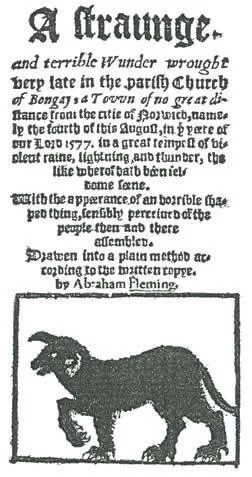
Abraham Fleming, A Straunge and Terrible Wunder, 1577. The title page includes a dog-shaped figure.
Abraham Fleming, 1552–1607. Public-domain pamphlet title page, via Wikimedia Commons. · Image source ↗ · Public Domain
Human Animals by Frank Hamel
Frank Hamel’s Human Animals gathers dog-shaped apparitions with distinct local settings. At Peel Castle on the Isle of Man, the dog keeps appearing in the same place. What matters to the story is how repeated encounters make the guards accustomed to it. [2][3]
The Hergest account connects a dog with a death-warning tradition. By contrast, the Hounds Pool story explains a spectral hound through a deceased weaver. Both involve a dog-shaped presence, but one foregrounds prediction and the other the identity of a haunting human dead. [3][6]
Hamel’s discussion of Trash includes sound and disappearance as well as visual appearance. A separate Highland story uses a matching wound to connect a dog-form encounter with a person. These details show why sound, location and attributed identity matter alongside the familiar dark animal outline. [5][4]
What makes each hound local
The apparition in Fleming’s Suffolk pamphlet occurs during a storm and enters a church. The hound of Peel Castle returns in a place whose occupants become used to it. At Hergest, the hound’s appearance is read as a warning about a household. Where the dog appears helps explain what its presence means. [2][3][6][11]
Animal ghosts ask whether an animal itself survives. A spectral hound attributed to a dead human does not establish that claim. Death omens ask a further question about timing: a frightening encounter becomes an omen only through a supposed connection with an event. [7][8][3][6][9]
See references (7)
- Human Animals, printed p. 240, Reader page 249
- Human Animals, printed p. 241, Reader page 250
- Human Animals, printed p. 242, Reader page 251
- Human Animals, printed p. 225, Reader page 234
- Human Animals, printed p. 226, Reader page 235
- Human Animals, printed p. 263, Reader page 272
- Abraham Fleming, A Straunge and Terrible Wunder, 1577
Read further in the library

Human Animals
Reading note
Frank Hamel collects the particular stories and interpretations discussed here; the account identifies exact printed and Library Reader pages.
Sources
See references (11)
- Human Animals, printed p. 238, Reader page 247Frank Hamel, Human Animals. Frederick A. Stokes Co., New York, undated title page; preface dated London, 1915. Exact printed pages refer to the retained Library scan.Read this page in Human Animals ↗Return to text ↑
- Human Animals, printed p. 240, Reader page 249Frank Hamel, Human Animals. Frederick A. Stokes Co., New York, undated title page; preface dated London, 1915. Exact printed pages refer to the retained Library scan.Read this page in Human Animals ↗Return to text ↑
- Human Animals, printed p. 241, Reader page 250Frank Hamel, Human Animals. Frederick A. Stokes Co., New York, undated title page; preface dated London, 1915. Exact printed pages refer to the retained Library scan.Read this page in Human Animals ↗Return to text ↑
- Human Animals, printed p. 243, Reader page 252Frank Hamel, Human Animals. Frederick A. Stokes Co., New York, undated title page; preface dated London, 1915. Exact printed pages refer to the retained Library scan.Read this page in Human Animals ↗Return to text ↑
- Human Animals, printed p. 239, Reader page 248Frank Hamel, Human Animals. Frederick A. Stokes Co., New York, undated title page; preface dated London, 1915. Exact printed pages refer to the retained Library scan.Read this page in Human Animals ↗Return to text ↑
- Human Animals, printed p. 242, Reader page 251Frank Hamel, Human Animals. Frederick A. Stokes Co., New York, undated title page; preface dated London, 1915. Exact printed pages refer to the retained Library scan.Read this page in Human Animals ↗Return to text ↑
- Human Animals, printed p. 225, Reader page 234Frank Hamel, Human Animals. Frederick A. Stokes Co., New York, undated title page; preface dated London, 1915. Exact printed pages refer to the retained Library scan.Read this page in Human Animals ↗Return to text ↑
- Human Animals, printed p. 226, Reader page 235Frank Hamel, Human Animals. Frederick A. Stokes Co., New York, undated title page; preface dated London, 1915. Exact printed pages refer to the retained Library scan.Read this page in Human Animals ↗Return to text ↑
- Human Animals, printed p. 263, Reader page 272Frank Hamel, Human Animals. Frederick A. Stokes Co., New York, undated title page; preface dated London, 1915. Exact printed pages refer to the retained Library scan.Read this page in Human Animals ↗Return to text ↑
- Abraham Fleming’s A Straunge and Terrible Wunder, 1577, with a dog-shaped apparition on its title page ↗Abraham Fleming, 1552–1607. Public-domain pamphlet title page, via Wikimedia Commons.Return to text ↑
- Abraham Fleming, A Straunge and Terrible Wunder, 1577 ↗Primary pamphlet transcribed by Royal Holloway, University of London.Return to text ↑