Bhakti Yoga
Bhakti Yoga is a Hindu path of love and devotion. Read Krishna on offering and Vivekananda on remembrance, love and the danger of fanaticism.
In this article
Understanding the concept
Bhakti Yoga is a Hindu path of devotion in which love of the divine shapes worship, attention and action. In the Bhagavad Gita, Krishna asks for devotion directed towards him. Swami Vivekananda also asks how that love can change the way a person remembers, worships and works. [1][4][5]
The Gita gives devotion a simple form. A leaf or a little water can be an offering when it is given with love. The value of the gift depends on the relationship in which it is offered. [2]
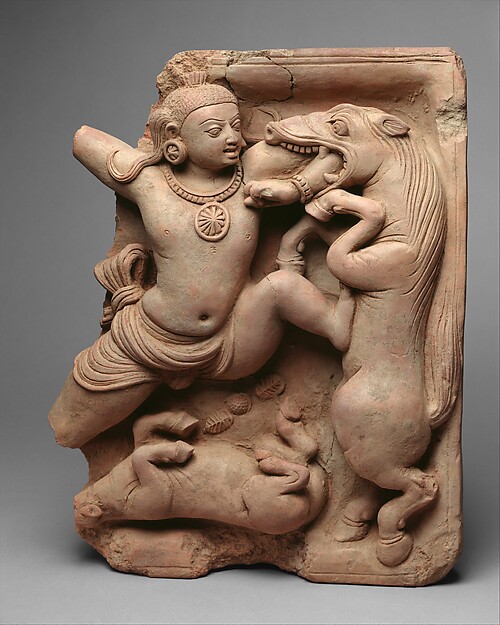
Krishna Killing the Horse Demon Keshi, Gupta-period terracotta, Uttar Pradesh, fifth century. The relief shows Krishna in an episode from his life.
Purchase, Florence and Herbert Irving Gift, 1991. Public Domain, The Met Open Access. · Image source ↗ · CC0
The Bhagavad Gita: dedication and devotion
In Bhagavad Gita 12.6–7, Krishna describes people who dedicate their acts to him, keep him as their supreme goal and worship with concentrated devotion. He promises release from the cycle of birth and death. Verse 9.26 gives that relationship a simple material expression through a modest offering made with love. Both passages are cited in Swami Mukundananda’s English translation. [1][2]
Vivekananda’s Bhakti-Yoga
Vivekananda begins with love of the Lord and cites Nārada on devotion as love that reaches beyond the pursuit of a reward. Love is part of the search from the start and also the condition the devotee seeks. [13]
Devotion can begin with strong attachment to a chosen ideal. Vivekananda warns that a devotee can turn that attachment into hostility towards people who worship differently. He says mature devotion gives the person a reason to relinquish that hostility. [14][15]
The discussion also presents constant remembrance as a form of worship. Its image is oil flowing in a steady stream from one vessel to another. The image describes how sustained attention can become part of love in practice. [16][17]
See references (5)
Karma-Yoga by Swami Vivekananda
Swami Vivekananda brings love into Karma-Yoga through the distinction between care and possession. His example of a jealous lover shows affection becoming an effort to control another person. He presents unattached love as freedom from that demand, and then extends the question to family, society and the wider world. [6][7]
For someone who believes in a personal God, work can be offered as worship. The worker gives its fruits to the Lord and relinquishes the demand for praise or repayment from other people. This is one of the book’s explanations of how devotion can transform the motive of action. [4][5]
The same discipline becomes a continuing self-offering: body, mind and acts are yielded to the Lord. Vivekananda contrasts this with the narrow self that appropriates the outcome. He also describes a non-theistic route relying on will and discrimination, so devotional surrender is an approach within his larger account rather than a condition he imposes on every worker. [5][8]
In Karma-Yoga, Vivekananda relates devotion to the other paths through self-abnegation. A person can express devotion through work, and the worker can follow a path even without religious belief. The chapter asks how love, knowledge and action can each loosen a possessive claim. [9][10][11][12]
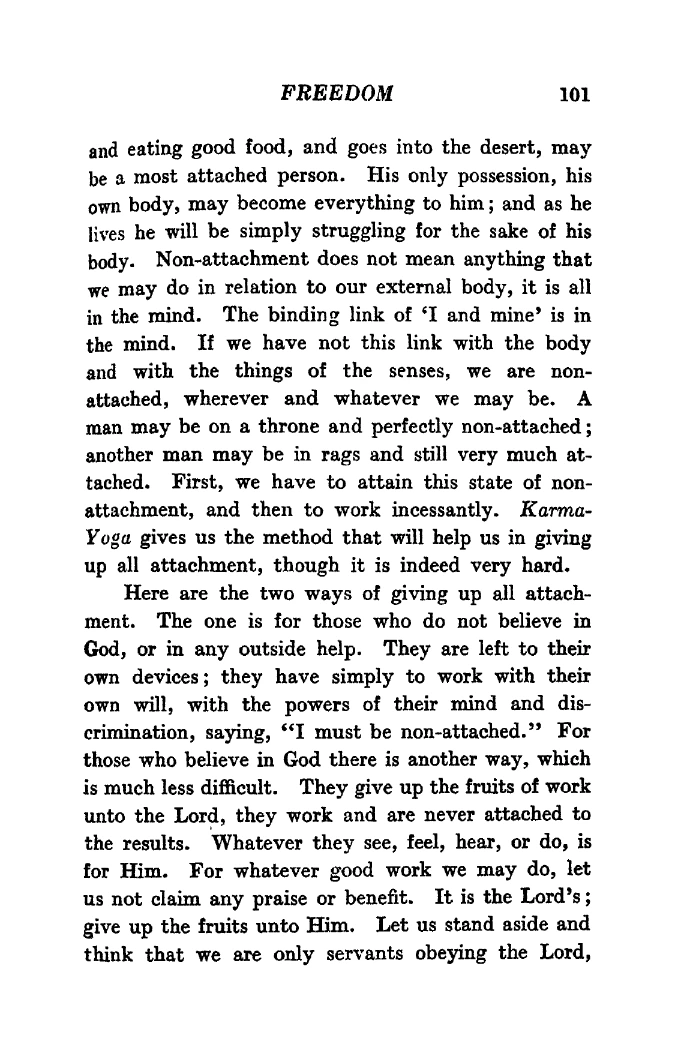
Source facsimile: Karma-Yoga (1939), Reader page 103. Offering the fruits of work to the Lord is one of the two approaches to non-attachment described here.
Swami Vivekananda, Karma-Yoga, English second printing in the 1939 combined volume. Historical public-domain text, exact checksum-verified Library scan. · Image source ↗ · Public Domain
What devotion changes
Krishna promises deliverance to those who devote their acts to him. Bhakti-Yoga asks how love itself matures and changes a devotee’s relation to other people. Karma-Yoga extends the offering of work to the question of what makes anyone’s action unselfish. [1][9][5][13][15]
Read further in the library
Karma Yoga
Reading note
The separately titled account draws on exact passages in the consulted Library edition.
Sources
See references (17)
- Bhagavad Gita 12.6–7, translated by Swami Mukundananda ↗Bhagavad Gita 12.6–7, Krishna’s words to Arjuna, translated by Swami Mukundananda. Offering actions and release from birth and death.Return to text ↑
- Bhagavad Gita 9.26, translated by Swami Mukundananda ↗Bhagavad Gita 9.26, Krishna’s words to Arjuna, translated by Swami Mukundananda. A simple offering is received with devotion.Return to text ↑
- Krishna Killing the Horse Demon Keshi, 1991.300 ↗The Metropolitan Museum of Art
- Karma-Yoga, Reader page 47Swami Vivekananda, Karma-Yoga, in Karma-Yoga & Bhakti-Yoga, English second printing, Ramakrishna-Vivekananda Center of New York, Inc., 1939. Exact Library edition IMJ-0097-E002. Only the Karma-Yoga part is used in this crawl; the old Work slug mentioning Hindi does not identify this edition’s language.Read this page in Karma Yoga ↗Return to text ↑
- Karma-Yoga, printed p. 101, Reader page 103Swami Vivekananda, Karma-Yoga, in Karma-Yoga & Bhakti-Yoga, English second printing, Ramakrishna-Vivekananda Center of New York, Inc., 1939. Exact Library edition IMJ-0097-E002. Only the Karma-Yoga part is used in this crawl; the old Work slug mentioning Hindi does not identify this edition’s language.Read this page in Karma Yoga ↗Return to text ↑
- Karma-Yoga, Reader page 45Swami Vivekananda, Karma-Yoga, in Karma-Yoga & Bhakti-Yoga, English second printing, Ramakrishna-Vivekananda Center of New York, Inc., 1939. Exact Library edition IMJ-0097-E002. Only the Karma-Yoga part is used in this crawl; the old Work slug mentioning Hindi does not identify this edition’s language.Read this page in Karma Yoga ↗Return to text ↑
- Karma-Yoga, Reader page 46Swami Vivekananda, Karma-Yoga, in Karma-Yoga & Bhakti-Yoga, English second printing, Ramakrishna-Vivekananda Center of New York, Inc., 1939. Exact Library edition IMJ-0097-E002. Only the Karma-Yoga part is used in this crawl; the old Work slug mentioning Hindi does not identify this edition’s language.Read this page in Karma Yoga ↗Return to text ↑
- Karma-Yoga, Reader page 104Swami Vivekananda, Karma-Yoga, in Karma-Yoga & Bhakti-Yoga, English second printing, Ramakrishna-Vivekananda Center of New York, Inc., 1939. Exact Library edition IMJ-0097-E002. Only the Karma-Yoga part is used in this crawl; the old Work slug mentioning Hindi does not identify this edition’s language.Read this page in Karma Yoga ↗Return to text ↑
- Karma-Yoga, Reader page 82Swami Vivekananda, Karma-Yoga, in Karma-Yoga & Bhakti-Yoga, English second printing, Ramakrishna-Vivekananda Center of New York, Inc., 1939. Exact Library edition IMJ-0097-E002. Only the Karma-Yoga part is used in this crawl; the old Work slug mentioning Hindi does not identify this edition’s language.Read this page in Karma Yoga ↗Return to text ↑
- Karma-Yoga, Reader page 83Swami Vivekananda, Karma-Yoga, in Karma-Yoga & Bhakti-Yoga, English second printing, Ramakrishna-Vivekananda Center of New York, Inc., 1939. Exact Library edition IMJ-0097-E002. Only the Karma-Yoga part is used in this crawl; the old Work slug mentioning Hindi does not identify this edition’s language.Read this page in Karma Yoga ↗Return to text ↑
- Karma-Yoga, Reader page 111Swami Vivekananda, Karma-Yoga, in Karma-Yoga & Bhakti-Yoga, English second printing, Ramakrishna-Vivekananda Center of New York, Inc., 1939. Exact Library edition IMJ-0097-E002. Only the Karma-Yoga part is used in this crawl; the old Work slug mentioning Hindi does not identify this edition’s language.Read this page in Karma Yoga ↗Return to text ↑
- Karma-Yoga, Reader page 115Swami Vivekananda, Karma-Yoga, in Karma-Yoga & Bhakti-Yoga, English second printing, Ramakrishna-Vivekananda Center of New York, Inc., 1939. Exact Library edition IMJ-0097-E002. Only the Karma-Yoga part is used in this crawl; the old Work slug mentioning Hindi does not identify this edition’s language.Read this page in Karma Yoga ↗Return to text ↑
- Bhakti-Yoga (1939), The definition of bhakti, Reader page 130Swami Vivekananda, Bhakti-Yoga, in the Library’s bound Karma-Yoga and Bhakti-Yoga volume, 1939.Read this page in Karma Yoga ↗Return to text ↑
- Bhakti-Yoga (1939), Devotion and fanaticism, Reader page 131Swami Vivekananda, Bhakti-Yoga, in the Library’s bound Karma-Yoga and Bhakti-Yoga volume, 1939.Read this page in Karma Yoga ↗Return to text ↑
- Bhakti-Yoga (1939), Mature devotion, Reader page 132Swami Vivekananda, Bhakti-Yoga, in the Library’s bound Karma-Yoga and Bhakti-Yoga volume, 1939.Read this page in Karma Yoga ↗Return to text ↑
- Bhakti-Yoga (1939), Love, knowledge and remembrance, Reader page 133Swami Vivekananda, Bhakti-Yoga, in the Library’s bound Karma-Yoga and Bhakti-Yoga volume, 1939.Read this page in Karma Yoga ↗Return to text ↑
- Bhakti-Yoga (1939), Constant remembrance, Reader page 134Swami Vivekananda, Bhakti-Yoga, in the Library’s bound Karma-Yoga and Bhakti-Yoga volume, 1939.Read this page in Karma Yoga ↗Return to text ↑