Baptism
What is Christian baptism? Learn what water, anointing and baptismal words express, with a separate account of Leadbeater’s Liberal Catholic rite.
In this article
What is baptism?
Baptism is a Christian rite of initiation with water. It marks entry into the life of the Church. In the Church of England’s rite, a minister dips the candidate in water or pours water on them in the name of the Father, Son and Holy Spirit. [1][2]
The Roman Catholic Catechism explains the use of water through Christ’s death and resurrection: the newly baptized enter a new life with Christ. An anointing with chrism after the baptism signifies the gift of the Holy Spirit. [1]
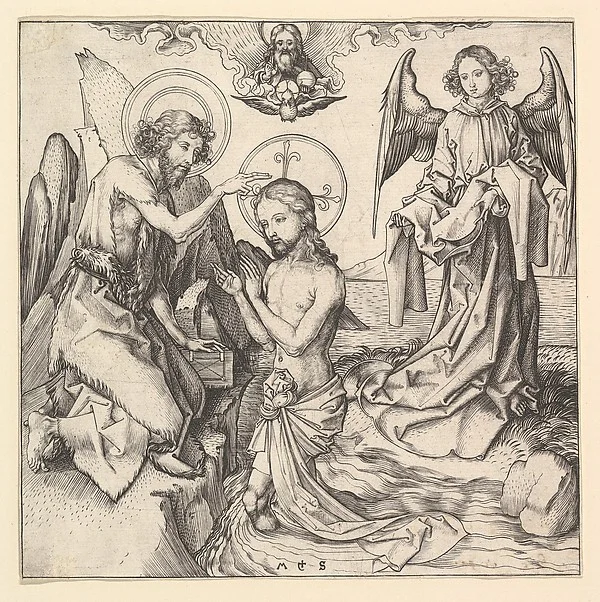
Martin Schongauer’s Baptism of Christ depicts the descent of the dove above Jesus in the Jordan. The water makes the action of baptism visible.
Martin Schongauer. The Metropolitan Museum of Art. Harris Brisbane Dick Fund, 1928. 28.97.107. · Image source ↗ · CC0
The Science of the Sacraments by Charles W. Leadbeater
Charles W. Leadbeater describes infant baptism as help for a soul beginning life in a new body. He believes the rite strengthens some tendencies and restrains others. Before the baptism with water, the priest uses the oil of catechumens in an action Leadbeater says forms a protective thought-form around the child. [4][5][6][7][8][9]
Leadbeater places baptism itself at the pouring of water with the words naming the Trinity. He says the words bring a threefold influence. Anointing with chrism follows, and in his explanation it helps the child retain what the rite has given. [10][11][12][13][14]
See references (11)
- The Science of the Sacraments, Reader page 262
- The Science of the Sacraments, printed p. 251, Reader page 263
- The Science of the Sacraments, printed p. 252, Reader page 264
- The Science of the Sacraments, printed p. 253, Reader page 265
- The Science of the Sacraments, printed p. 254, Reader page 266
- The Science of the Sacraments, printed p. 259, Reader page 271
- The Science of the Sacraments, printed p. 260, Reader page 272
- The Science of the Sacraments, printed p. 261, Reader page 273
- The Science of the Sacraments, printed p. 262, Reader page 274
- The Science of the Sacraments, printed p. 263, Reader page 275
- The Science of the Sacraments, printed p. 264, Reader page 276
What water and anointing signify
The Catholic Catechism links the water with dying and rising with Christ and the chrism with receiving the Spirit. Leadbeater gives the same actions a role in his Liberal Catholic account of preparing and strengthening the child’s subtle bodies. [1][9][10][13][14]
See references (5)
In the library
The Science of the Sacraments
Reading note
The separately titled account draws on exact passages in the consulted Library edition.
Sources
See references (14)
- Catechism of the Catholic Church, §§1233–1243 ↗Holy See, Catechism of the Catholic Church, English edition.
- Common Worship: Baptism and Confirmation within a Celebration of Holy Communion ↗Church of England, Common Worship, Liturgy of Initiation.
- Baptism of Christ ↗Martin Schongauer. The Metropolitan Museum of Art. Harris Brisbane Dick Fund, 1928. 28.97.107.
- The Science of the Sacraments, Reader page 262Charles W. Leadbeater, The Science of the Sacraments, The St. Alban Press, 1920. Exact Library edition IMJ-0615-E001.Read this page in The Science of the Sacraments ↗
- The Science of the Sacraments, printed p. 251, Reader page 263Charles W. Leadbeater, The Science of the Sacraments, The St. Alban Press, 1920. Exact Library edition IMJ-0615-E001.Read this page in The Science of the Sacraments ↗
- The Science of the Sacraments, printed p. 252, Reader page 264Charles W. Leadbeater, The Science of the Sacraments, The St. Alban Press, 1920. Exact Library edition IMJ-0615-E001.Read this page in The Science of the Sacraments ↗
- The Science of the Sacraments, printed p. 253, Reader page 265Charles W. Leadbeater, The Science of the Sacraments, The St. Alban Press, 1920. Exact Library edition IMJ-0615-E001.Read this page in The Science of the Sacraments ↗
- The Science of the Sacraments, printed p. 254, Reader page 266Charles W. Leadbeater, The Science of the Sacraments, The St. Alban Press, 1920. Exact Library edition IMJ-0615-E001.Read this page in The Science of the Sacraments ↗
- The Science of the Sacraments, printed p. 259, Reader page 271Charles W. Leadbeater, The Science of the Sacraments, The St. Alban Press, 1920. Exact Library edition IMJ-0615-E001.Read this page in The Science of the Sacraments ↗
- The Science of the Sacraments, printed p. 260, Reader page 272Charles W. Leadbeater, The Science of the Sacraments, The St. Alban Press, 1920. Exact Library edition IMJ-0615-E001.Read this page in The Science of the Sacraments ↗
- The Science of the Sacraments, printed p. 261, Reader page 273Charles W. Leadbeater, The Science of the Sacraments, The St. Alban Press, 1920. Exact Library edition IMJ-0615-E001.Read this page in The Science of the Sacraments ↗
- The Science of the Sacraments, printed p. 262, Reader page 274Charles W. Leadbeater, The Science of the Sacraments, The St. Alban Press, 1920. Exact Library edition IMJ-0615-E001.Read this page in The Science of the Sacraments ↗
- The Science of the Sacraments, printed p. 263, Reader page 275Charles W. Leadbeater, The Science of the Sacraments, The St. Alban Press, 1920. Exact Library edition IMJ-0615-E001.Read this page in The Science of the Sacraments ↗
- The Science of the Sacraments, printed p. 264, Reader page 276Charles W. Leadbeater, The Science of the Sacraments, The St. Alban Press, 1920. Exact Library edition IMJ-0615-E001.Read this page in The Science of the Sacraments ↗