Babbitt’s Luminelles and the Nature of Shadow
What did Edwin D. Babbitt mean by luminelles? Follow his idea of luminous atmospheric particles and compare his theory of shadow with ordinary optics.
In this article
What are luminelles?
Luminelles are tiny particles Edwin D. Babbitt proposed to explain light and shadow. In his theory, solar ethers make them luminous. When a screen blocks the incoming light, the particles lose brightness. [4][5][6]
The Principles of Light and Color by Edwin D. Babbitt
In The Principles of Light and Color, Edwin D. Babbitt cites William Spottiswoode’s observation that suspended dust can make a beam visible. Babbitt uses it as a starting point for a theory in which solar currents drive or ignite particular classes of luminelles in the atmosphere. [4][5]
When a screen cuts off the incoming rays, Babbitt supposes the luminelles retain some brightness through reflected light. He also suggests darker luminelles could be photographed. For him, the image would register the proposed particles and the reduced illumination. [6][7]
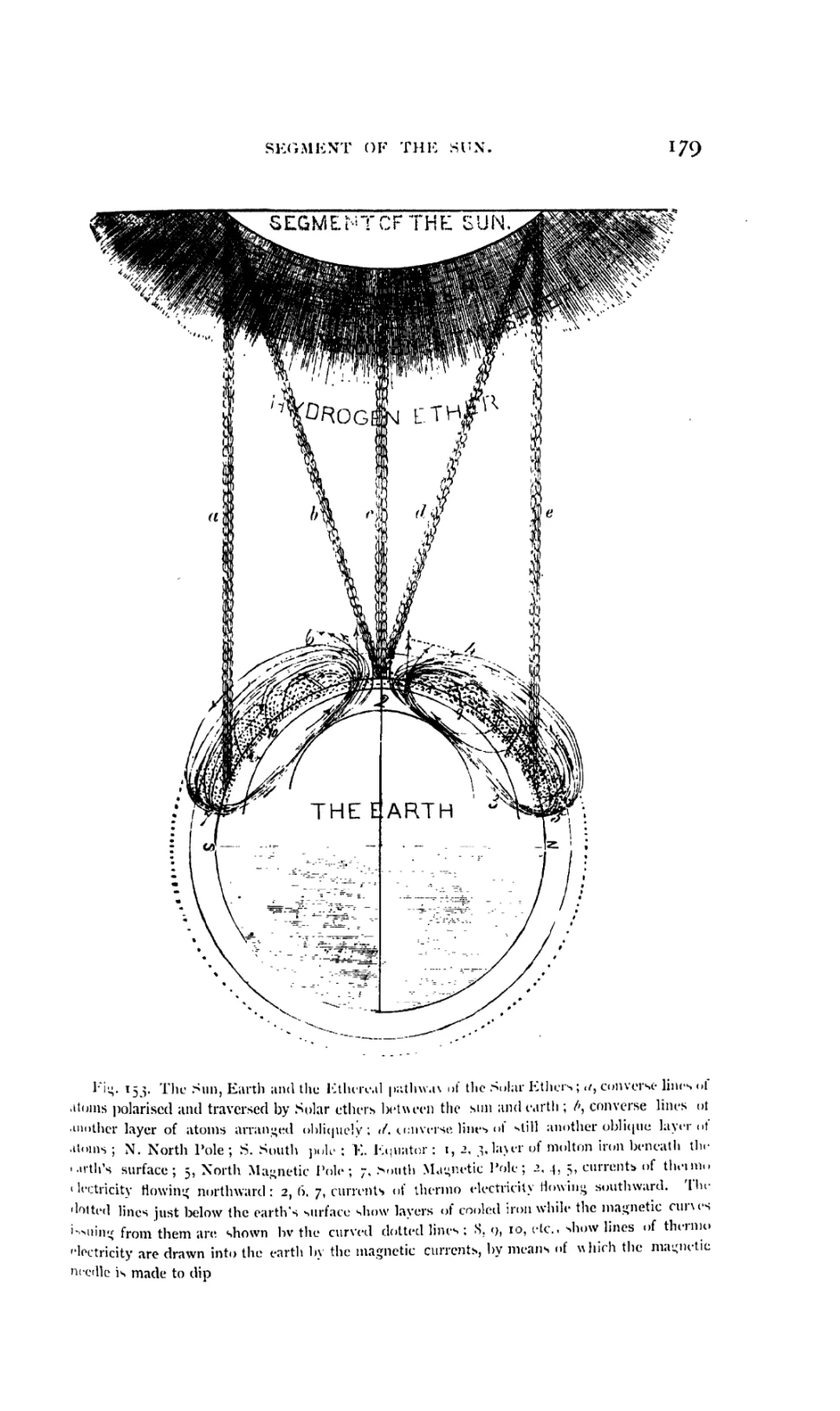
Figure 153 traces the solar ethers Babbitt imagines reaching Earth. He later proposes that these currents make atmospheric particles luminous.
Edwin D. Babbitt, The Principles of Light and Color, second edition, 1896. Lumitheca Library facsimile. · Image source ↗ · Public Domain
Opticks by Isaac Newton
In Book III of Opticks, Isaac Newton describes placing a hair and other slender objects in a narrow beam. Their shadows extend beyond what a straight-line drawing predicts. He separately reports coloured fringes along the edges. [2]
How light reaches a shadow
In a solar eclipse, the umbra is where the Moon blocks the entire solar disc and the penumbra is where it blocks only part. Newton’s thin-object experiments raise a further question about the behaviour of light at edges. Both accounts explain aspects of a shadow through the light reaching the observer. [6][7][2][3]
In the library
The Principles of Light and Color
Reading note
Separately attributed primary Library account, cited on exact verified Reader leaves.
Sources
See references (7)
- Figure 153, Babbitt’s proposed pathway of solar ethers, Reader page 186Edwin D. Babbitt, The Principles of Light and Color, second edition, 1896. Lumitheca Library facsimile.Read this page in The Principles of Light and Color ↗
- Opticks, Book III, observations I and II, pp. 114–117 ↗Isaac Newton, Opticks (1704). Newton Project, University of Oxford.
- Why Do Eclipses Happen? Total Solar Eclipse ↗NASA Science.
- The Principles of Light and Color, printed p. 193, Reader page 200Edwin D. Babbitt, The Principles of Light and Color, second edition, College of Fine Forces, East Orange, New Jersey, 1896. Lumitheca Library edition IMJ-0607-E001.Read this page in The Principles of Light and Color ↗
- The Principles of Light and Color, printed p. 197, Reader page 204Edwin D. Babbitt, The Principles of Light and Color, second edition, College of Fine Forces, East Orange, New Jersey, 1896. Lumitheca Library edition IMJ-0607-E001.Read this page in The Principles of Light and Color ↗
- The Principles of Light and Color, printed p. 198, Reader page 205Edwin D. Babbitt, The Principles of Light and Color, second edition, College of Fine Forces, East Orange, New Jersey, 1896. Lumitheca Library edition IMJ-0607-E001.Read this page in The Principles of Light and Color ↗
- The Principles of Light and Color, printed p. 199, Reader page 206Edwin D. Babbitt, The Principles of Light and Color, second edition, College of Fine Forces, East Orange, New Jersey, 1896. Lumitheca Library edition IMJ-0607-E001.Read this page in The Principles of Light and Color ↗