Babbitt’s Thermolume and Chromo Lens
The thermolume and chromo lens give Edwin D. Babbitt’s colour theory a physical form. See the original engravings and what each device was meant to do.
In this article
Two devices for Babbitt’s colour theory
Edwin D. Babbitt’s thermolume was a cabinet for exposing the body to light. His chromo lens was a hollow glass vessel that held a substance in the light. Both devices put a different part of his nineteenth-century colour theory into physical form. [4][5]
The Principles of Light and Color by Edwin D. Babbitt
In The Principles of Light and Color, Edwin D. Babbitt illustrates a solar thermolume with a hinged lid and openings for panes. He also describes an electric version. His distinction between light sources reflects what he thought different kinds of light could do. [4][6][7]
The chromo lens is a double-convex hollow vessel with a narrow neck. Babbitt believed that light could give a substance inside it new properties. The cabinet directed light toward the body, while the vessel was designed to expose its contents. [4][5]
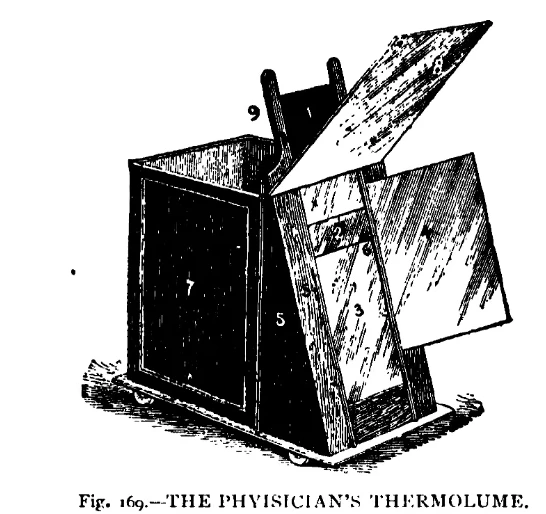
Figure 169 shows the hinged lid and pane openings of Babbitt’s solar thermolume. The cabinet was designed to expose the body to light.
Edwin D. Babbitt, The Principles of Light and Color, second edition, 1896. Lumitheca Library facsimile (detail). · Image source ↗ · Public Domain
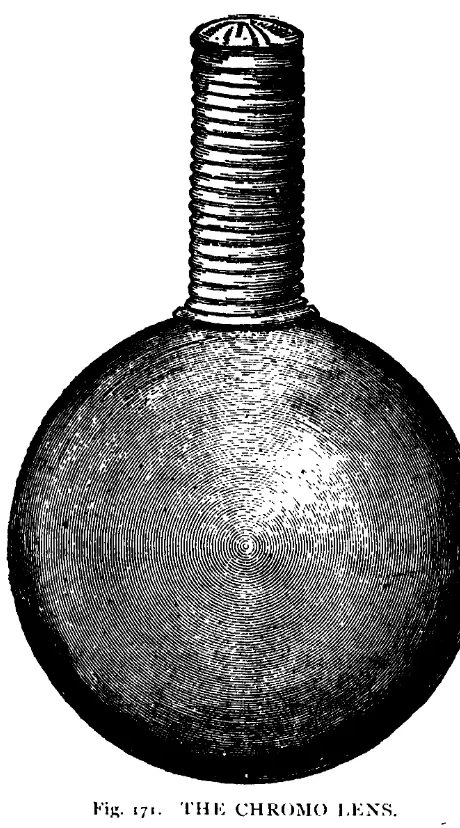
Figure 171 shows the double-convex vessel and its narrow neck. Babbitt used the vessel to expose its contents to light.
Edwin D. Babbitt, The Principles of Light and Color, second edition, 1896. Lumitheca Library facsimile (detail). · Image source ↗ · Public Domain
An early clinical use of concentrated light
Niels Ryberg Finsen received the 1903 Nobel Prize for work using concentrated light to treat disease, particularly lupus vulgaris. Babbitt’s engravings document a different nineteenth-century project, founded on a general theory of colour powers. Each claim of therapeutic benefit calls for evidence about the particular treatment and condition. [4][7][5][3]
In the library
The Principles of Light and Color
Reading note
Separately attributed primary Library account, cited on exact verified Reader leaves.
Sources
See references (7)
- Figure 169, The Physician’s Thermolume, printed p. 341, Reader page 348Edwin D. Babbitt, The Principles of Light and Color, second edition, 1896. Lumitheca Library facsimile (detail).Read this page in The Principles of Light and Color ↗
- Figure 171, The Chromo Lens, printed p. 351, Reader page 358Edwin D. Babbitt, The Principles of Light and Color, second edition, 1896. Lumitheca Library facsimile (detail).Read this page in The Principles of Light and Color ↗
- The Nobel Prize in Physiology or Medicine 1903 ↗Nobel Prize Outreach, 1903 award citation.
- The Principles of Light and Color, printed p. 341, Reader page 348Edwin D. Babbitt, The Principles of Light and Color, second edition, College of Fine Forces, East Orange, New Jersey, 1896. Lumitheca Library edition IMJ-0607-E001.Read this page in The Principles of Light and Color ↗
- The Principles of Light and Color, printed p. 351, Reader page 358Edwin D. Babbitt, The Principles of Light and Color, second edition, College of Fine Forces, East Orange, New Jersey, 1896. Lumitheca Library edition IMJ-0607-E001.Read this page in The Principles of Light and Color ↗
- The Principles of Light and Color, printed p. 347, Reader page 354Edwin D. Babbitt, The Principles of Light and Color, second edition, College of Fine Forces, East Orange, New Jersey, 1896. Lumitheca Library edition IMJ-0607-E001.Read this page in The Principles of Light and Color ↗
- The Principles of Light and Color, printed p. 348, Reader page 355Edwin D. Babbitt, The Principles of Light and Color, second edition, College of Fine Forces, East Orange, New Jersey, 1896. Lumitheca Library edition IMJ-0607-E001.Read this page in The Principles of Light and Color ↗