Babbitt’s Chromo-Philosophy
What did Babbitt mean by chromo-philosophy? His chapter on refraction, absorption and polarization applies a speculative theory of atomic spirals.
In this article
Babbitt’s model of refraction
Chromo-philosophy is Edwin D. Babbitt’s name for an account of how light interacts with matter. He tries to explain familiar effects such as refraction and the splitting of a ray in certain crystals through atomic spirals and streams of ether. [3][4][5][6]
The Principles of Light and Color by Edwin D. Babbitt
In The Principles of Light and Color, Edwin D. Babbitt traces a ray through a slab of glass. The ray bends at each face and leaves parallel to its incoming path. He attributes the change of direction to the resistance experienced by a stream of ether and applies the same idea to a prism. [4]
Iceland spar offers a harder test. It splits light into ordinary and extraordinary rays. Babbitt considers what happens when a second crystal is turned, and interprets the rays’ different paths in terms of the orientation of the atomic lines they meet. [6][7]
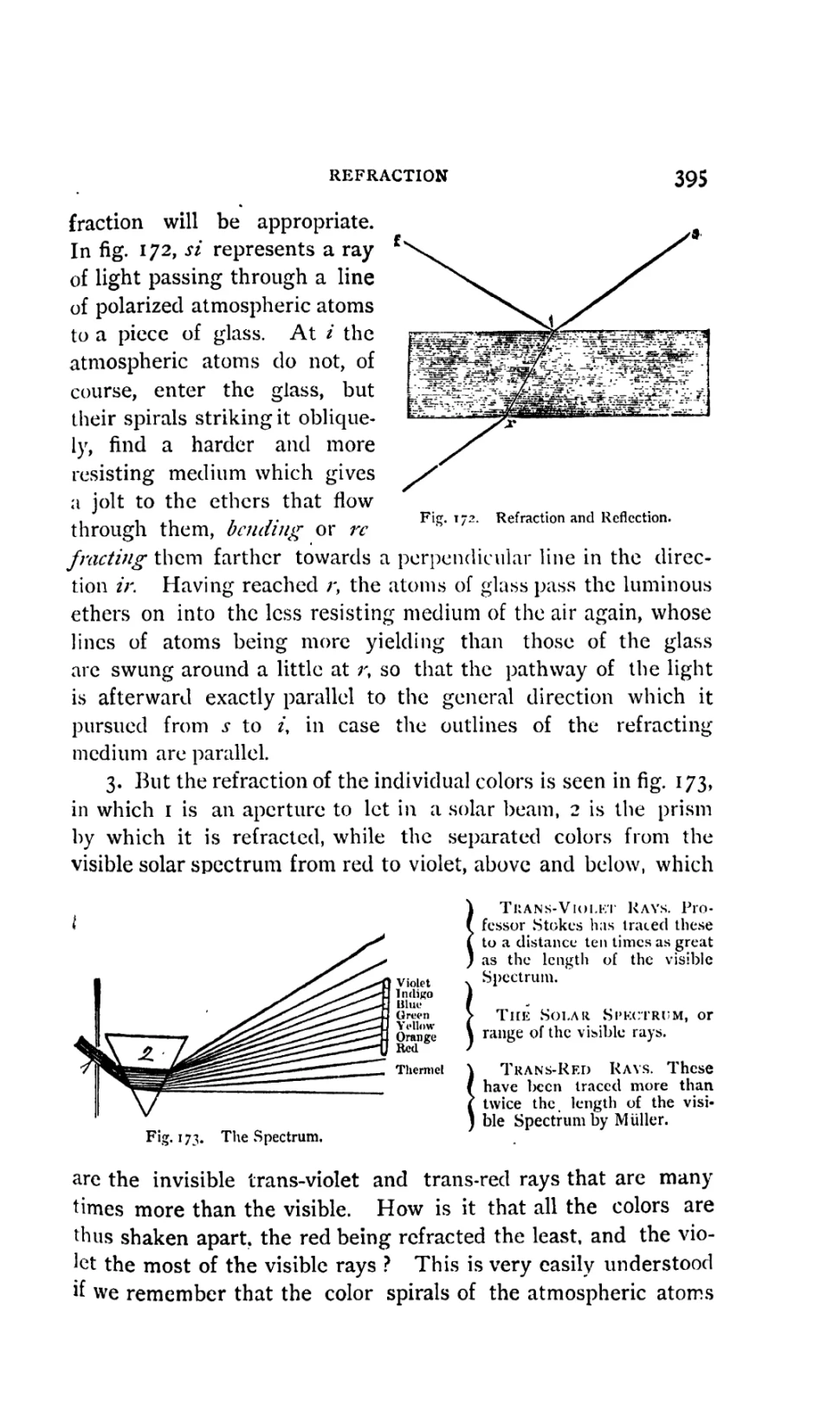
Figure 172 traces a ray through parallel faces of a glass slab. Figure 173 shows a prism spreading the beam into colours.
Edwin D. Babbitt, The Principles of Light and Color, second edition, 1896. Lumitheca Library facsimile. · Image source ↗ · Public Domain
Treatise on Light by Christiaan Huygens
In chapter V of Treatise on Light, Christiaan Huygens describes the two rays formed in Iceland crystal. He models the wave associated with the extraordinary ray as expanding in a spheroidal form. This gives him a geometric account of its direction. [2]
Two explanations for a divided ray
The two authors begin from the division of light in the same crystal. Huygens constructs the direction of the unusual ray from a wave’s geometry. Babbitt asks how a flow would move through different orientations of atomic spirals. [6][7][2]
In the library
The Principles of Light and Color
Reading note
Separately attributed primary Library account, cited on exact verified Reader leaves.
Sources
See references (7)
- Figures 172 and 173, refraction and the spectrum, printed p. 395, Reader page 402Edwin D. Babbitt, The Principles of Light and Color, second edition, 1896. Lumitheca Library facsimile.Read this page in The Principles of Light and Color ↗
- Treatise on Light, chapter V, On the Strange Refraction of Iceland Crystal ↗Christiaan Huygens, Treatise on Light (1690), Silvanus P. Thompson translation, Macmillan, 1912, chapter V.
- The Principles of Light and Color, printed p. 393, Reader page 400Edwin D. Babbitt, The Principles of Light and Color, second edition, College of Fine Forces, East Orange, New Jersey, 1896. Lumitheca Library edition IMJ-0607-E001.Read this page in The Principles of Light and Color ↗
- The Principles of Light and Color, printed p. 395, Reader page 402Edwin D. Babbitt, The Principles of Light and Color, second edition, College of Fine Forces, East Orange, New Jersey, 1896. Lumitheca Library edition IMJ-0607-E001.Read this page in The Principles of Light and Color ↗
- The Principles of Light and Color, printed p. 400, Reader page 407Edwin D. Babbitt, The Principles of Light and Color, second edition, College of Fine Forces, East Orange, New Jersey, 1896. Lumitheca Library edition IMJ-0607-E001.Read this page in The Principles of Light and Color ↗
- The Principles of Light and Color, printed p. 407, Reader page 414Edwin D. Babbitt, The Principles of Light and Color, second edition, College of Fine Forces, East Orange, New Jersey, 1896. Lumitheca Library edition IMJ-0607-E001.Read this page in The Principles of Light and Color ↗
- The Principles of Light and Color, printed p. 409, Reader page 416Edwin D. Babbitt, The Principles of Light and Color, second edition, College of Fine Forces, East Orange, New Jersey, 1896. Lumitheca Library edition IMJ-0607-E001.Read this page in The Principles of Light and Color ↗